Commercial Landscape Lighting in Dallas: Hotel Grounds, Corporate Campuses, Resorts & Water Features
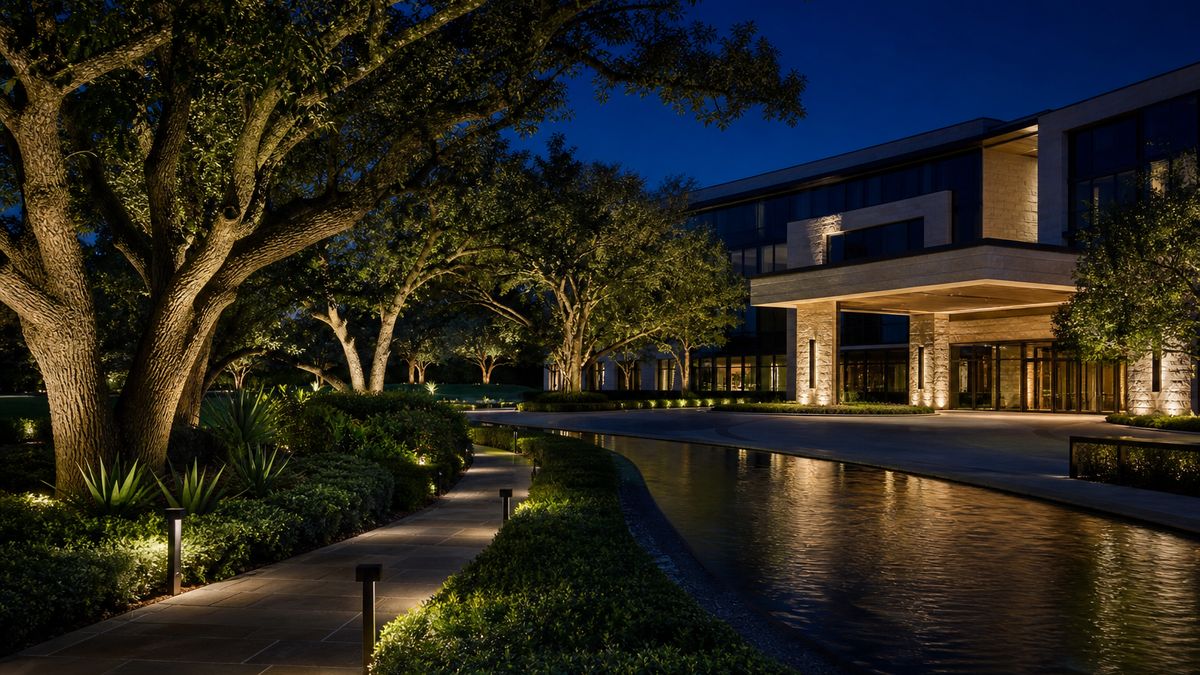
Commercial landscape lighting in Dallas is not the same job as lighting a backyard. On a hotel motor court, a corporate headquarters campus, a resort, a university quad, or a mixed-use plaza, the landscape is part of the building’s identity after dark. It is the first thing guests see when they arrive, the route employees walk to their cars after a late shift, and the backdrop for every evening event on the lawn. Done well, it makes a large property feel premium, safe, and welcoming from the street to the front door. Done poorly, it leaves dark gaps, glare in drivers’ eyes, dead fixtures hidden in the beds, and a maintenance headache that grows every season.
This guide is for owners, developers, asset managers, hotel general managers, campus facility directors, and landscape architects responsible for big sites across Dallas–Fort Worth. It explains how large-scale landscape lighting is planned zone by zone, how to light trees, walls, signs, and water features, what the energy code and local site-lighting rules mean for your design, how Texas heat, storms, and irrigation affect the hardware, and how a big landscape lighting project runs from first walk-through to final aiming at night.
A big-project commercial landscape lighting plan in Dallas should cover:
- A site-wide concept: arrival, pathways, trees, architecture, water features, amenity spaces, and parking edges designed as one composition, not fixture by fixture
- Layered light: uplighting and moonlighting for trees, grazing for walls, low path and step light for safety, and controlled accents for focal points
- Responsible light: shielded, well-aimed fixtures with warm color temperatures that avoid glare, light trespass, and wasted uplight
- Commercial-grade, Texas-ready hardware: sealed, corrosion-resistant fixtures, proper wire and transformer sizing, and protection from heat, hail, irrigation, and mowers
- Controls: astronomical scheduling, late-night dimming, and event scenes so the site looks right every night without wasting energy
- Phasing and service: installation around guests, tenants, and events, followed by night aiming and an ongoing maintenance plan
Why landscape lighting in Dallas is a big-project discipline
On a large commercial property, the landscape can cover more ground than the building itself. A resort hotel may have a motor court, a front lawn, several courtyards, a pool deck, an event lawn, and miles of walking paths. A corporate campus may have quads, parking edges, bridges over detention ponds, and a monument entrance on a major road. Each of those spaces is used at night, and each needs light that is safe, attractive, and consistent with the rest of the site.
Scale changes the engineering. A residential system might be a few dozen fixtures on one transformer. A big commercial landscape can mean hundreds of fixtures on many circuits, long wire runs with real voltage drop, in-grade fixtures under drive lanes, fixtures inside fountains, and controls tied into the building system. That is why commercial landscape lighting belongs inside a coordinated lighting plan — the same way we approach architectural LED lighting for Dallas commercial buildings and high-rise facade lighting.
It also changes what success looks like. On a big property, landscape lighting supports brand and revenue: it helps a hotel win evening weddings and events, helps a headquarters campus recruit and retain staff, and helps a retail or mixed-use center keep visitors after sunset. It is a business asset, and it should be designed and maintained like one.
Most of the landscape lighting complaints we hear on large properties come down to three things: fixtures that were never aimed at night, low-grade hardware that failed after a few Texas summers, and no one responsible for maintenance. All three are planning problems, and all three are solvable before the first trench is dug.
The big properties that need commercial landscape lighting
Hotels and resorts
Arrival is everything for a hotel. Guests judge the property from the motor court, the porte-cochère, the front lawn, and the walk to the lobby. Landscape lighting ties those spaces to the building’s architecture and to the interior experience covered in our hotel LED lighting guide. Resorts add courtyards, garden paths, event lawns, and pool decks; for pool and amenity-deck lighting, our partner site covers premium pool and amenity lighting.
Corporate headquarters and office campuses
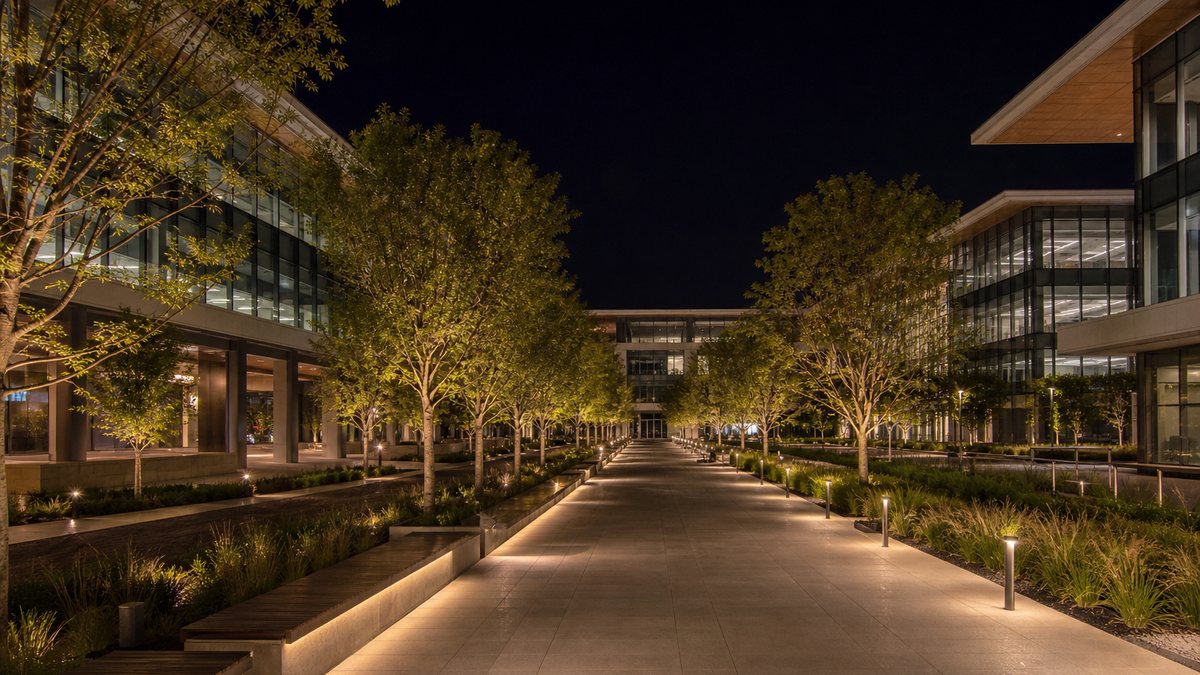
North Texas is home to many large corporate campuses, especially along the Legacy, Las Colinas, and Uptown corridors. Their landscapes include quads, plazas, walking trails, parking edges, and water features. The priorities are safe, even pathway lighting for people leaving late, a calm and refined nighttime image, and controls that keep a huge site from burning full power all night.
Universities, hospitals, and medical campuses
Campuses need clear wayfinding, safe walking routes between buildings and parking, and light that respects nearby residents and patients. We cover the broader campus picture in our hospital and campus LED lighting guide.
Mixed-use developments, retail centers, and plazas
Mixed-use districts depend on evening foot traffic. Landscape lighting on plazas, green spaces, tree-lined streets, and fountains keeps people outdoors longer and makes the district feel active. See our shopping center and mixed-use lighting guide for how landscape lighting fits into the full site.
Entertainment venues, stadium districts, and event properties
Venues and stadium districts use landscape lighting for plazas, gathering lawns, and the walk from parking to the gates. These spaces often need flexible scenes for game nights and events, coordinated with the systems in our stadium and arena and entertainment venue guides.
The seven landscape lighting zones on a large property
A large site is a set of outdoor rooms with different jobs. Planning each one on purpose is what separates a commercial landscape lighting design from a box of fixtures.
1. Entrance, monument, and arrival
The monument sign, the entry drive, and the motor court set the first impression. Light should guide drivers in, make the monument readable, and create a clear, welcoming hierarchy toward the front door — without glare in drivers’ eyes. For signs, pylons, and monuments, our partner network covers LED signs, pylons and monument signage.
2. Pathways, steps, and pedestrian routes
Paths need steady, low-glare light that shows edges, level changes, and steps. Bollards, path lights, step lights, and wall-recessed fixtures each have their place. The goal is uniform, comfortable light with no dark gaps — not bright pools separated by shadow.
3. Trees and major plantings
Mature live oaks, cedar elms, and specimen trees are often a large property’s best nighttime feature. Uplighting reveals the trunk and canopy; moonlighting from fixtures mounted high in the tree casts a soft, natural pattern on the ground below. Fixture count, beam spread, and distance from the trunk change with tree size, so large trees usually need more than one fixture.
4. Architecture, walls, and hardscape
Garden walls, columns, limestone, and textured surfaces come alive with grazing light. Where the landscape meets the building, the design should coordinate with the facade lighting so the two read as one composition.
5. Water features, fountains, and ponds
Fountains, water walls, reflecting pools, and detention ponds are focal points that need specialized underwater fixtures and careful electrical design. We cover them in their own section below.
6. Amenity and event spaces
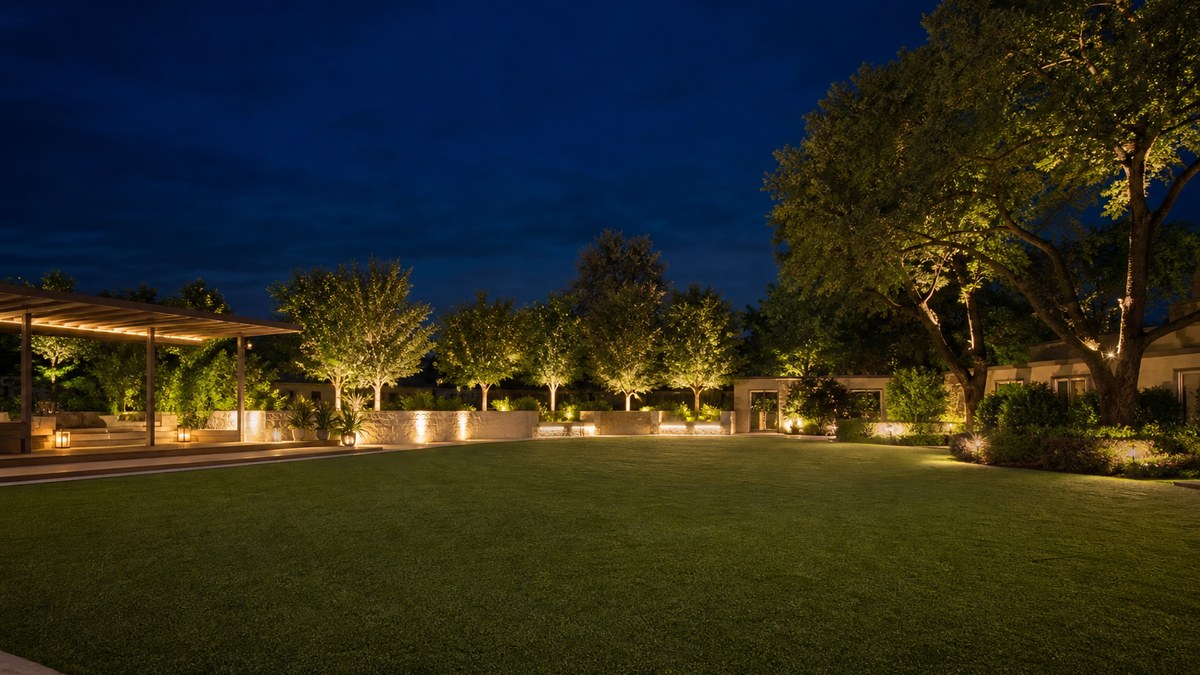
Event lawns, courtyards, terraces, and outdoor dining spaces need light that works for both everyday use and events: a quiet everyday scene, a brighter setup scene, and an event scene that can be dimmed or changed for weddings, receptions, and corporate gatherings. Our event lighting guide covers the indoor side of the same venues.
7. Parking edges and site perimeter
The landscape usually meets the parking field and the property line. These edges need careful aiming so landscape light does not spill into neighbors’ windows or streets, and so it blends with the pole lighting in our parking garage and lot lighting guide.
| Zone | Main Goal | Typical LED Approach | Controls |
|---|---|---|---|
| Entrance & monument | Clear, welcoming arrival | Shielded accent lights on the monument, tree uplights along the drive | Astronomical schedule, late-night dimming |
| Pathways & steps | Safe walking, no dark gaps | Bollards, path lights, step and wall-recessed lights | Dusk-to-dawn, reduced after hours |
| Trees & plantings | Reveal canopy and form | Adjustable uplights, moonlighting from within trees | Schedules, scene levels |
| Walls & hardscape | Texture and depth | Linear grazers and wall washers | Schedules tied to facade lighting |
| Water features | Focal point, safe electrical design | Submersible fixtures rated for the application | Scenes, holiday color where used |
| Amenity & event spaces | Flexible use | Accent, pergola, and concealed linear lighting | Event scenes, manual override |
| Parking edges & perimeter | Blend with site lighting, no spill | Low, well-shielded fixtures aimed inward | Tied to site lighting schedule |
Design principles for premium, responsible landscape light
The best commercial landscapes at night look effortless. That look comes from a few disciplined principles.
Light what matters, not everything
A premium landscape is defined by contrast. Choose focal points — the specimen oak, the fountain, the entry wall — and let the rest of the site sit in softer light. Lighting every surface evenly flattens the property and wastes energy.
Hide the source
Guests should see the effect, not the fixture. Shielded fixtures, glare guards, careful aiming, and fixtures tucked into plantings keep bright points of light out of people’s eyes. This matters most along drive aisles and walkways, where glare is a safety issue as well as an aesthetic one.
Keep light on the property
DarkSky International’s lighting principles sum up responsible outdoor lighting in five ideas: light should be useful, targeted, no brighter than necessary, controlled so it is used only when needed, and warmer in color. Those principles line up with what makes a large landscape look expensive: precise aim, comfortable levels, and warm tones.
Choose color with intent
Most premium landscapes use warm white in the 2700–3000K range, which flatters stone, wood, and foliage and matches hospitality interiors. Some properties add tunable or color-capable fixtures on select features for holidays and events — best kept to a few focal points, with a warm white default scene every other night.
Design for the mature landscape
Trees grow, beds fill in, and hedges get taller. Fixtures need adjustable aiming and enough cable slack to be moved, and the layout should be reviewed as plantings mature. A design that only works on planting day will look wrong in three years.
One partner from the front gate to the lobby
Site survey, lighting design, fixture sourcing, installation, controls, night aiming, and ongoing service — handled end to end for hotels, resorts, corporate campuses, and large commercial properties across Dallas–Fort Worth.
Fountain and water feature lighting
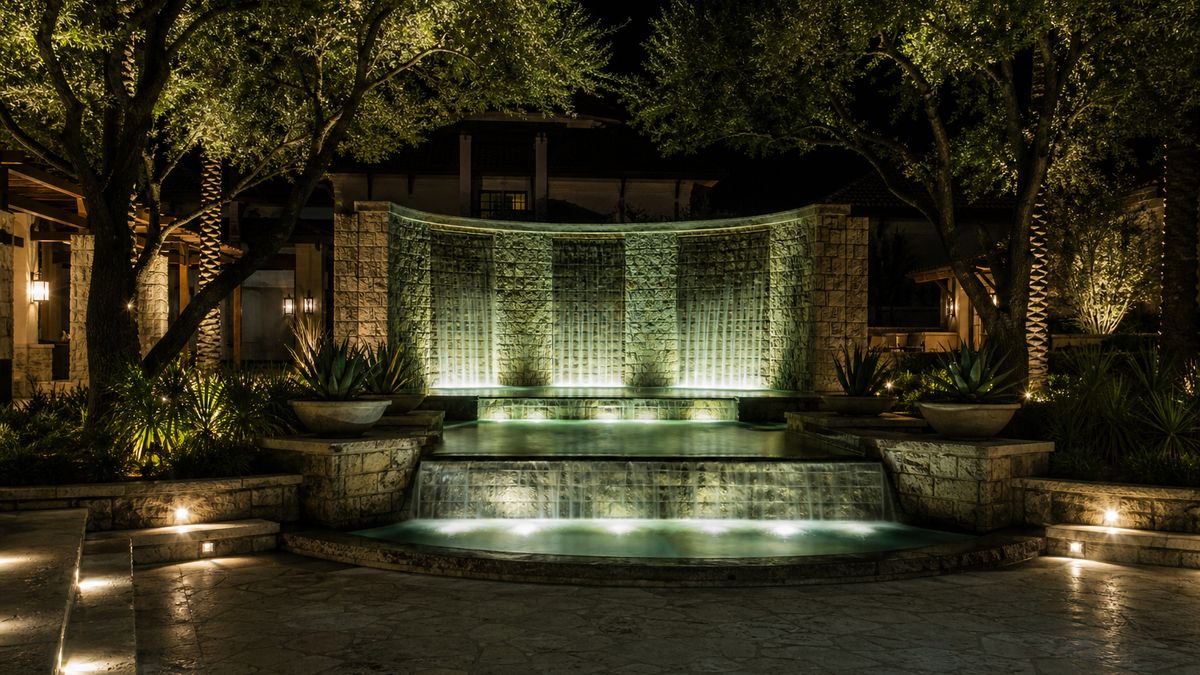
Water features are often the signature moment on a large property, and they are the most technical part of landscape lighting. Underwater light makes moving water sparkle and turns a fountain into a focal point that can be seen from the street. But water and electricity demand serious design.
Fountains, reflecting pools, and similar features fall under the special rules for bodies of water in the National Electrical Code, which cover equipment listing, low-voltage and isolated supplies, GFCI protection, bonding, and the wiring methods used in and around the water. The IAEI’s overview of fountains and reflection pools is a useful primer on how the code treats these features. On a commercial project, fixtures, transformers, and wiring must be designed and installed by licensed professionals and approved by the local inspector.
- Fixture placement: lights placed where the water falls or rises, aimed to light the water itself rather than shine at viewers
- Hardware rated for submersion: fixtures and connections listed for the specific underwater application, built to resist minerals and chemicals in the water
- Serviceability: fixtures that can be reached and cleaned during routine maintenance without draining a large basin
- Coordination: lighting drawn together with the fountain designer’s pumps, nozzles, and controls, so scenes and water effects work together
- Detention ponds and lakes: aerating fountains and shoreline lighting on campuses and business parks, kept subtle to protect wildlife and neighbors
Codes and site-lighting rules in DFW
Commercial landscape lighting sits inside a larger set of rules for exterior lighting, and those rules vary by city, district, and project type.
The energy code
The 2021 International Energy Conservation Code groups sites into exterior lighting zones, from LZ1 (parks and rural areas) to LZ4 (high-activity commercial districts in major metropolitan areas), as shown in the U.S. DOE Building Energy Codes Program exterior lighting materials. The zone sets the exterior lighting power allowances that new and renovated sites must meet. Some categories, such as lighting for water features and swimming pools, are treated separately. Exterior controls — automatic shutoff in daylight and reduced levels late at night — are also part of the code conversation. Which edition applies, and any local amendments, depend on the city and the project, so we check each site against its jurisdiction.
Local site-lighting standards
Cities across North Texas have their own outdoor lighting rules. In the City of Dallas, for example, the site lighting section of the form district code (Sec. 51A-13.601) calls for full cutoff fixtures, light sources concealed from public rights-of-way and adjacent properties, light that does not cross the property line, and accent uplighting that is shielded to minimize light spill into the night sky, according to the City of Dallas Article XIII lighting text. Other districts, planned developments, and suburbs have their own versions, and some nearby cities have adopted dark-sky style ordinances.
Bring the lighting design into the site plan early. Pole heights, fixture shielding, and light at the property line are much easier to get right on paper than after the landscape has been planted and the hardscape poured.
Texas-ready hardware: built for heat, storms and sprinklers
Landscape fixtures live in the harshest environment on the property. In North Texas they face summer heat, intense sun, hail, strong storms, heavy clay soils that shift, and irrigation that hits them every night. Commercial-grade hardware is the difference between a system that looks the same in year ten and one that is half dark by year three.
- Sealed, corrosion-resistant fixtures in solid brass, bronze, stainless, or heavy marine-grade finishes, with ingress ratings matched to the location — in-grade, near sprinklers, or under water
- Thermal design that keeps LED drivers and boards within their rated temperatures through a Texas summer
- Impact resistance for fixtures near drives, mowers, and foot traffic, and drive-over ratings for in-grade lights in vehicle areas
- Proper electrical design: transformer and circuit sizing, voltage-drop calculations on long runs, and connections rated for direct burial
- Lightning and surge protection for large exterior systems tied to building controls
- Standardized fixtures and spares across the property, so replacement parts match and the site looks consistent
Our role is to specify and source the right fixtures for each location as an authorized architectural lighting dealer and project coordinator — we are not a manufacturer, which lets us match products to the project instead of the other way around. Our design-build lighting guide explains how that process works.
Controls: the right scene every night
On a large property, controls do as much for the nighttime image as the fixtures do. They make sure the landscape turns on at the right time, looks right all night, and does not burn full power at 3 a.m. when no one is there.
- Astronomical time clocks and photocells turn lights on at dusk and off at dawn year-round without seasonal adjustments
- Late-night dimming lowers decorative layers after hours while keeping pathways and safety lighting at the right level
- Scenes for everyday, event, holiday, and maintenance modes
- Zoning by area, so the event lawn can be lit for a wedding while the rest of the grounds stay in their normal scene
- Integration with building automation or networked lighting systems for monitoring and fault alerts
For larger campuses and hotels, landscape zones can sit inside the same control platform as interior and facade lighting. Our networked lighting controls guide explains how those systems are planned. Switching older halogen and metal halide landscape fixtures to LED commonly cuts lighting energy by 50–75%, and good controls add more savings on top. Large upgrades may also qualify for utility incentive programs, such as those offered by Oncor, depending on program availability.
New construction vs. upgrading an existing landscape
New developments
On new hotels, campuses, and mixed-use projects, landscape lighting should be designed alongside the landscape architecture, civil, and electrical drawings. That is when conduit and sleeves under hardscape, transformer locations, water-feature equipment, and control wiring are cheapest to plan. A mockup at night of a few key trees and the entry often settles color and intensity decisions before full procurement.
Existing properties
Many mature DFW properties have landscapes that look wonderful by day and disappear at night, or older halogen and metal halide systems with failing fixtures and corroded connections. An upgrade starts with a night survey of what works, what is dark, and what glares, followed by a plan that reuses good infrastructure where it makes sense. Our large-property lighting audit and commercial lighting audit are the usual starting points, and our commercial LED retrofit guide covers how upgrades are phased.
How a big landscape lighting project runs, step by step
- Discovery and night walk: we review the site at night, talk through the brand, events, safety concerns, and neighbors, and identify focal points and problem areas.
- Concept and zones: a site-wide concept defines the seven zones, the hierarchy of light, color temperature, and the control approach.
- Design and coordination: fixture locations, beams, circuits, transformers, and control zones are drawn and coordinated with landscape, civil, irrigation, fountain, and electrical plans.
- Mockup: a nighttime mockup of key trees, walls, or the entry confirms the look before full procurement.
- Sourcing: commercial-grade fixtures and controls are specified and sourced to match each location.
- Installation and phasing: work is scheduled around guests, tenants, events, and planting seasons, area by area.
- Night aiming and commissioning: every fixture is aimed and adjusted after dark, scenes are programmed, and the system is documented.
- Service plan: seasonal re-aiming as plants grow, cleaning, fixture checks, and repairs keep the site looking the way it did on opening night.
This is exactly how our Luminance design-build program is structured, and it is the same process we use on the hotel, venue, and campus projects described across our lighting guides. If you want the wider picture first, start with our complete guide to LED lighting in Dallas or our overview of premium lighting solutions.
Who we are and how we work
Dallas LED Lights brings 15+ years as an authorized architectural lighting dealer and project coordinator. Our licensed installation partner has completed over 200 major sports and commercial projects across the US and Canada — NFL, NBA, NHL, MLS, NCAA and NASCAR. For large landscape projects, that means one coordinated team for design, sourcing, installation, controls, and service, with a single point of contact for the owner. Learn more about our team or explore our full list of lighting services.
Frequently Asked Questions
What is commercial landscape lighting?
How is commercial landscape lighting different from residential landscape lighting?
What color temperature is best for landscape lighting on a hotel or campus?
How do you light large trees like live oaks?
What is needed to light a fountain or water feature safely?
Does Dallas have rules for commercial outdoor lighting?
How do controls save energy on landscape lighting?
Can landscape lighting be upgraded without disrupting guests or tenants?
Are there incentives for upgrading commercial outdoor lighting in Dallas?
How much does commercial landscape lighting cost in Dallas?
Planning landscape lighting for a hotel, campus or large property?
Tell us about your grounds. We will review the site and send a clear, project-specific proposal covering design, fixtures, water features, controls, installation, and phasing around your guests and tenants.
Related services
Need help with a project elsewhere? Contact us through our contact page. Our partner network covers large projects across Texas and beyond: Fort Worth LED lighting, commercial LED lighting in Arlington, LED lighting in Plano, Irving LED lighting services, Texas-wide LED lighting, and wholesale LED solutions, plus fiber optic lighting solutions, modular building solutions, and modular structures in Dallas. For a dramatic indoor counterpart to a lit garden, see starlight ceilings.