Shopping Center LED Lighting in Dallas: The Guide for Retail Centers, Lifestyle Districts & Mixed-Use Developments
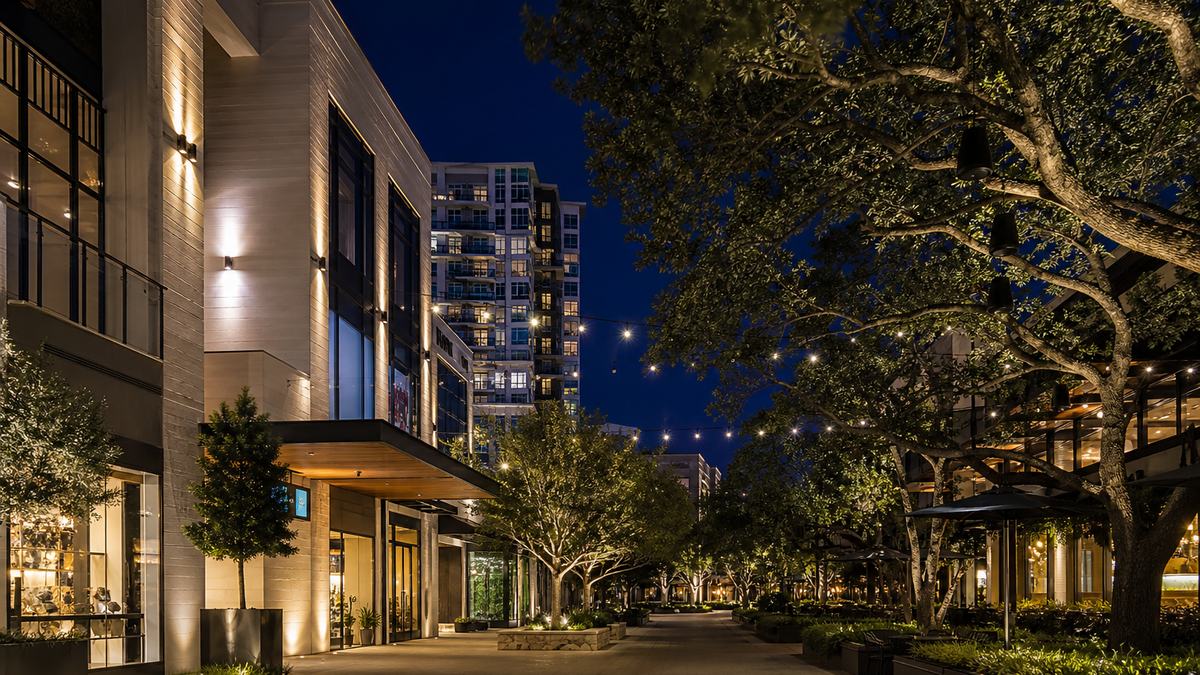
Shopping center LED lighting in Dallas has become one of the most important decisions an owner or developer makes after the leases are signed. In North Texas, the most successful retail centers, lifestyle districts and mixed-use developments are designed to be visited at night: dinner on the patio, a movie, a concert on the plaza, a walk back to an apartment upstairs. Lighting decides whether those evenings feel safe, inviting and worth posting about — or dark, flat and forgettable.
Big retail and mixed-use properties are also some of the most complicated lighting jobs in the metroplex. A single development can include surface parking, a structured garage, storefront facades, a central plaza, landscape and water features, pylon signs, office towers, a hotel and residential amenity decks — each with different owners, tenants, hours and code requirements. That is why owners increasingly bring the entire site under one plan through a design-build approach like our Luminance program.
This guide covers every lighting layer on a modern Dallas–Fort Worth retail or mixed-use property, the standards and local rules that shape the design, how to control it all from one system, and how to phase an upgrade without closing a single storefront.
A complete shopping center or mixed-use lighting plan in Dallas covers seven layers under one design and one control system:
- Parking lots & garages: uniform, glare-controlled LED that meets IES guidance and supports security cameras
- Building facades & anchors: architectural LED that makes the center readable from the tollway at night
- Streetscape, plazas & promenades: warm, layered pedestrian light plus festoon and event-ready accents
- Signage & wayfinding: pylons, monuments and tenant signs coordinated with the site lighting
- Landscape, water & amenities: tree uplighting, fountains, pool decks and rooftop terraces
- Controls: networked schedules, dimming and curfews that follow tenant hours and local rules
- Energy: LED commonly uses 50–75% less energy than the older lighting it replaces, and sensors can save more
Why lighting decides whether a retail center thrives after dark
Retail has changed. The centers that keep growing in Dallas–Fort Worth are no longer just places to run errands; they are destinations built around dining, entertainment, fitness, offices and homes. Much of that traffic happens after sunset, which means the property's lighting is working during some of its highest-value hours.
Lighting influences three things owners care about most:
- Perceived safety. Shoppers decide in seconds whether a parking field or garage feels safe. Even, well-controlled light with good vertical illumination on faces and car doors does more for that feeling than simply adding brighter fixtures.
- Dwell time and tenant sales. Warm, layered light on patios, plazas and storefront arcades encourages people to linger, and lingering is what restaurants and retailers pay premium rents for.
- Brand and leasing. A center that glows from the highway sells itself to future tenants, residents and office users. Night photos are marketing assets — for leasing teams and for every visitor with a phone.
The scale of these properties is significant. Legacy West in Plano, for example, changed hands in 2025 in what was described as the largest sale of a mixed-use asset in Dallas–Fort Worth history, according to Local Profile. (It is cited only as a public example of the market — not a project of ours.) When asset values reach that level, lighting is clearly part of protecting the investment.
On most retail properties, the largest share of lighting energy is in the parking field and garage, not the storefronts. Start the energy plan there, then invest in design where visitors walk, dine and gather.
The seven layers of shopping center and mixed-use lighting
Every part of a retail or mixed-use site has a different job. Here is how a complete plan treats each layer.
1. Parking lots and surface parking fields
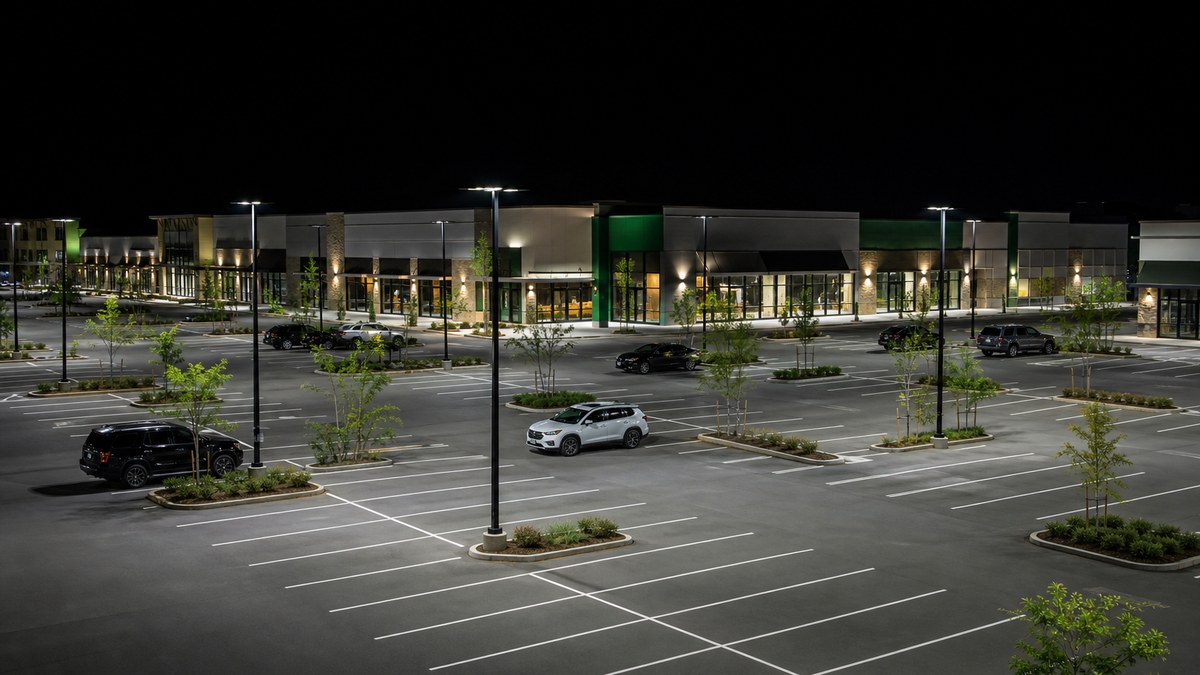
The parking field is the first and last thing every visitor experiences. Good parking lot lighting is about uniformity and glare control, not raw brightness. Guidance from the Illuminating Engineering Society (IES), as summarized by ASIS Security Management, calls for a minimum of about 0.2 footcandles of horizontal light in typical lots with a maximum-to-minimum uniformity ratio of 20:1, and higher minimums (around 0.5 footcandles, 15:1) where enhanced security is needed. Modern LED area lights with precise optics hit those targets with fewer, better-aimed fixtures and far less light spilling into neighboring properties or the sky.
LED also pays off quickly here because lots run every night of the year. In a U.S. Department of Energy GATEWAY demonstration at a shopping plaza parking lot, LED area lighting combined with occupancy controls cut energy use by 58%, as reported by Buildings. Results vary by site, but the pattern is consistent: efficient fixtures plus smart controls beat a simple one-for-one swap.
2. Parking garages and structured parking
Mixed-use developments rely on garages, and garages need bright, uniform light 24/7. Security guidance summarized by ASIS suggests around 5 footcandles with a 4:1 uniformity ratio in parking structures. LED fixtures with bi-level occupancy sensors and daylight zones at the perimeter keep garages bright when people are present and dim them when bays are empty. We cover garage retrofits in depth in our guide to commercial LED retrofits for office towers, parking garages and distribution centers.
3. Building facades, anchors and storefront arcades
From the Dallas North Tollway, SH-121 or I-635, a retail center is read as a skyline of facades. Architectural LED — wall washers, linear grazers, cornice and canopy lighting, and color-capable accents on towers and entry features — gives the property a consistent identity at night. Storefront arcades and canopies need soft, even downlight so window displays pop and walkways feel open. For the design principles, see our guide to architectural LED lighting for Dallas commercial buildings, and for taller office or residential towers above the retail podium, our high-rise facade lighting guide.
4. Streetscapes, plazas and promenades
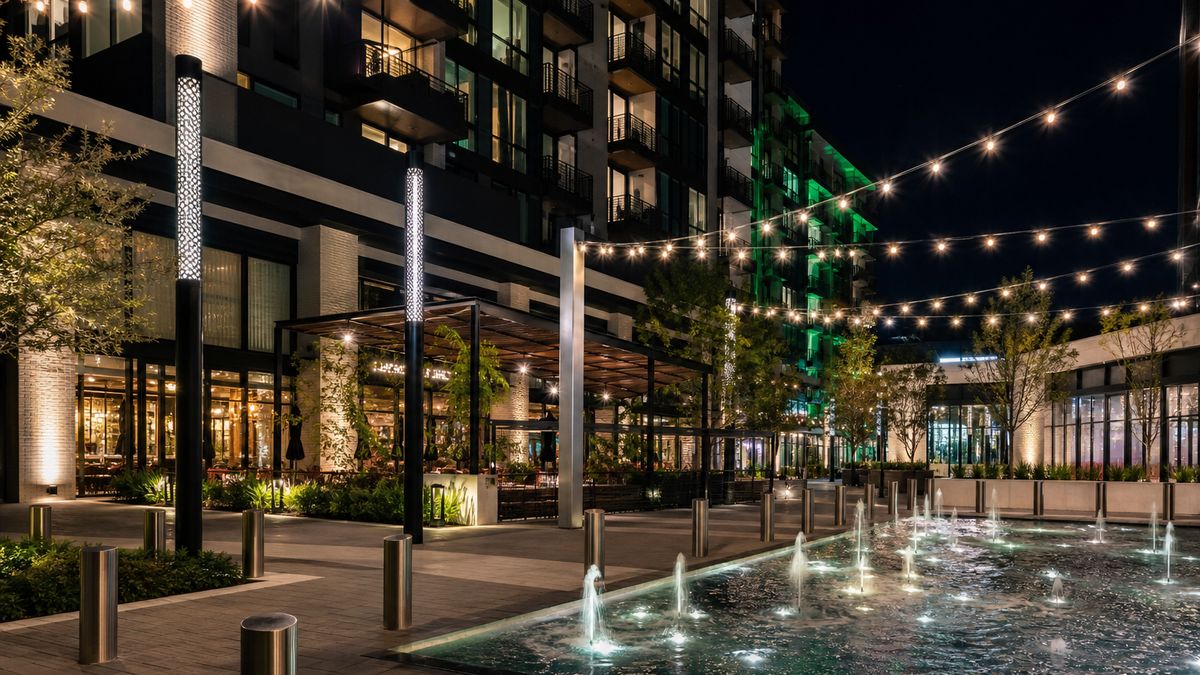
The heart of a lifestyle center or mixed-use district is its public realm: main streets, paseos, courtyards and the central plaza. These spaces need human-scale light — decorative poles, bollards, step and handrail lights, festoon or catenary lighting overhead, and tree uplighting — in warm color temperatures that flatter people and food. A plaza that hosts concerts, markets and holiday events also benefits from color-capable accents and pre-programmed scenes, the same tools we describe in our event lighting guide. A permanent outdoor LED video wall can turn a plaza into a watch-party venue or a stage backdrop.
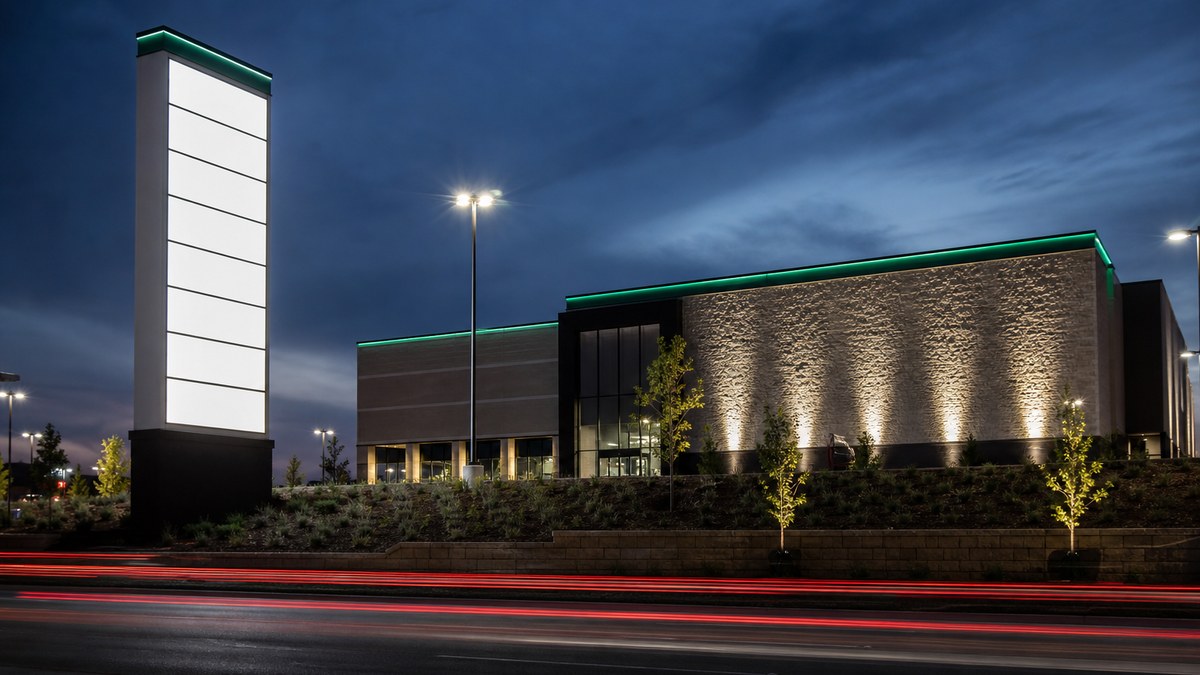
5. Signage, pylons and wayfinding
Pylon and monument signs, tenant channel letters, directories and garage wayfinding all need to look like one family with the site lighting — same color temperature, balanced brightness, coordinated schedules. Our partners at American LED Signage handle pylons, monuments, marquees and tenant signs built to match, and our marquee and entertainment venue lighting guide covers theaters and entertainment anchors.
6. Landscape, water features and amenity decks
Large sites use landscape lighting to define edges, highlight specimen trees and lead people from parking to the core. Fountains and water walls become focal points after dark with submersible LED. In mixed-use projects, residential and hotel components add pool decks and rooftop terraces — our network partners at premium pool and amenity lighting specialize in those environments.
7. Interiors: food halls, entertainment and common areas
Enclosed malls, food halls, cinema lobbies and entertainment anchors bring the experience indoors. Layered LED, tunable white, and signature features such as fiber optic starlight ceilings in lounges and restaurants create spaces visitors remember. Hotel components follow the approach in our hotel LED lighting guide.
Retail and mixed-use lighting plan at a glance
| Zone | Main Goal | Typical LED Approach | Controls |
|---|---|---|---|
| Surface parking | Safety, uniformity, low glare | Full-cutoff LED area lights with precise optics | Astronomic schedule, after-hours dimming, occupancy sensors |
| Parking garages | 24/7 visibility, security cameras | Low-glare LED garage fixtures, perimeter daylight zones | Bi-level occupancy and daylight sensors |
| Facades & anchors | Identity, visibility from highways | Wall washers, grazers, color-capable accents | Scenes, seasonal and event programs (DMX/sACN) |
| Storefront arcades & canopies | Window displays, open walkways | Recessed and linear downlights, soffit lighting | Tenant-hours schedules, dimming |
| Streetscapes & plazas | Dwell time, atmosphere, events | Decorative poles, bollards, festoon, tree uplights | Event scenes, curfew dimming |
| Signage & wayfinding | Visibility, consistent brand | LED pylons, monuments, channel letters | Coordinated schedules and brightness |
| Landscape, water & amenities | Edges, focal points, resident experience | In-grade uplights, submersible LED, deck lighting | Zoned schedules |
| Interiors & food halls | Mood, comfort, merchandising | Layered, tunable-white and high-CRI LED | Time-of-day scenes (DALI) |
Standards and local rules that shape the design
Great retail lighting is not just a creative exercise. Several sets of standards and rules apply, and a good plan meets all of them from day one.
IES recommendations and security guidance
IES guidance sets the baseline for light levels and uniformity in parking areas and walkways, and security practitioners add recommendations for vertical light (so faces are visible) and for glare control at camera lenses. The goal is a site where cameras capture clear images and people feel comfortable walking to their cars — without the harsh, overlit look of older pole lighting.
Outdoor lighting ordinances and dark-sky rules
Many North Texas cities regulate outdoor lighting on commercial sites. Rules commonly address fully shielded (full-cutoff) fixtures, light trespass at the property line, pole heights next to residential areas, color temperature and after-hours curfews. Frisco's outdoor lighting chapter, which the city was reviewing in 2025, is one example that covers shielding, trespass, color temperature and curfews (City of Frisco). Requirements differ by city and zoning district, so every design should be checked against the current local code before fixtures are ordered.
Energy codes
Commercial energy codes based on IECC and ASHRAE 90.1 limit lighting power and require automatic controls such as schedules, photocells and, in many exterior applications, after-hours reduction. Networked controls make compliance simpler and document it for inspectors. Our guide to networked lighting controls in Dallas explains the systems in detail.
One partner for your entire development
Audit, design, supply, installation, controls and ongoing service — handled end to end for retail centers, mixed-use districts, hotels, venues and large commercial properties across Dallas–Fort Worth.
One control system for a property with many schedules
A mixed-use property never really closes. Restaurants stay open late, the gym opens at 5 a.m., residents come and go all night, and the office tower empties at six. A single networked control system lets the owner run all of it from one dashboard instead of dozens of time clocks scattered across electrical rooms.
- Astronomic schedules: exterior lighting follows sunset and sunrise automatically through every season.
- Tenant-hours zoning: storefront and arcade lighting follows each block's operating hours, then steps down.
- Curfew dimming: parking fields drop to a lower security level after close, with sensors bringing light back up when someone arrives.
- Event and seasonal scenes: plaza, facade and tree lighting switch to holiday, sports or concert looks on a schedule.
- Monitoring: failed fixtures and drivers are flagged so maintenance teams fix them before a tenant or visitor notices.
Protocols matter too. Facade and plaza color effects usually run on DMX or sACN; interiors and food halls often use DALI; and parking fields and garages typically use wireless networked sensors. The key is designing them to work together rather than as separate islands.
How to upgrade a retail center without closing storefronts
Owners rarely have the luxury of shutting down a revenue-producing property. A well-planned project keeps every tenant open and every parking field usable.
- Site-wide lighting audit: a fixture-by-fixture survey of poles, garages, facades, signage and common areas, with photometric readings of problem areas. Our commercial lighting audit builds the baseline for design, savings and any incentive applications.
- Master plan and photometrics: one design for the whole property, with light-level calculations for parking and walkways and checks against local ordinances.
- Mockups: sample fixtures on site — a pole, a facade bay, a section of festoon — so owners and tenants approve the look before full rollout.
- Phasing plan: work scheduled by parking zone and building block, mostly overnight, avoiding holiday shopping peaks and major events.
- Installation: pole heads and garage fixtures replaced in sequence, with temporary lighting where needed so no area goes dark.
- Commissioning: every schedule, sensor and scene tested and tuned, then documented for property management.
- Service: ongoing monitoring and maintenance so the property looks as good in year five as on opening night.
For more on how big projects move from concept to commissioning under one contract, read our guide to design-build lighting in Dallas.
Energy savings and incentives
Retail and mixed-use properties run exterior and garage lighting thousands of hours a year, so efficiency gains add up fast. Replacing metal halide, high-pressure sodium and fluorescent fixtures with LED commonly reduces lighting energy by 50–75%, and controls such as after-hours dimming and occupancy sensors can push savings further, as the DOE shopping-plaza demonstration showed. Longer LED life also means fewer lift rentals and night maintenance calls across acres of poles.
Commercial properties in the Dallas area may qualify for utility energy-efficiency incentive programs, such as those offered through Oncor, depending on the project and program availability. A documented audit is usually the first step in any application.
Because every development is different, we do not publish one-size-fits-all pricing. We prepare a project-specific proposal after reviewing your property. Start with our project quote form or explore our full range of commercial lighting services and premium lighting solutions.
What makes Dallas retail projects different
Heat, hail and storms
North Texas summers push outdoor drivers and electronics hard, and spring storms bring hail and high winds. Pole-mounted and facade fixtures should be rated for high ambient temperatures, sealed against water and dust, and built with impact-resistant lenses and secure mounting. Pole bases, wiring and surge protection deserve attention on older centers, where a lighting upgrade is often the right moment to fix underground issues.
Growth corridors and competition
DFW's retail and mixed-use growth runs along the Dallas North Tollway, SH-121, I-35E and I-635, from Uptown and the Design District to Plano, Frisco, Las Colinas and Grapevine. When several centers compete along the same stretch of highway, the one that reads clearly and looks inviting at night has an advantage with shoppers and with prospective tenants.
Event-driven traffic
Major concerts, sports championships and global events bring waves of visitors to North Texas, and retail districts near venues and hotels feel it first. Owners preparing for those moments — see is your Dallas property World Cup ready — benefit from color-capable facades and plaza scenes that can join the celebration. Districts next to sports venues can also learn from our stadium and arena LED lighting guide.
Choosing a lighting partner for a large retail or mixed-use project
A shopping center is not a job for a crew that only swaps pole heads. Look for a partner who can show:
- Whole-site design — parking, garages, facades, public realm, signage and interiors in one coordinated plan
- Photometric and code expertise — IES targets, local outdoor lighting ordinances and energy codes
- Controls capability — DMX, DALI and networked sensors commissioned to work as one system
- Phasing experience — overnight work plans that keep tenants open and parking usable
- Specification and sourcing — fixtures selected for Texas conditions and documented for owners
- Long-term service — monitoring and maintenance after the ribbon cutting
Dallas LED Lights brings 15+ years as an authorized architectural lighting dealer and project coordinator. We are not a fixture manufacturer; we specify, source and coordinate the right products for each project. Our licensed installation partner has completed over 200 major sports and commercial projects across the US and Canada — NFL, NBA, NHL, MLS, NCAA and NASCAR. Learn more about our team, browse our services, or read our complete guide to LED lighting in Dallas. If your center shows the warning signs it needs a lighting audit, now is a good time to plan.
Frequently Asked Questions
What does shopping center LED lighting in Dallas include?
How bright should a shopping center parking lot be?
How much energy can a retail center save with LED parking lot lighting?
Do Dallas-area cities regulate outdoor lighting on commercial properties?
Can a shopping center upgrade its lighting while staying open?
What lighting works best for mixed-use plazas and promenades?
How do you control lighting on a large mixed-use property?
Do retail lighting upgrades qualify for incentives in Dallas?
How much does a shopping center lighting project cost?
Does Dallas LED Lights work on other large projects?
Planning a retail center or mixed-use lighting upgrade?
Tell us about your property. We will review it and send a clear, project-specific proposal covering design, photometrics, installation, controls and phasing.
Related services
Our partner network covers large projects across Texas and beyond: Fort Worth LED lighting, commercial LED lighting in Arlington, LED lighting in Plano, Irving LED lighting services, Texas-wide LED lighting, and wholesale LED solutions, plus fiber optic lighting solutions, modular building solutions, and modular structures in Dallas. Questions first? Contact our team.