Stadium & Arena LED Lighting in Dallas: The DFW Guide to Sports & Venue Lighting
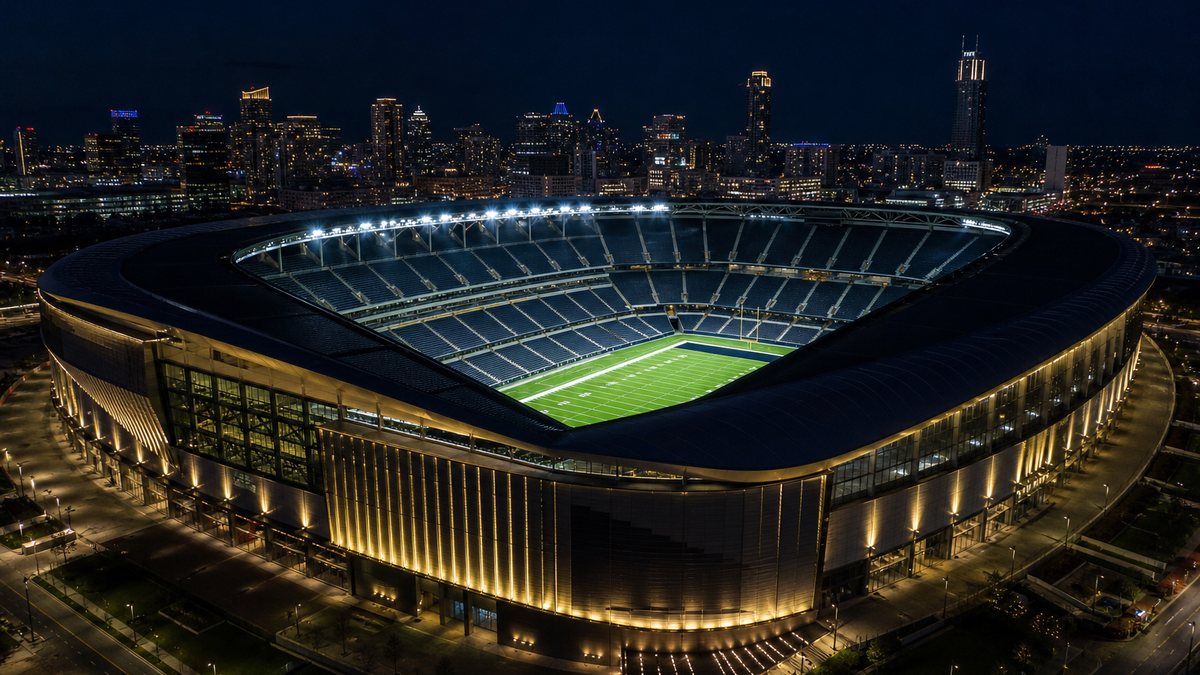
Stadium LED lighting in Dallas has moved from a nice upgrade to a basic expectation. Fans, broadcasters, promoters, and sponsors now expect instant-on field lighting, flicker-free video, light shows between plays, and concourses that feel as polished as a luxury hotel. For owners and operators of arenas, stadiums, ballparks, and multi-use event centers across Dallas–Fort Worth, lighting is now part of the product you sell.
DFW is one of the most active sports and entertainment markets in the country. It is home to NFL, NBA, NHL, MLB, and MLS teams, major college programs, busy rodeo and concert calendars, and it hosted matches during the 2026 FIFA World Cup. Around those headline venues sit hundreds of high school stadiums, college fields, minor-league parks, indoor arenas, and event centers that compete for the same bookings. The venues that look and broadcast best win more of them.
This guide covers every lighting system in a modern venue — sports lighting, show lighting, concourses, suites, exterior facades, parking, and LED video — plus the controls that connect them, how to plan an upgrade around a live event calendar, and how to choose a large-project lighting partner. It is written for venue owners, facility directors, athletic directors, and developers planning their next big project.
A complete stadium or arena LED lighting program in Dallas should cover:
- Sports lighting: high-output, flicker-free LED sports fixtures designed for your play level and broadcast needs
- Show lighting: DMX-controlled color, strobe, and chase effects for intros, halftime, and celebrations
- Concourses, suites & clubs: layered, premium lighting that drives food, beverage, and hospitality revenue
- Exterior & facade: architectural LED that turns the venue into a landmark on game night
- Parking & site: bright, uniform LED for safety and faster post-event exits
- Energy impact: LED commonly uses 50–75% less energy than the metal halide and older lighting it replaces
Why stadium lighting is now a revenue system
For decades, venue lighting had one job: put enough light on the field. Older metal halide systems did that, but they took 10 to 20 minutes to warm up, could not be dimmed well, shifted color as they aged, and needed constant lamp replacements at height. If the power blinked mid-game, the crowd waited in the dark while the lamps restruck.
LED changed the economics and the experience at the same time. Modern LED sports lighting turns on instantly, holds its output and color over a long service life, and can be controlled fixture by fixture. That opens up opportunities older systems could never offer:
- Fan experience: blackout-to-spotlight player intros, touchdown and goal celebrations, and synchronized light shows set to music.
- Sponsorship: color scenes tied to sponsor moments — the kind of activation that can be packaged and sold.
- More events, faster changeovers: saved lighting presets let a venue switch from a game to a concert or rodeo setup far faster than with manual adjustments.
- Better broadcasts: flicker-free, high color quality light that looks sharp in HD, 4K, and slow-motion replay.
- Lower operating costs: less energy, far fewer lamp changes, and fewer lift rentals and crew hours.
Industry reports on arena upgrades show the same pattern. Venues with modern LED and DMX control describe switching between event layouts in seconds, cutting rented show lighting, and adding bookings because turnarounds are faster. Results vary by venue, but the direction is clear: in a busy market like DFW, lighting is part of how a venue competes.
Do not plan sports lighting in isolation. The biggest value comes when field lighting, show effects, video boards, concourse lighting, and exterior lighting all run on one coordinated control plan. That is what makes a venue feel like a production instead of a building.
Stadium LED lighting in Dallas, system by system
A large venue is really several lighting projects under one roof — or under the open sky. Here is how a complete plan treats each system.
Field and court sports lighting
This is the core of any stadium or arena. The design starts with the play level: training and recreational facilities, high school and collegiate competition, and professional or televised events all call for different light levels and quality. Design targets include horizontal and vertical illuminance, uniformity across the playing surface (so there are no dark spots or hot spots), glare control for players and spectators, and color quality for cameras. Lighting designers use photometric modeling to aim every fixture before anything is installed, and a good design also controls spill light and sky glow so neighbors are not affected.
Broadcast-ready lighting
If your venue is televised or streamed, the camera is your most demanding fan. Broadcast lighting needs high vertical light levels on players' faces, strong uniformity, high color rendering (CRI 90 or higher is often specified for HD and 4K), and flicker-free drivers that hold up in high-speed, slow-motion replay. Many modern systems also allow different intensity presets for different broadcast partners and event types.
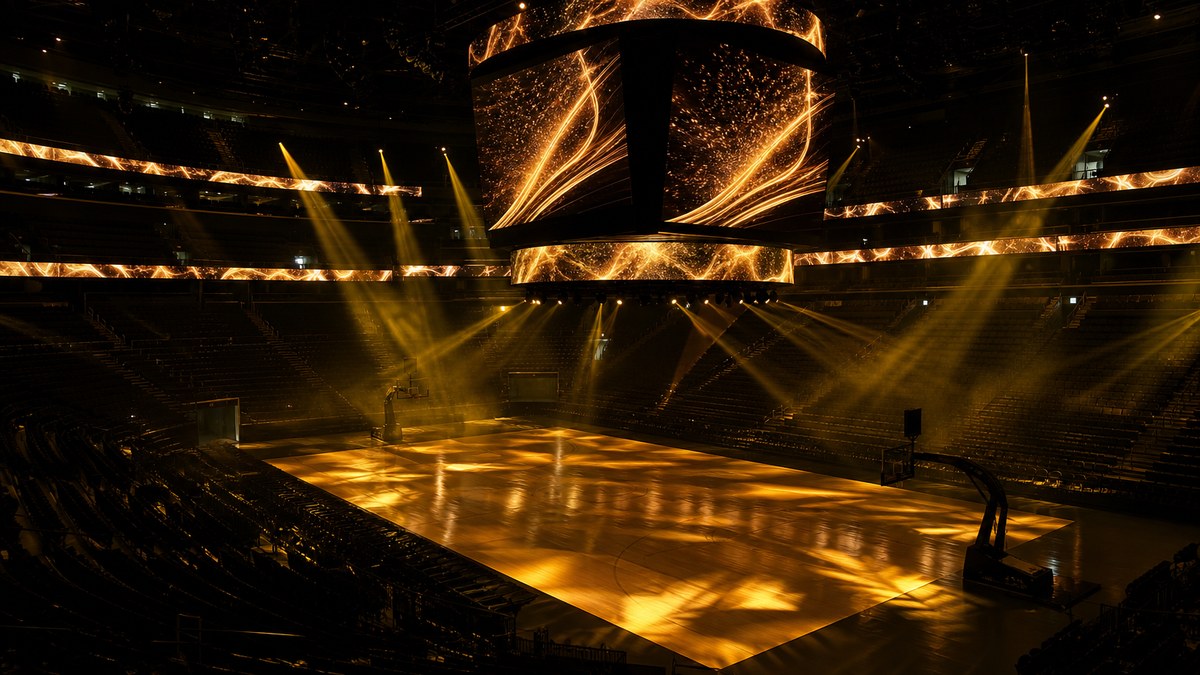
Show and entertainment lighting
With DMX control, the same sports fixtures — plus dedicated color and effect fixtures — become a show system. Programmed scenes can run player intros, halftime shows, fireworks-style chases, and team-color celebrations, all triggered from a control booth or synced to audio and video. Concerts, graduations, rodeos, and corporate events can each have their own saved looks.
LED video boards, ribbon boards, and displays
Center-hung scoreboards, ribbon boards around the seating bowl, concourse displays, and entrance video walls are part of the same visual system. They should be planned alongside the lighting so brightness, color, and content work together. For interior and event displays, see our LED video wall guide or request a video wall quote. For exterior marquees, pylons, and illuminated venue signage, our network partners at American LED Signage build large-format signs to match.
Concourses, suites, and premium clubs
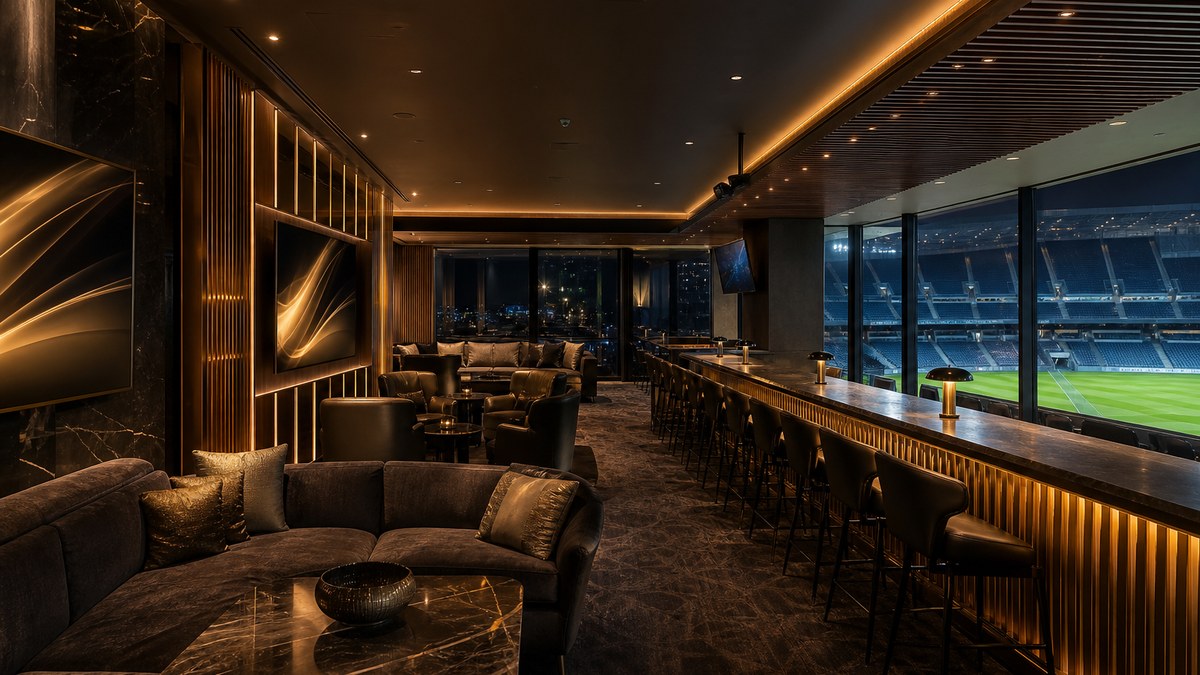
Premium spaces generate some of the highest revenue per square foot in any venue. Suites, club lounges, and VIP areas deserve hospitality-grade lighting: warm, layered, dimmable, and designed to make food, finishes, and branding look their best. Many of the same principles in our hotel LED lighting guide apply directly to clubs and suites. Signature features such as fiber optic starlight ceilings can give a club lounge a look fans remember and photograph.
Exterior facade and architectural lighting
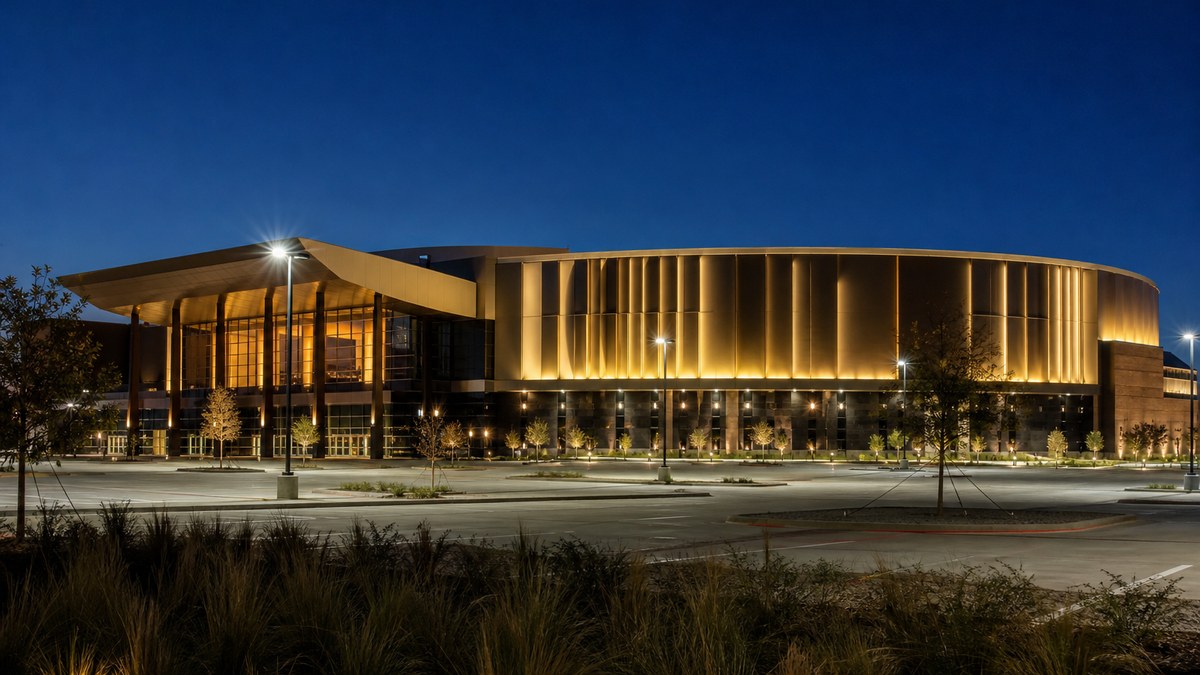
On event nights, the building itself is the first thing fans see from the highway. Architectural LED — wall washers, linear grazers, and color-changing accent systems — turns a venue into a landmark and can shift to team colors, sponsor themes, or holiday looks on a schedule. Learn more in our guide to architectural LED lighting for Dallas commercial buildings.
Parking lots, garages, and site lighting
Tens of thousands of fans often arrive and leave within the same window. Bright, uniform LED lighting in lots, garages, and walkways improves safety, helps security cameras capture clear footage, and makes wayfinding easier. With sensors and scheduling, site lighting can drop to security levels on non-event days and ramp up automatically before gates open.
Back-of-house, locker rooms, and service areas
Loading docks, kitchens, locker rooms, storage, and service corridors are where LED plus occupancy sensors deliver steady savings year-round. These spaces are also where maintenance teams spend the most time, so reliable, long-life fixtures reduce work orders.
Venue lighting plan at a glance
| System | Main Goal | Typical LED Approach | Controls |
|---|---|---|---|
| Field / court sports lighting | Play quality, safety, uniformity | High-output LED sports fixtures with precision optics | DMX or networked control, event presets |
| Broadcast lighting | Camera-ready image | High-CRI, flicker-free fixtures and drivers | Broadcast intensity presets |
| Show & effects | Fan experience, sponsorship | RGBW color and effect fixtures, sports fixtures with effects | DMX, show control synced to audio/video |
| Video boards & displays | Content, scoring, advertising | Center-hung, ribbon, and concourse LED displays | Video processing coordinated with lighting |
| Concourses & clubs | Hospitality, F&B revenue | Layered warm LED, accent and cove lighting | Scene dimming, schedules |
| Exterior facade | Landmark presence | Wall washers, grazers, color-changing accents | Astronomical time clock, DMX scenes |
| Parking & site | Safety, traffic flow | Area and garage LED fixtures | Photocells, event schedules, sensors |
| Back-of-house | Energy, maintenance | High-efficiency LED fixtures | Occupancy and daylight sensors |
Sports lighting standards: what your design must hit
Every sport and play level has its own recommended practices, published by bodies such as the Illuminating Engineering Society (IES) and by individual leagues, conferences, and broadcasters. Your lighting designer should confirm the exact requirements for your facility, but the key metrics are consistent:
- Illuminance: how much light reaches the playing surface. Recreational and training facilities need far less than collegiate or professional venues, and televised events typically need the most.
- Vertical illuminance: light on players' faces and the ball from camera angles — critical for broadcast.
- Uniformity: how even the light is across the field or court. Poor uniformity creates dark zones that affect play and look bad on camera.
- Glare control: precision optics and careful aiming keep light out of players' and fans' eyes.
- Color rendering and temperature: sports lighting typically uses neutral to cool white, with high CRI for broadcast.
- Flicker: flicker-free drivers prevent rolling bands and strobing in slow-motion replay.
- Spill and sky glow: outdoor venues near homes need designs that keep light on the field and off the neighbors.
Because these requirements are so specific, a proper design always starts with a site survey and photometric study. That is also where an energy baseline is built — the same approach behind our commercial lighting audit.
One partner for your entire venue
Audit, lighting design, supply, installation, controls, and ongoing service — handled end to end for stadiums, arenas, hotels, and large commercial properties across Dallas–Fort Worth and beyond.
Controls: the show brain of a modern venue
Fixtures produce light. Controls turn a venue full of fixtures into a system you can program, schedule, and monitor. On a large property, the control design matters as much as the fixtures themselves.
- DMX show control: the standard for color, effects, and fast scene changes, allowing individual fixture control and synchronized shows.
- Event presets: saved looks for each event type — practice, game, broadcast, concert, graduation, cleaning — recalled in seconds.
- Networked architectural control: DALI or networked systems for concourses, clubs, offices, and back-of-house, with sensors and schedules.
- Astronomical time clocks: exterior and site lighting that follows sunset and sunrise automatically.
- Monitoring: a central dashboard where facility staff can see fixture status, run schedules, and troubleshoot before an event.
- Integration: coordination with video boards, audio, and building management systems so everything cues together.
Controls also support code compliance. Commercial energy codes based on IECC and ASHRAE 90.1 require automatic shutoff and other controls in many spaces. A well-designed system meets those rules while keeping every guest-facing space exactly as bright as the event demands.
How to upgrade a venue around a live event calendar
The biggest worry for venue operators is simple: the building cannot go dark during the season. A large lighting project has to fit around games, concerts, and rentals. Here is how a well-run project works.
- Site survey and audit: a full inventory of fixtures, poles, rigging points, circuits, controls, and run hours, plus photometric readings. This builds the energy baseline and identifies structural or electrical limits.
- Design and photometrics: fixture selections, aiming, light-level modeling, control design, and show concepts. For big venues, on-site mockups of key fixtures help owners see the result first.
- Phasing around the calendar: work is scheduled into the off-season, dark days, and overnight windows. Large projects are often split into sports lighting, concourses, exterior, and parking phases.
- Installation: crews experienced with lifts, rigging, and work at height install fixtures, drivers, and controls with minimal disruption to operations.
- Commissioning and aiming: every fixture is aimed and verified, light levels are measured, and every preset, show scene, and schedule is tested before the first event.
- Training and service: operations and production staff learn the system, and ongoing service keeps it performing season after season.
Energy savings, maintenance, and incentives
Venues use enormous amounts of light, often for long hours on event days and for practices, cleaning, and security the rest of the week. Replacing metal halide, fluorescent, and halogen fixtures with LED commonly cuts lighting energy by 50–75%, and controls can reduce it further by dimming or switching off lighting when full output is not needed. Because LED does not need warm-up time, venues also stop leaving lights on between sessions just to avoid restrike delays.
Maintenance savings can be just as important. Sports fixtures sit high on poles, catwalks, and roof trusses. Every lamp change on an older system means lifts, crews, and scheduling. Quality LED fixtures are commonly rated for 50,000 hours or more, which dramatically reduces how often anyone has to go up there.
Commercial and institutional properties in the Dallas area may also qualify for utility energy-efficiency incentive programs, such as those offered through Oncor, depending on the project and program availability. A proper audit documents the baseline you need to apply.
Every venue is different, so we do not publish one-size-fits-all pricing. Share your venue details and we will prepare a project-specific proposal. You can start with our project quote form, contact our team, or review our full list of lighting services.
What makes DFW venue projects different
Lighting a stadium or arena in North Texas brings challenges that a generic spec sheet will not cover.
Heat, hail, and severe weather
Outdoor fixtures, drivers, and controls on light poles and stadium roofs face intense summer heat, high winds, and spring hail. Fixtures should be rated for high ambient temperatures and sealed against dust and driving rain, and mounting and pole loading must be engineered for the added weight and wind area. Choosing the right outdoor ratings up front prevents failures that are expensive to fix 100 feet in the air.
A crowded events calendar
DFW venues compete for concerts, tournaments, rodeos, esports, graduations, and corporate events. Faster changeovers and better-looking shows help win those bookings. Venues that hosted or supported global events — see is your Dallas property World Cup ready — have raised expectations for what a first-class venue looks like.
Scale from pro stadiums to community fields
The metroplex has some of the largest venues in the world, and many of its biggest stadiums and arenas have already moved to LED sports lighting. That shift sets the standard for everyone else. High school districts, colleges, minor-league parks, and private event centers across Dallas, Fort Worth, Arlington, Frisco, and Plano are now upgrading to match what fans see on TV.
Neighbors and night sky
Many community and school stadiums sit close to homes. Modern LED optics and shielding keep light on the field and reduce spill and glare into neighborhoods — often a major improvement over older systems and an important point in community approvals.
Choosing a stadium lighting partner in Dallas
Stadium and arena lighting is not a job for a small electrical crew with a catalog. When comparing commercial LED lighting installers for a large venue, ask to see:
- Large-project capability — stadiums, arenas, hotels, towers, and multi-building campuses
- Photometric design — modeled light levels and uniformity, not guesswork
- Show and controls expertise — DMX show programming and networked architectural controls, commissioned properly
- Structural and electrical coordination — pole, truss, and power assessments before fixtures are selected
- Event-aware phasing — installation plans built around your season and booking calendar
- Ongoing service — a team that supports the system long after the first game
Venues are just one part of the big-project picture. Owners of hotels, office towers, and commercial buildings in Dallas are upgrading too, and our premium lighting solutions cover properties of every scale. If your building shows the warning signs it needs a lighting audit, now is a good time to plan.
Dallas LED Lights serves venues and large commercial properties across the metroplex, including Dallas, Fort Worth, Arlington, Irving, Plano, Frisco, and Grapevine. Learn more about our team, explore our commercial lighting services, or read our complete guide to LED lighting in Dallas.
Frequently Asked Questions
Why are stadiums switching to LED lighting?
How much energy can a stadium save with LED lighting?
Can LED sports lights do light shows?
What makes stadium lighting broadcast ready?
Can a venue upgrade its lighting during the season?
How long do LED stadium lights last?
Do high school and college stadiums in DFW upgrade to LED?
Do stadium lighting upgrades qualify for incentives in Dallas?
How much does stadium LED lighting cost?
What other large projects does Dallas LED Lights handle?
Planning a stadium or arena lighting upgrade?
Tell us about your venue. We will review it and send a clear, project-specific proposal covering design, installation, controls, and phasing around your event calendar.
Related services
Our partner network covers large projects across Texas and beyond: Fort Worth LED lighting, commercial LED lighting in Arlington, LED lighting in Plano, Irving LED lighting services, Texas-wide LED lighting, and wholesale LED solutions, plus fiber optic lighting solutions, modular building solutions, and modular structures in Dallas.