Business Lighting Services in Lake Dallas & North DFW: The Big-Project Guide for Denton County Campuses, Industrial Parks & Venues
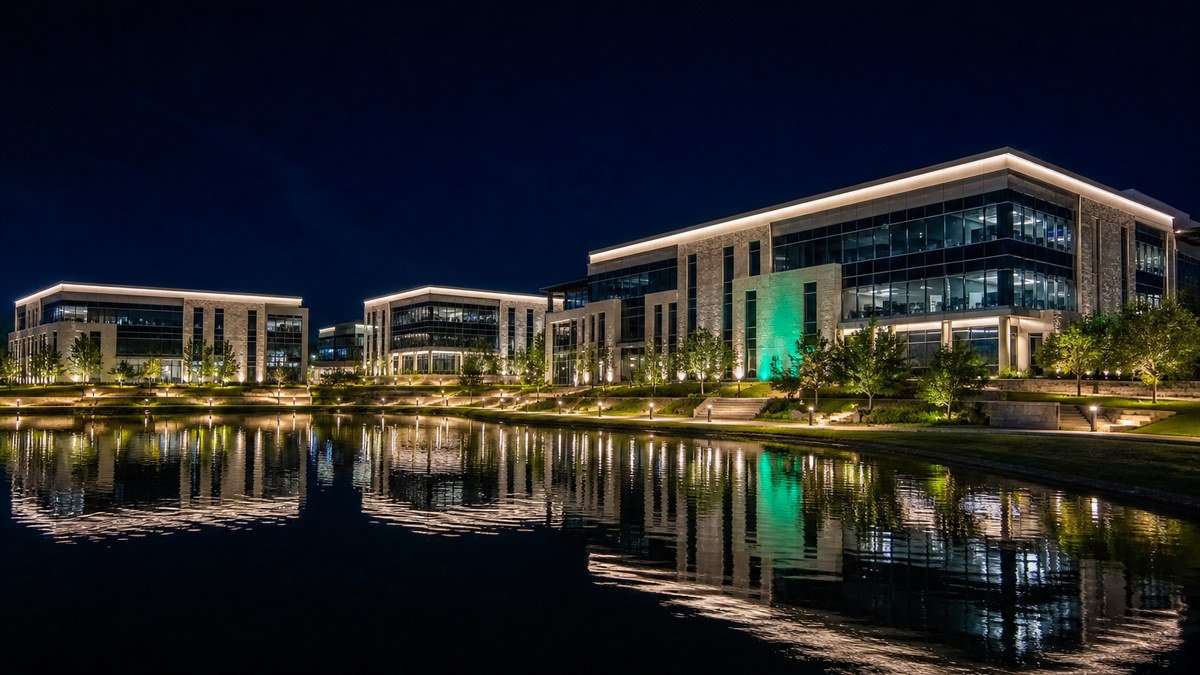
Business lighting services in Lake Dallas and the rest of North DFW look very different today than they did ten years ago. The I-35E corridor between Dallas and Denton is no longer a quiet stretch of lakeside towns — it is one of the fastest-growing commercial regions in Texas, filling up with corporate campuses, distribution parks, hotels, medical centers, schools, and entertainment venues. Those are big properties with big lighting needs, and they deserve more than a bulb swap from whoever answers the phone first.
This guide is written for owners, developers, facility directors, and property managers planning large lighting projects in Lake Dallas, Lewisville, Corinth, Denton, Little Elm, and the wider Denton County area. It explains what complete commercial lighting services should include for a large property, how each building type is lit, what makes North DFW conditions different, and how a big project runs from audit to commissioning. It is the same big-project approach behind our Luminance design-build program, applied to the northern half of the metroplex.
For a large property in Lake Dallas or North DFW, business lighting services should cover the whole site under one plan:
- Audit & design: a zone-by-zone survey, photometric design, and fixture specifications before anything is ordered
- Interior & architectural: lobbies, offices, warehouses, ballrooms, and facades lit for their actual purpose
- Site lighting: parking, truck courts, walkways, and perimeters with full-cutoff fixtures that respect nearby homes and the lake
- Controls: networked sensors, schedules, and scenes — the difference between an LED swap and real savings
- Energy impact: LED commonly uses 50–75% less energy than the older lighting it replaces
- Pricing: quote-only — every big property gets a project-specific proposal
Why North DFW is where big projects are heading
Denton County is growing faster than almost any large county in the country. According to the U.S. Census Bureau, the county went from 906,422 residents in the April 2020 census to an estimated 1,069,346 by July 2025 — an 18.0% jump in about five years. People follow jobs, and jobs follow buildings.
The commercial side is moving just as quickly. A September 2026 report citing CoStar data put Denton County at about 137 million square feet of industrial space, with almost 12 million more square feet under construction, and called the Alliance area the No. 1 submarket in the country for industrial construction (source). The same report notes that the University of North Texas is the county's largest employer, alongside major corporate and manufacturing employers across the region.
Lake Dallas sits right in the middle of this growth. The city lines I-35E on the shore of Lewisville Lake, between Lewisville and Denton, with Corinth, Hickory Creek, Shady Shores, and Little Elm all within a short drive. That location puts Lake Dallas businesses next door to corporate campuses, logistics parks, healthcare facilities, and the hotels and venues that serve them. When people search for “business lighting services in Lake Dallas,” many of them are not lighting a single storefront — they are responsible for large buildings, multiple buildings, or a whole portfolio along the corridor.
In a growth corridor, today’s lighting decision is also tomorrow’s leasing decision. A new campus or logistics building next door will have modern LED and controls on day one. Older properties that want to compete for the same tenants, guests, and employees need to close that gap.
What business lighting services should include for a large property
“Lighting services” can mean anything from changing a few lamps to delivering a fully commissioned, networked lighting system across a 40-acre site. For big properties, the second definition is the one that protects your budget. A complete scope looks like this:
- Lighting audit: a fixture-by-fixture and zone-by-zone survey, light-level readings, and run hours that build the baseline for design and savings. See how it works in our guide to the big-property lighting audit.
- Lighting design: photometric layouts, color temperature and color rendering choices, glare control, and controls zoning — done before fixtures are ordered.
- Specification and sourcing: fixtures selected for each environment and backed by tested photometric and lifetime data. We are an authorized architectural lighting dealer and project coordinator, not a manufacturer — see how design-build lighting works.
- Installation: licensed crews, phased around operations, tenants, and events.
- Controls and commissioning: sensors, schedules, and scenes programmed, tested, and tuned before handover.
- Documentation and incentives: the paperwork your utility program, insurer, or brand standard may require.
- Ongoing service: a partner who stays after the ribbon cutting.
If you only need one piece today — for example a garage retrofit or a lobby redesign — it still pays to plan it inside a site-wide master plan so every later phase fits. That is the core idea of our commercial lighting services.
North DFW properties, type by type
Denton County has an unusually wide mix of large property types in a small area. Here is how a big-project lighting plan treats each one.
Corporate campuses and headquarters
North DFW has attracted corporate offices and regional headquarters that sit on landscaped campuses rather than downtown blocks. These properties need lighting that does three jobs at once: make the architecture look premium after dark, keep long walks from parking to entrances safe, and keep office floors comfortable and efficient. Tunable-white lighting in offices, architectural lighting on the facade, and networked controls across buildings are the standard toolkit. Our guide to architectural LED lighting for Dallas commercial buildings covers the facade side in depth.
Industrial parks, distribution and logistics centers
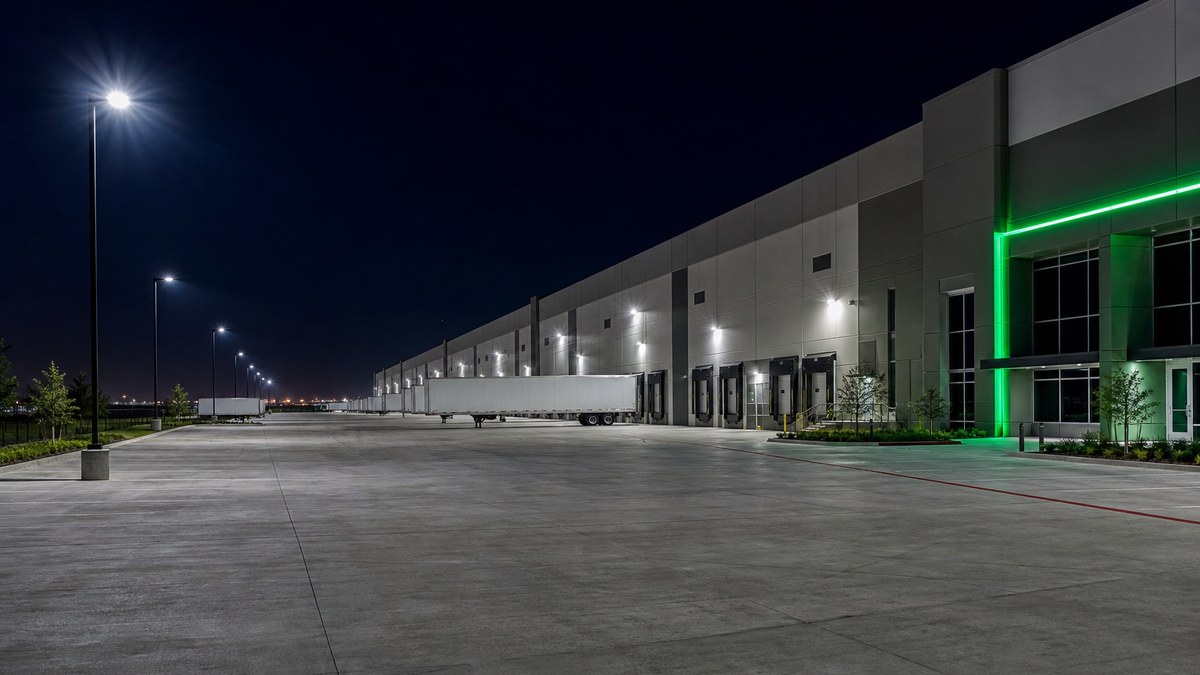
With millions of square feet of industrial space under construction, warehouses and distribution centers are the largest lighting footprint in the county. High bay LED with occupancy sensors in racked aisles, bright and uniform light at dock doors, and full-cutoff truck court lighting are the priorities. For production plants specifically, read our industrial and manufacturing lighting guide; for existing warehouses and garages, see commercial LED retrofits in Dallas.
Hotels and conference properties
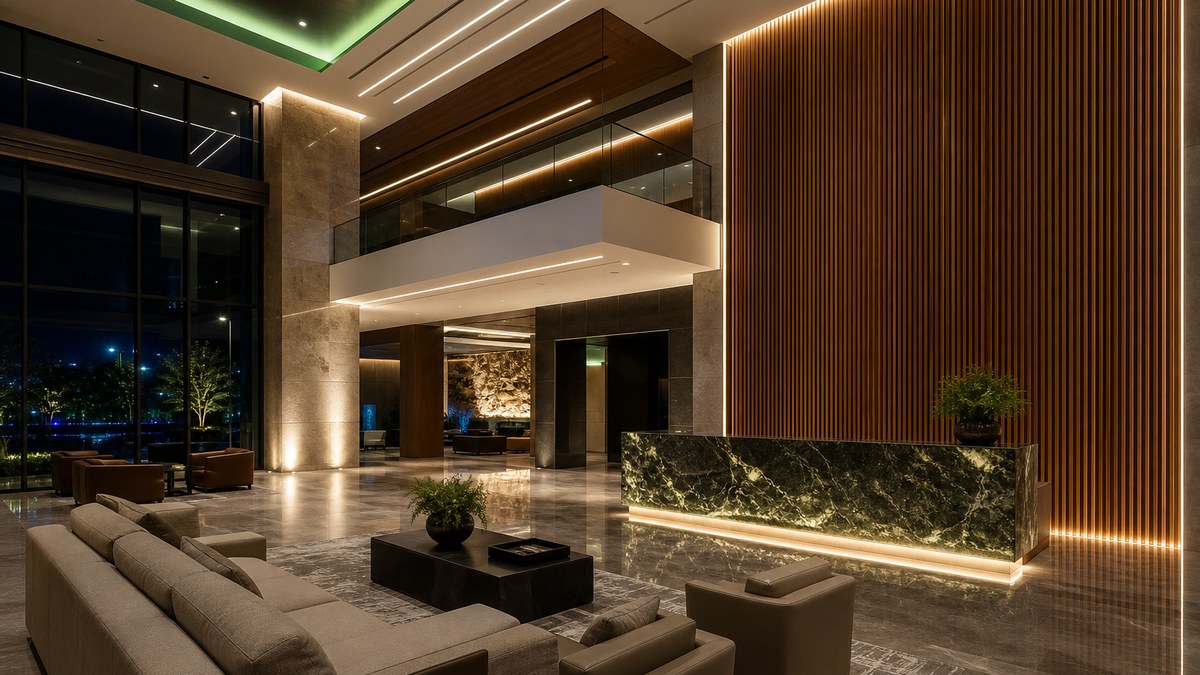
Hotels along I-35E, near the lake, and close to corporate campuses compete hard for business travelers and weekend guests. Facade lighting that reads from the freeway, a warm and layered lobby, and flexible ballroom scenes all matter. Our hotel LED lighting guide and event lighting guide explain the zone-by-zone approach.
Entertainment, sports and event venues
North Texas has no shortage of stadiums, arenas, ballparks, and entertainment destinations, and more are being planned as the population grows. Venue lighting covers performance and broadcast lighting, concourses, marquees, and LED video walls. See stadium and arena LED lighting, marquee and entertainment venue lighting, and our LED video wall options.
Retail centers and town-center developments
New rooftops bring new shopping centers, lifestyle districts, and mixed-use town centers. These sites need welcoming storefront and plaza lighting, safe and code-compliant parking fields, and pylons and signage that stand out. Our shopping center and mixed-use lighting guide goes deeper, and our partners at American LED Signage handle pylons, monuments, and marquee signs.
Healthcare, university and school campuses
Hospitals, medical office buildings, universities, and school districts are expanding with the population. They run lighting around the clock, care deeply about safety and comfort, and often need to upgrade while staying fully open. Our hospital and campus lighting guide covers patient rooms, campus walkways, and phasing.
Lakefront hospitality and amenity spaces
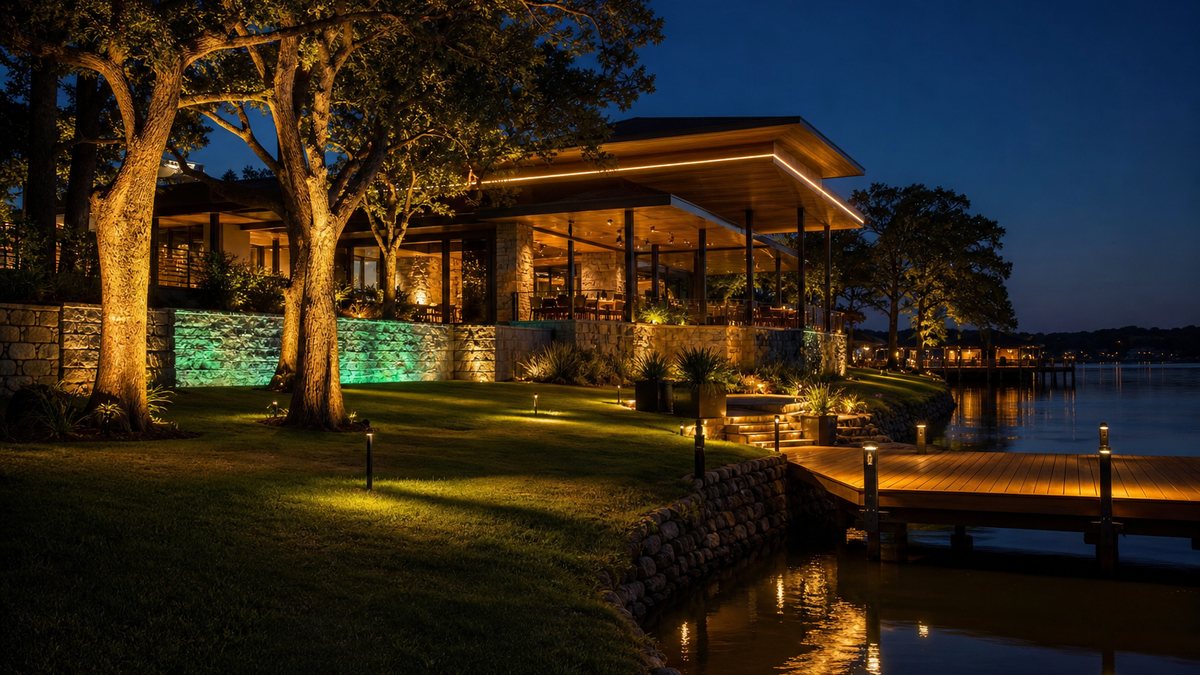
Lewisville Lake gives the Lake Dallas area something most of DFW does not have: waterfront. Restaurants, event lawns, resort-style amenity decks, and multifamily clubhouses near the water can use lighting to become destinations after sunset — as long as fixtures are rated for wind, moisture, and humidity, and aimed so the light stays on the property and off the water. For pools and amenity decks, our network partners at premium pool lighting specialize in exactly this.
Lighting plan by property type at a glance
| Property Type | Top Priorities | Typical LED Approach | Controls |
|---|---|---|---|
| Corporate campus / HQ | Image, comfort, safe walkways | Architectural facade, tunable-white offices, path lighting | Networked sensors, schedules, scenes |
| Distribution & logistics | Energy, safety, dock visibility | High bay LED, dock and truck court lighting | Aisle occupancy, daylight, time clocks |
| Industrial plants | Task light, special environments | Task-sized high bay, rated fixtures | Occupancy, daylight, shift schedules |
| Hotels & conference | Arrival, atmosphere, events | Facade, layered lobby, ballroom tunable white | Scenes, DMX/DALI, astronomical clock |
| Venues & sports | Broadcast, show, crowd safety | Sports lighting, concourse, video walls | DMX/sACN show control |
| Retail & town centers | Welcome, parking safety, signage | Storefront, plaza, full-cutoff parking | Photocells, dimming after hours |
| Healthcare & education | 24/7 safety, comfort, phasing | Layered patient/classroom light, site lighting | Networked controls, night modes |
| Lakefront hospitality | Atmosphere, weather, neighbors | Wet-rated accent and landscape lighting | Scenes, curfew dimming |
What makes North DFW and the Lewisville Lake area different
A lighting plan that works in a dense downtown block does not automatically work on a large suburban site by a lake. North DFW brings its own conditions.
Many cities, many codes
A short drive on I-35E crosses Lewisville, Lake Dallas, Hickory Creek, Corinth, and Denton — each with its own permitting office and its own adopted edition of the commercial energy code and local outdoor-lighting rules. A portfolio owner with buildings in several of these cities needs a partner who checks requirements city by city instead of assuming one set of rules applies everywhere. Energy codes based on the IECC and ASHRAE 90.1 commonly require automatic shutoff, daylight-responsive controls, and exterior lighting limits on new work and major renovations.
More than one utility
Denton County is served by more than one electric provider. Depending on the address, a property may be served through Oncor’s delivery network, by CoServ, or by a municipal utility such as Denton Municipal Electric. Energy-efficiency incentive programs, rate structures, and paperwork differ between them, so the utility question belongs at the start of the project, not the end.
Weather: heat, hail and lake wind
North Texas summers push exterior drivers and rooftop equipment hard, and spring storms bring hail and high winds. Properties near Lewisville Lake add humidity and wind exposure. Exterior fixtures should carry appropriate IP (ingress protection) and IK (impact) ratings, be rated for high ambient temperatures, and use mounting details designed for wind load. Specifying this up front prevents early failures that are expensive to fix on a 30-foot pole.
Neighbors, the lake and the night sky
Many large North DFW properties sit next to neighborhoods, parks, and the lakeshore. Light trespass and glare create complaints and can stall approvals. Full-cutoff fixtures, careful aiming, warmer color temperatures in sensitive areas, and after-hours dimming keep light on the property where it belongs. DFW also sits under a major spring and fall bird migration route, and programs such as Lights Out Texas encourage reducing unnecessary exterior lighting overnight during migration. Networked controls make that easy.
Growth means phases
Campuses and industrial parks in a growth corridor rarely get built all at once. Building two, the parking expansion, and the new amenity center may come years later. A lighting master plan with standard fixture families, consistent color temperatures, and a control system that can expand keeps every future phase looking and operating like part of the same property.
One partner for your entire North DFW property
Audit, design, supply, installation, controls, and ongoing service — handled end to end for campuses, industrial parks, hotels, venues, and large commercial properties from Dallas to Denton and beyond.
How a big North DFW lighting project runs, step by step
Whether it is one large building or a portfolio across several Denton County cities, big projects follow the same disciplined path.
- Discovery and goals: what the property needs to achieve — energy, safety, image, tenant requirements, brand standards, or code compliance — and which buildings and zones are in scope.
- Audit and baseline: fixture counts, light levels, run hours, and existing controls, plus the utility and city for each site. Our commercial lighting audit builds this baseline.
- Master plan and design: photometric layouts, fixture families, color temperature standards, and a controls architecture that can grow with the site.
- Mockups and approvals: on-site mockups of key fixtures and scenes, plus permitting and any owner, brand, or HOA reviews.
- Phased installation: work sequenced by building, floor, aisle, or parking field — often overnight or on weekends — so tenants, guests, and shifts keep moving.
- Commissioning: every sensor, schedule, and scene tested and tuned. This is where networked controls either deliver their savings or do not. See our guide to networked lighting controls.
- Training, documentation and service: facility staff trained on the system, incentive and as-built documentation delivered, and ongoing service in place.
New construction vs. retrofit in a growth corridor
North DFW has both brand-new buildings and properties that were built decades ago, often side by side. The lighting strategy is different for each.
New construction and expansions
For new buildings, the best time to involve a lighting partner is before the electrical design is final. Early involvement lets the team coordinate fixture locations with ceilings, racking, and structure, size circuits for the actual LED loads, plan control wiring or wireless networks, and choose fixtures that match the rest of the campus. It also avoids the costly pattern of value-engineering lighting out of the budget and paying to add it back after tenants move in.
Retrofits of existing properties
For existing buildings, the goal is to modernize without disrupting operations. That means reusing mounting points and circuits where it makes sense, upgrading controls at the same time as fixtures, and phasing work around business hours. Older properties along the corridor often still run metal halide parking lot poles, fluorescent office troffers, and high-pressure sodium wall packs — all strong LED retrofit candidates. If you are not sure where to start, the 7 warning signs your building needs a lighting audit is a quick checklist.
Controls, energy and incentives
On large North DFW properties, lighting often runs longer than people realize: warehouses running multiple shifts, parking fields lit from dusk to dawn, hotel corridors and hospital spaces lit 24/7. That is why LED upgrades on big properties tend to produce strong savings. Replacing older fluorescent, metal halide, and high-pressure sodium fixtures with LED commonly cuts lighting energy by 50–75%, and networked controls — occupancy sensing, daylight harvesting, scheduling, and task tuning — can reduce what is left even further.
Controls also make big properties easier to manage. Facility teams can see fixture status, adjust schedules across buildings, and set special modes for events, holidays, or migration seasons from a single dashboard instead of walking the site with a ladder.
Commercial properties in the area may qualify for utility energy-efficiency incentive programs, such as those offered through Oncor or other local utilities, depending on the property’s provider and program availability. Many programs require pre-approval before fixtures are removed, so start with an audit and keep the old fixtures in place until any required inspection is done.
Every property is different, so we do not publish one-size-fits-all pricing. Tell us about your site and we will prepare a project-specific proposal through our project quote form. You can also explore our premium lighting solutions for showcase spaces.
Choosing a lighting partner for Lake Dallas and North DFW
The lighting partner you choose for a large property should be able to show more than a truck and a ladder. Look for:
- Big-project experience: campuses, venues, industrial sites, and multi-building portfolios — not just small storefronts
- Design capability: photometric design and fixture specification, not catalog swaps
- Controls expertise: networked sensors, DALI, and DMX systems commissioned properly
- Local knowledge: multiple cities’ codes, multiple utilities, and North Texas weather
- Phasing discipline: work plans that keep tenants, guests, and production running
- Service after install: someone who answers when a zone misbehaves next summer
Dallas LED Lights brings 15+ years as an authorized architectural lighting dealer and project coordinator. Our licensed installation partner has completed over 200 major sports and commercial projects across the US and Canada — NFL, NBA, NHL, MLS, NCAA and NASCAR. Learn more about our team and our full range of LED lighting services, or read the complete guide to LED lighting in Dallas and our overview of commercial lighting in Dallas.
Planning for big crowds is also part of the picture across the metroplex — see is your Dallas property World Cup ready for event-season lighting priorities, and our high-rise facade lighting guide if your portfolio includes towers further south.
Frequently Asked Questions
What do business lighting services in Lake Dallas include for large properties?
Do you serve Lewisville, Corinth, Denton and the rest of Denton County?
What types of properties do you light in North DFW?
How much energy can a large property save with LED lighting?
Can lighting be upgraded without shutting down our business?
Which utility incentive programs apply in Denton County?
How do you keep site lighting from bothering neighbors or the lake?
Should we bring in a lighting partner for new construction?
Are you a lighting manufacturer?
How much does a commercial lighting project in North DFW cost?
Planning a big lighting project in Lake Dallas or North DFW?
Tell us about your campus, industrial park, hotel, or venue. We will review it and send a clear, project-specific proposal covering design, installation, controls, and phasing.
Related services
Our partner network covers large projects across Texas and beyond: Fort Worth LED lighting, commercial LED lighting in Arlington, LED lighting in Plano, Irving LED lighting services, Texas-wide LED lighting, and wholesale LED solutions, plus fiber optic lighting solutions, modular building solutions, and modular structures in Dallas.