High-Rise Facade Lighting in Dallas: The Guide to Architectural & Media Facade LED for Towers
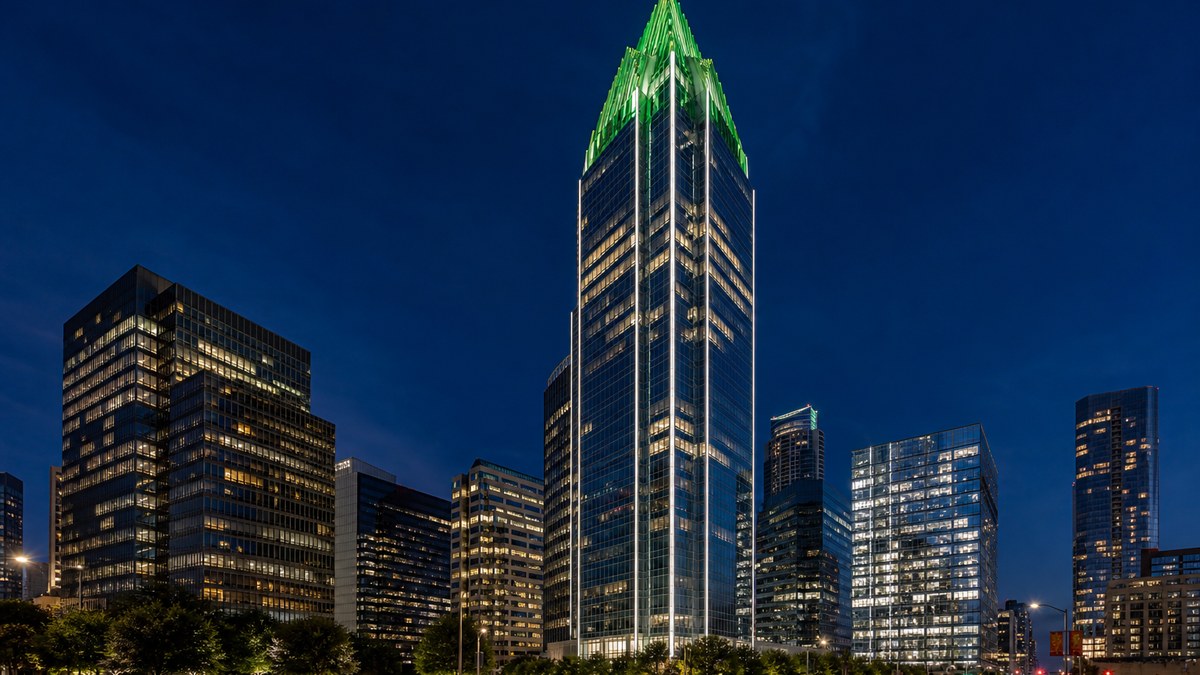
High-rise facade lighting in Dallas is what turns a tower from one more silhouette into a piece of the skyline people recognize from the freeway, the airport approach and the evening news. For owners, developers and asset managers of office towers, hotels and mixed-use high-rises, architectural and media facade LED has become a branding tool, a leasing tool and a civic statement all at once.
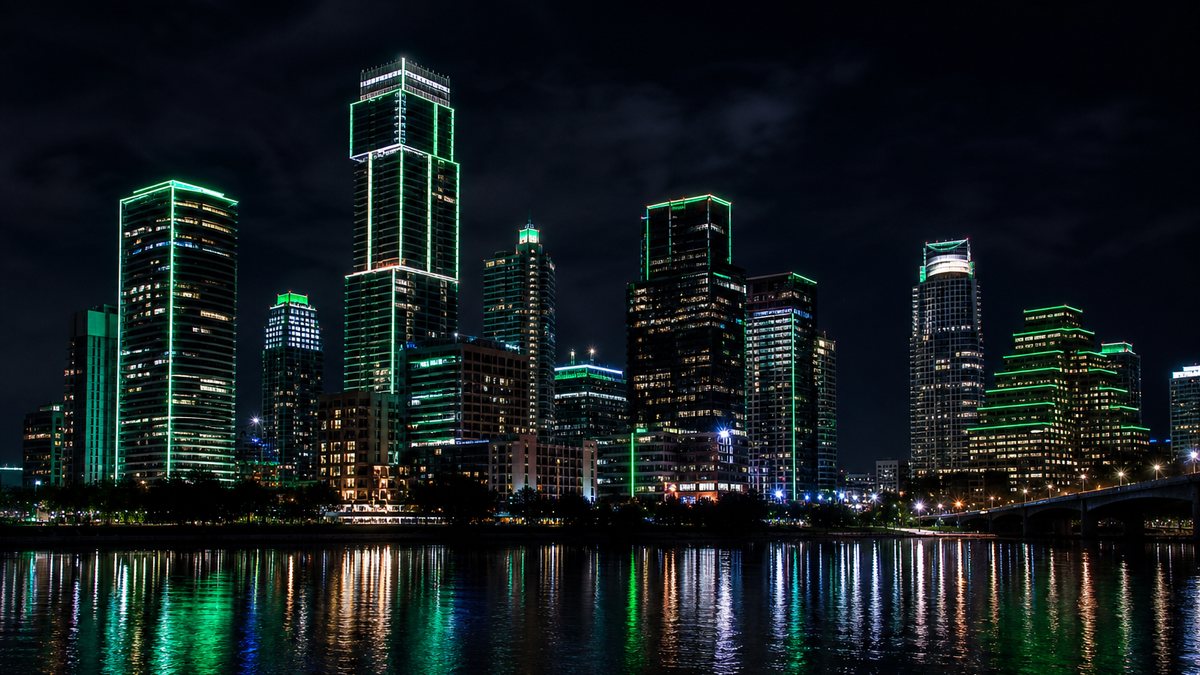
Dallas already has one of the most recognizable lit skylines in the country. Towers outlined in light, a lit sphere that changes almost nightly, and full-height LED canvases that show color and motion have made "the skyline color" part of how the city celebrates. That raises the bar for every new building and every repositioning project downtown, in Uptown, in Victory Park, along the Tollway and in Las Colinas.
This guide explains the main types of facade lighting, how a media facade differs from an LED video wall, what control systems a tower actually needs, how Dallas weather, codes and bird-migration programs shape the design, and how large facade projects are delivered without disrupting tenants. It is written for decision-makers planning big projects — the kind we handle through our Luminance design-build program.
A successful high-rise facade lighting project in Dallas usually combines:
- Architectural lighting: linear grazers, wall washers and floodlights that reveal the building's form in white or color
- Crown and outline lighting: the "signature" that makes the tower readable on the skyline from miles away
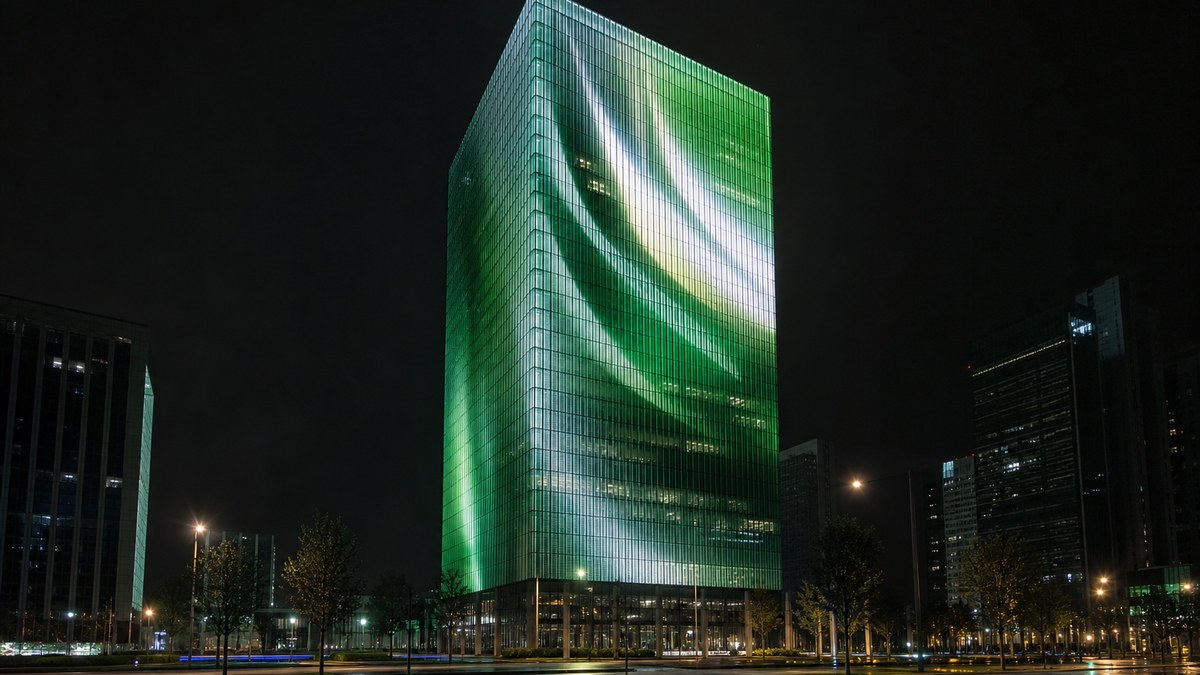
- Optional media facade: pixel-controlled LED that shows slow color motion or low-resolution imagery across the building
- Networked controls: DMX/Art-Net or similar control with schedules, event scenes and remote monitoring
- Dallas-ready hardware: fixtures rated for heat, UV, hail, wind and driving rain, mounted for safe service at height
- Responsible operation: glare control, dimming curves and migration-season schedules that reduce light pollution
Why facade lighting is a tower asset
A lit facade works every night of the year. It tells drivers, travelers and prospective tenants that the building is active, maintained and premium. In a competitive office market, where landlords are investing in amenities to bring tenants back downtown, an iconic exterior is one of the few upgrades that every person in the city sees for free.
Facade lighting also supports the businesses inside the building. Hotels gain arrival presence and photos guests share. Restaurants and rooftop bars in a lit tower become destinations. Corporate headquarters gain a visual identity that shows up in recruiting videos, media coverage and sports broadcasts that cut to the skyline.
Finally, LED makes it affordable to operate. Older metal halide floodlights and neon or argon outlines were costly to run, hard to maintain and limited to one look. Modern LED facade systems typically use 50–75% less energy than the floodlighting they replace, last for many years between major service visits, and can change from warm white to team colors at the push of a button.
The most memorable Dallas towers are not the brightest. They have one clear idea — an outline, a glowing crown, a vertical rhythm of light — executed consistently every night. Start with the idea, then choose the hardware.
How Dallas lights its skyline
To design for Dallas, it helps to understand how the skyline already behaves. According to local reporting from NBC DFW and Dallas Innovates, several landmark downtown buildings operate color-capable LED systems and coordinate their shows for holidays, sports wins and charity causes. Building lighting coordinators share upcoming shows so the skyline can glow in a single color on special nights.
Public reporting describes a wide range of approaches. One tower is outlined in LED along its full height. Reunion Tower's sphere uses 259 domed LED fixtures programmed for its unusual shape. One headquarters uses more than 1,600 individually addressable fixtures. A downtown hotel uses LED sections around each floor to create a full-height canvas that can show text and images. These are public examples of what the city already expects — not projects of ours — but they show why a new tower needs a deliberate lighting concept to stand out.
For an owner, this creates an opportunity. A tower that can join a coordinated skyline color night, or answer with its own signature look, earns attention every time Dallas celebrates.
The four types of facade lighting
Most large projects combine two or three of these approaches. Each has a different look, budget profile and maintenance plan.
1. Architectural accent lighting
Linear LED grazers, wall washers and narrow-beam floodlights reveal the building's materials and geometry: vertical fins, setbacks, columns, stone texture and canopy edges. This is the foundation of most facade schemes. It can be static white, tunable white or full color. For the broader design principles, see our guide to architectural LED lighting for Dallas commercial buildings.
2. Crown, spire and outline lighting
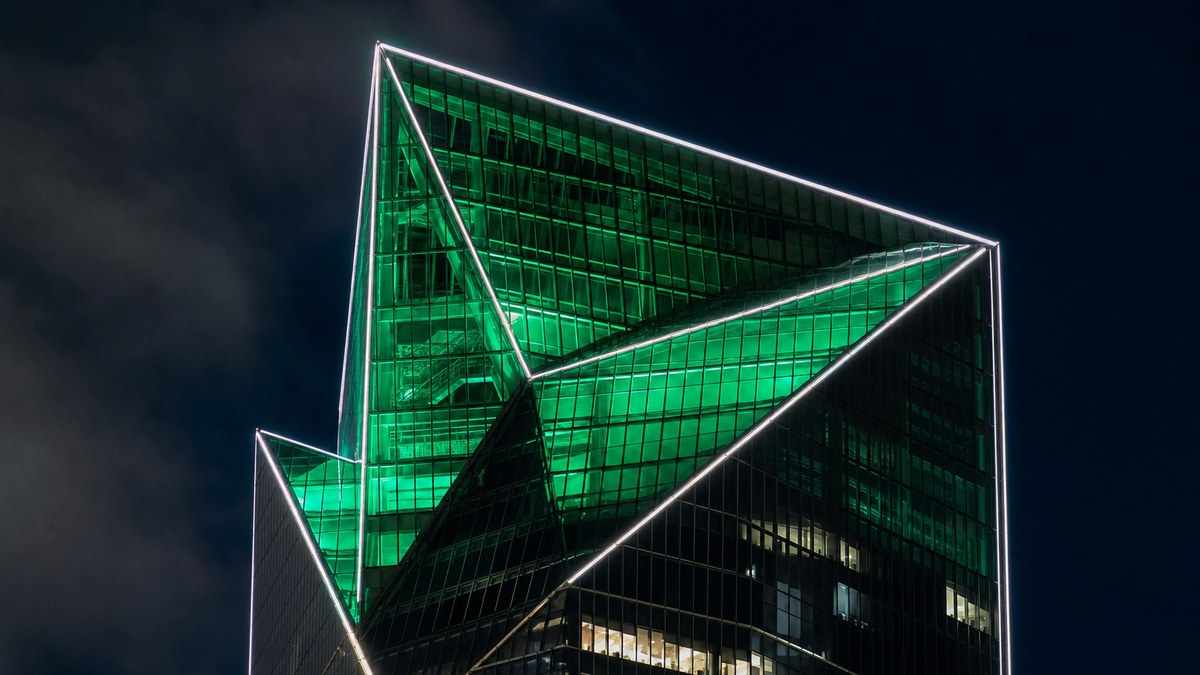
The top of a tower is what people see from miles away. Crown lighting, rooftop floods, spire uplights and edge outlines create the "signature" that identifies the building on the skyline. Outline lighting uses continuous linear LED along edges so the building's shape reads clearly at night, even from the highway.
3. Media facades
A media facade uses pixel-controlled LED — linear pixels, LED mesh, dots or bars mounted on or behind the glass — so the whole facade becomes a low-resolution canvas. Content is usually abstract: flowing color, gradients, slow motion and simple graphics designed to be read from a distance. Because a media facade can display images or text, it may be treated differently under local sign rules than plain architectural light, so it needs early review with the city.
4. Podium, canopy and arrival lighting
The street level matters as much as the crown. Lit canopies, porte-cochères, columns, entry portals and landscape make the building welcoming and safe for pedestrians. This is also where signage lives — our network partners at American LED Signage handle building-name letters, monuments and marquees designed to match the facade.
Facade lighting options compared
| Approach | Best For | Look | Controls | Key Design Question |
|---|---|---|---|---|
| Architectural accent | Most towers, hotels, HQs | Reveals form and texture | Scenes, schedules, DMX | Which surfaces should glow? |
| Crown & outline | Skyline identity | Signature shape, visible for miles | Color scenes, event calendar | What is the tower's one idea? |
| Media facade | Entertainment districts, iconic towers | Motion and low-res imagery | Pixel mapping, media server | What content, and is it permitted? |
| Podium & arrival | Pedestrian streets, hotels, retail | Welcoming, safe, branded | Photocell, dimming | How does it meet signage and landscape? |
| LED video wall | Plazas, lobbies, venue exteriors | Full video resolution | Video processor, CMS | Viewing distance and brightness |
Media facade vs. LED video wall
Owners often ask whether they need a media facade or an outdoor LED video wall. They solve different problems.
- Viewing distance: a media facade is designed to be seen from blocks or miles away, so pixels can be widely spaced. A video wall is viewed from the street or plaza and needs a much finer pixel pitch.
- Transparency: media facades are usually mounted on mullions, fins or behind glass, keeping views from inside the building. A video wall is a solid display surface.
- Content: a media facade shows color and slow motion that complements the architecture. A video wall shows full video, sponsor content and live feeds.
- Brightness: a media facade can run at modest night-time levels. An outdoor video wall must be bright enough to read in daylight and needs automatic dimming at night.
Many projects use both: a media facade on the tower and a high-resolution display at the plaza or entrance. If a screen is part of your plan, start with our LED video wall page and the deeper LED video wall guide.
Controls: the brain behind the skyline
On a tower, the fixtures are only half the system. Controls decide every color, schedule and show — and they decide how easy the system is to run five years from now.
- Protocols: DMX512 and Art-Net/sACN are standard for color-changing and pixel facades; larger systems may combine them with DALI or a networked control platform for white-light zones.
- Pixel mapping: for media facades, every fixture or pixel is mapped to its exact place on the building so content lines up across floors and faces.
- Show calendar: astronomical clocks start the lighting at sunset, while a calendar runs holiday colors, sports scenes and charity nights automatically.
- Remote access and monitoring: engineers can change scenes, check fixture health and respond to requests from a laptop instead of the roof.
- Dimming curves: late-night and migration-season schedules lower output without losing the building's identity.
Good commissioning matters as much as good hardware. Every address, scene and schedule should be tested, documented and handed over with training. Our article on commercial LED retrofits for Dallas office towers covers why commissioning makes or breaks large controls projects.
From skyline concept to commissioned system
Lighting concept, renderings and mockups, fixture specification, controls, permitting support, installation at height and ongoing service — handled as one project for towers and large properties across Dallas–Fort Worth.
Designing for Dallas conditions
A facade system in North Texas faces a tougher environment than an interior lobby. These factors should be settled during design, not after the first summer.
Heat, UV and storms
Rooftop and facade equipment can see extreme surface temperatures in July and August. Fixtures, drivers and power supplies should be rated for high ambient temperatures, with proper ingress protection against dust and wind-driven rain. Spring hail and severe wind make lens materials, housings and mounting hardware a real design decision. Cable runs, connectors and surge protection deserve the same attention, because the most common facade failures happen at connections, not in the LEDs.
Access and maintenance at height
The cost of a facade system over its life depends heavily on how hard it is to reach. Good designs place drivers and controllers in accessible locations, coordinate with window-washing davits and swing-stage routes, and use fixtures that can be serviced without removing curtain-wall components. Planning service access early avoids expensive lift and rope-access work later.
Glare, light trespass and neighbors
Facade light should land on the building, not in nearby apartments, hotel rooms or drivers' eyes. Precise optics, shielding, aiming and sensible brightness levels keep the result elegant. Residential towers and mixed-use projects in Uptown and Victory Park make this especially important.
Bird migration and Lights Out Texas
Texas sits on one of the busiest bird migration routes in North America. The Lights Out, Texas! initiative asks buildings to turn off non-essential exterior lighting from 11 p.m. to 6 a.m. during migration, with fall migration running from mid-August through November and a peak from early September to late October. Dallas has supported the effort with official lights-out nights. A modern control system makes participation simple: a scheduled "migration mode" dims or switches off non-essential facade zones overnight while keeping safety and arrival lighting on.
Codes, permits and approvals
Facade projects touch several approval paths: electrical permits, structural review for attachments, energy code requirements for exterior lighting controls, and — for media facades that can display images or text — local sign regulations. Planned developments and special districts may add their own design guidelines. Early conversations with the city, the building's architect and its structural engineer save months.
How a facade project gets built
Large facade projects follow a clear sequence. Skipping steps is what leads to uneven light, color mismatches and systems that are hard to operate.
- Site survey and lighting audit: existing fixtures, power, controls, structure, access and sight lines from key viewpoints. Our commercial lighting audit documents the baseline.
- Concept and renderings: the tower's lighting idea, shown from the street, the freeway and the skyline, with day and night views.
- On-site mockups: sample fixtures mounted on the real facade to confirm color, brightness and glare before full specification.
- Engineering and approvals: fixture schedules, power and data risers, mounting details, control architecture and permit documents.
- Phased installation: work scheduled by elevation and zone around tenants, events and weather, often at night for street-level work.
- Programming and commissioning: addressing, pixel mapping, scenes, show calendar and migration schedules tested and tuned.
- Training and service: engineering staff learn the system, and a service plan keeps every face of the building performing.
Every tower is different, so we do not publish fixed pricing. Scope depends on height, the number of faces lit, the approach chosen, access methods and control requirements. Tell us about your building and we will prepare a project-specific proposal through our quote form.
Retrofitting an existing tower
Many of the best facade projects are upgrades, not new construction. Older towers often have metal halide floodlights, failing neon or argon outlines, or early-generation LED that has drifted in color. A retrofit can keep the building's established look while adding color control, lower energy use and remote monitoring.
- Like-for-like modernization: replace failing outline or flood systems with LED that matches the original color the city knows.
- Add color capability: let the tower join skyline color nights and celebrate events.
- Re-use infrastructure: existing mounting points, conduit and power can often be reused, reducing work at height.
- Bundle with interior upgrades: combine the facade with lobby, garage and amenity lighting under one program, as described in our commercial lighting Dallas guide.
Commercial properties in the Dallas area may also qualify for utility energy-efficiency incentive programs, such as those offered through Oncor, depending on the project and program availability. A documented baseline from an audit supports any application.
Where facade lighting fits in a big-project program
A tower's facade rarely stands alone. Hotels pair it with lobby and ballroom lighting, as covered in our hotel LED lighting guide. Venues pair it with marquees and show lighting, as in our entertainment venue lighting guide and stadium and arena lighting guide. With major international events bringing global attention to the region, many owners are asking whether their property is ready — see is your Dallas property World Cup ready.
Rooftop amenities often complete the picture: lit pool decks from our partners at premium pool lighting and signature starlight ceilings in sky lounges and penthouse bars give the top of the building the same premium feel as its crown.
Choosing a facade lighting partner in Dallas
Facade lighting is a specialist discipline. Before you choose a partner, ask for:
- Big-project experience — towers, venues, hotels and large commercial properties, not just storefronts
- Design capability — concepts, renderings and on-site mockups, not only a fixture catalog
- Controls depth — DMX, Art-Net, pixel mapping and show programming, commissioned and documented
- Work-at-height planning — access, safety and coordination with building operations
- Permitting support — electrical, structural and signage considerations handled early
- Long-term service — a team that maintains the system after the first lighting night
Dallas LED Lights coordinates large projects with a licensed installation partner. Our licensed installation partner has completed over 200 major sports and commercial projects across the US and Canada — NFL, NBA, NHL, MLS, NCAA and NASCAR. Our team brings 15+ years as an authorized architectural lighting dealer and project coordinator. Learn more about our team, browse our lighting services and premium lighting solutions, or read the complete guide to LED lighting in Dallas.
Frequently Asked Questions
What is high-rise facade lighting?
What is the difference between a media facade and an LED video wall?
Can a Dallas tower change colors for holidays and sports teams?
What controls does a facade lighting system need?
Do I need a permit for facade lighting in Dallas?
How does facade lighting handle Dallas heat and hail?
What is Lights Out Texas and does it affect my building?
Can an existing tower be retrofitted with LED facade lighting?
How much does high-rise facade lighting cost?
Does Dallas LED Lights handle other big projects besides towers?
Ready to put your tower on the skyline?
Tell us about your building. We will review it and send a clear, project-specific proposal covering concept, mockups, controls, installation and phasing.
Related services
Our partner network covers large projects across Texas and beyond: Fort Worth LED lighting, commercial LED lighting in Arlington, LED lighting in Plano, Irving LED lighting services, Texas-wide LED lighting, and wholesale LED solutions, plus fiber optic lighting solutions, modular building solutions, and modular structures in Dallas.