Networked Lighting Controls in Dallas: DMX, DALI & Smart Control Systems for Large Properties
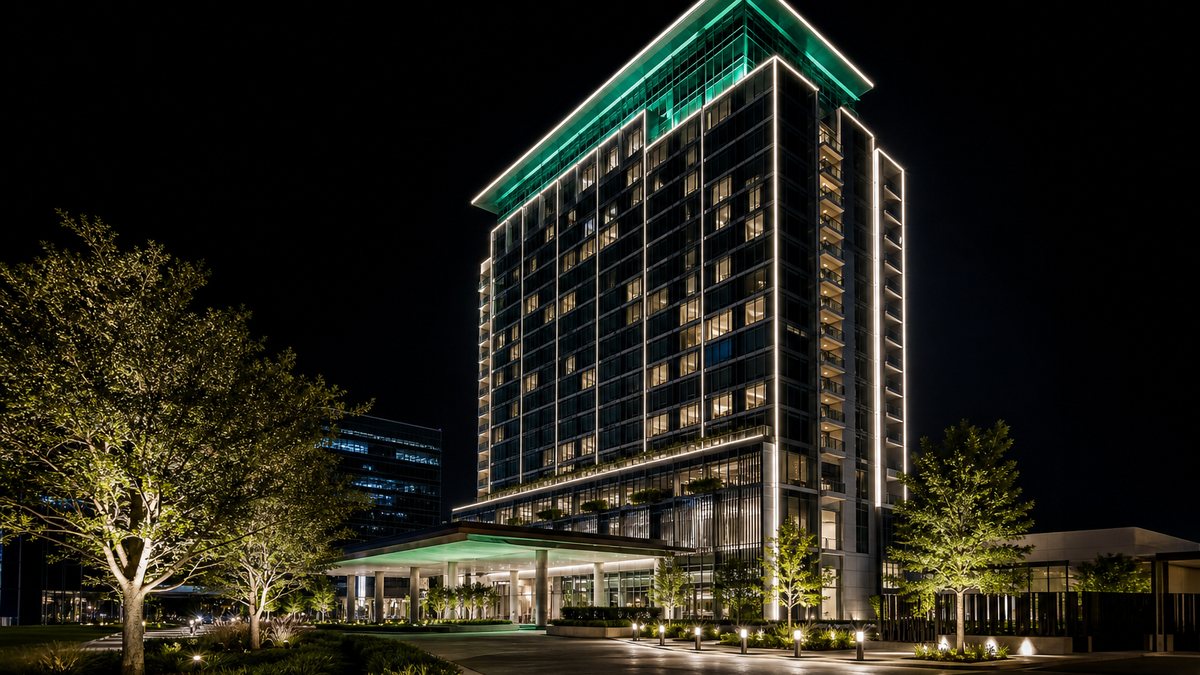
Networked lighting controls in Dallas are the difference between a building full of LED fixtures and a lighting system you can actually run. On a hotel, arena, entertainment venue, office tower or mixed-use campus, the fixtures are only half the investment. The other half is the control layer that decides when every light turns on, how bright it gets, what color it shows, and how quickly your engineering team can find a problem at 2 a.m.
That control layer has a vocabulary of its own — DMX, DALI, sACN, 0–10V, wireless mesh, BACnet — and the wrong mix can leave a beautiful project stuck with scenes nobody can change and sensors nobody trusts. This guide explains how large-property lighting controls work, which protocols fit which spaces, what the 2021 energy code expects in Dallas, and how to plan a control system that still makes sense ten years from now.
It is written for owners, asset managers, facility directors, architects and developers planning big projects across Dallas–Fort Worth. If you want one accountable partner for fixtures and controls together, that is exactly what our Luminance design-build program is built for.
A networked lighting control system connects fixtures, sensors, keypads and software so a large property can be scheduled, dimmed, colored and monitored from one place. On big Dallas projects:
- DMX / sACN: fast, channel-based control for color-changing facade, marquee, show and media lighting
- DALI / DALI-2: addressable digital dimming with two-way feedback for interiors, lobbies, ballrooms and offices
- Networked (wired or wireless) systems: sensors and software for garages, warehouses, corridors and office floors
- Energy: a DesignLights Consortium study found networked controls added about 47% average savings on top of LED alone
- Code: Dallas enforces the 2021 energy code (effective May 12, 2023), which requires automatic controls in most commercial spaces
- Best results: design controls with the fixtures, then commission and train — not as an afterthought
What networked lighting controls actually are
Traditional lighting control is a wall switch, a time clock in an electrical room and maybe a photocell on the roof. Each one controls a circuit, not a fixture, and none of them can tell you anything back. That model breaks down on a property with thousands of fixtures, dozens of space types and lights that run around the clock.
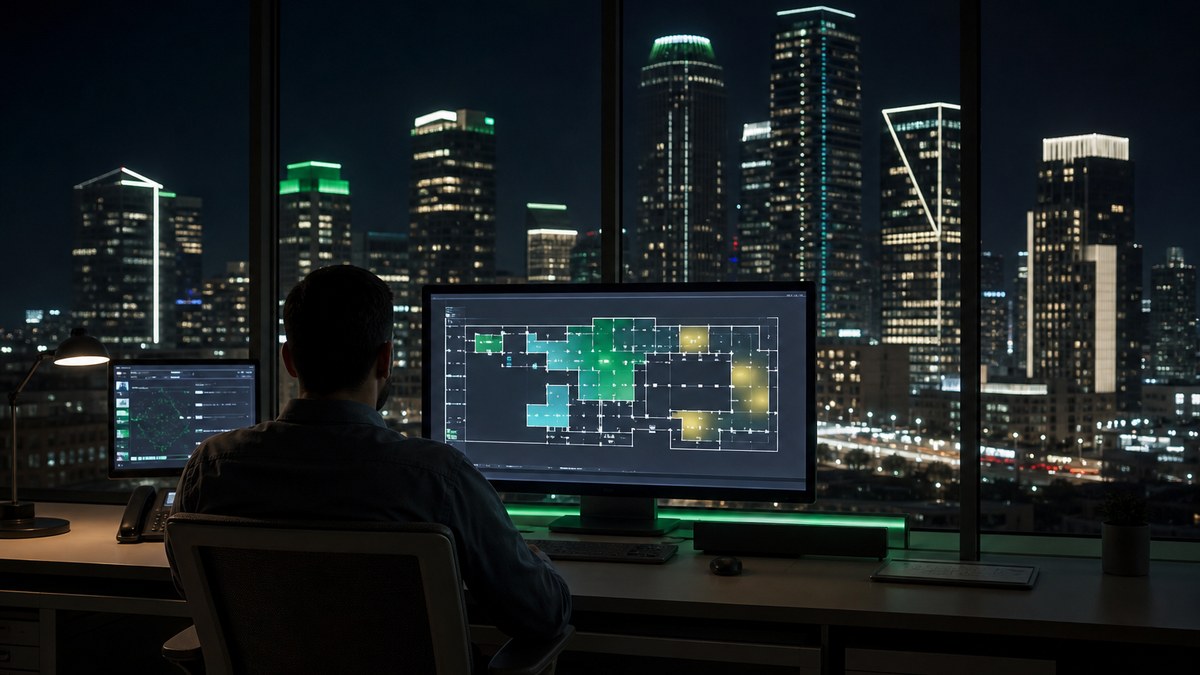
A networked lighting control system replaces that patchwork with a connected layer. Fixtures, drivers, sensors and keypads become addressable devices on a network. Software — on a local server, a building controller or a secure cloud dashboard — holds the schedules, scenes and sensor logic. Because the devices are addressed individually or in groups, you can re-zone a floor, change a ballroom look or trim the light level in a garage without pulling a single wire.
For big properties, three things make networked controls worth the effort:
- Control at scale: one schedule can manage every exterior fixture on a campus, and one keypad can recall a lobby scene that touches hundreds of lights.
- Feedback: many systems report fixture status, energy use and faults, so engineering knows what failed before a guest or tenant complains.
- Flexibility: spaces change. Tenants move, ballrooms get rebranded and towers add color shows. Addressable systems adapt in software rather than with conduit.
On large properties, the controls are where most of the long-term value lives. LED fixtures cut energy once. A well-commissioned control system keeps cutting energy, protects the design intent and makes your team faster every year after handover.
The control protocols, in plain English
There is no single “best” protocol. Large projects usually combine two or three, each doing the job it was designed for. Here is what each one is good at.
DMX512 and RDM: the language of color and show lighting
DMX512 came from the theater and concert world, and it is still the standard for dynamic lighting. A single DMX “universe” carries 512 control channels, refreshed many times per second. An RGBW fixture might use four channels; a pixel-mapped linear fixture can use dozens. That speed and granularity is why DMX drives color-changing facades, marquees, arena show lighting, nightclub and venue effects, and the architectural layer of hotel exteriors. RDM (Remote Device Management) adds two-way communication on the same cable, so technicians can address and check fixtures remotely instead of climbing to each one.
DMX is one-directional by nature and not built for occupancy sensing or energy reporting. It is the right tool for the expressive layer of a building, and usually not the right tool for the back-of-house layer.
sACN and Art-Net: DMX over the building network
Big facades and venues quickly outgrow a handful of DMX universes. sACN (streaming ACN) and Art-Net carry many DMX universes over standard Ethernet, so a media facade or an arena ring of light can be controlled from a central media server or lighting controller over fiber and network switches. For a high-rise crown or a stadium exterior, this is how hundreds of universes stay synchronized. We cover the facade side in depth in our guide to high-rise facade lighting in Dallas.
DALI and DALI-2: addressable dimming with feedback
DALI (Digital Addressable Lighting Interface, standardized as IEC 62386) was built for buildings rather than stages. Each DALI line supports up to 64 addressable control gear devices, which can be grouped and recalled in scenes. Unlike DMX, DALI is two-way: drivers can report lamp failures and status back to the controller. DALI-2 tightened interoperability and added standardized sensors and keypads, and the related D4i specification adds luminaire-level data such as energy and diagnostics. DALI is a strong fit for hotel lobbies, ballrooms, conference centers, premium office floors and anywhere smooth, consistent dimming and long-term manageability matter.
0–10V: simple and familiar, with limits
0–10V analog dimming is everywhere in commercial lighting because it is simple and inexpensive to specify. It dims groups of fixtures on the same control wiring but does not address individual fixtures or report anything back. On large projects it often survives as the fixture-level interface inside a broader networked system, with a networked sensor or controller doing the thinking.
Networked and wireless systems: sensors everywhere
Many modern systems put a sensor and a radio in or next to each fixture — luminaire-level lighting control. Fixtures sense occupancy and daylight on their own, talk to their neighbors and report to a central gateway. This is the workhorse approach for parking garages, warehouses, distribution centers, corridors and open offices, and it is a common choice in retrofits where running new control wiring would be disruptive. Our commercial LED retrofit guide shows where these systems pay back fastest.
BACnet and building integration
Large properties already run a building automation system for HVAC and other equipment. Many lighting control systems can share schedules, occupancy data and alarms with the BAS through BACnet or similar integrations, so the building has one view of what is happening. Integration should be scoped early — it is much easier to plan points lists and responsibilities before the controls are installed than after.
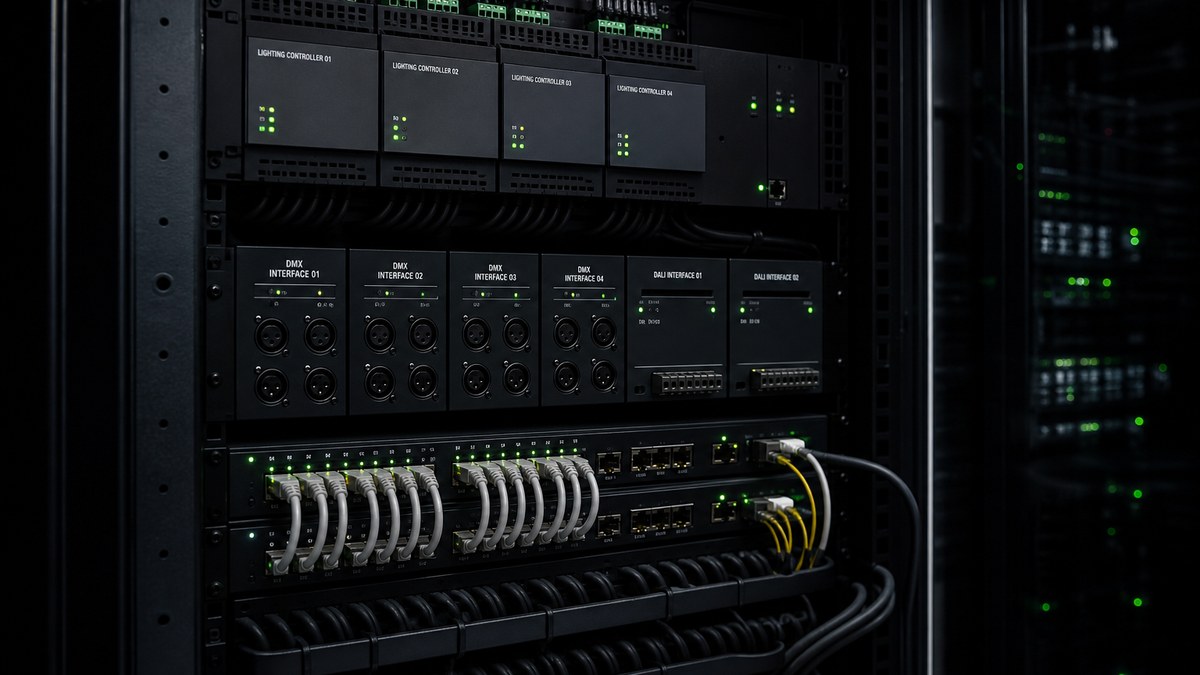
Which protocol for which space: a big-project map
Here is how these protocols typically line up on large Dallas properties. Every project is different, but this map is a good starting point for design conversations.
| Space | Main Goal | Typical Control Approach | Key Features |
|---|---|---|---|
| High-rise facade & crown | Identity, events, color | DMX over sACN / Art-Net, media server | Calendar shows, astronomical clock, migration-season dimming |
| Marquees & venue exteriors | Attention, show-night energy | DMX with show controller | Pre-built effects, event triggers, curfew schedules |
| Arena & stadium show lighting | Broadcast-ready, fan experience | DMX / sACN integrated with show control | Instant on, light shows, game-mode presets |
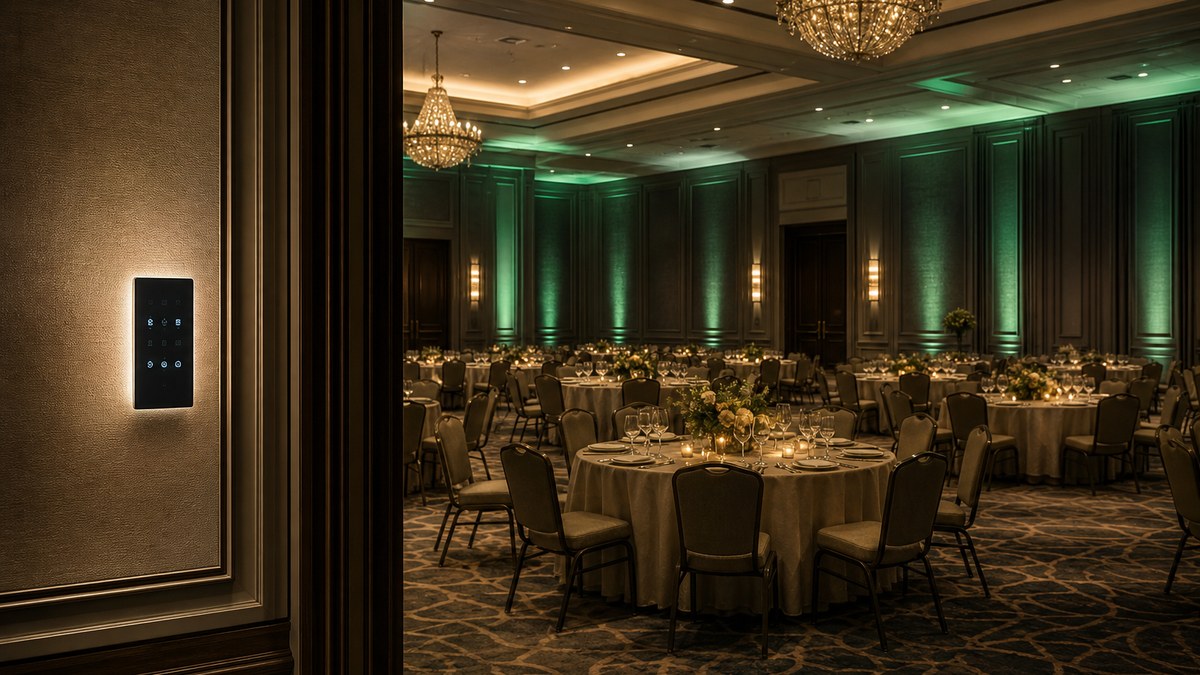
| Hotel lobbies & ballrooms | Atmosphere, flexibility | DALI-2 plus DMX for color accents | Time-of-day scenes, event presets, touch panels |
| Office floors | Comfort, code, energy | Networked sensors, DALI or 0–10V fixtures | Occupancy, daylight harvesting, high-end trim |
| Parking garages | Safety, energy | Luminaire-level wireless sensors | Dim-when-vacant, perimeter daylight zones |
| Warehouses & distribution centers | Energy, uptime | Luminaire-level networked controls | Aisle occupancy, task tuning, energy reporting |
| Site & exterior lighting | Security, code compliance | Networked exterior controls, photocells | After-hours reduction, astronomical scheduling |
The control strategies that save energy
Protocols are the plumbing. Strategies are what you actually do with them. The biggest energy and operational wins on large properties come from a handful of well-understood techniques:
- Occupancy and vacancy sensing: lights dim or turn off when a space is empty — essential in garages, stairwells, storage, restrooms and warehouse aisles.
- Daylight harvesting: fixtures near windows and skylights dim automatically when daylight is available, which matters in sunny North Texas.
- High-end trim (task tuning): new LED systems are often brighter than a space needs. Trimming the maximum output saves energy every hour the lights are on, and most occupants never notice.
- Scheduling and astronomical clocks: exterior and facade lighting follow sunset and sunrise automatically, with reduced levels late at night.
- Scene control: one button sets a whole room correctly — and prevents staff from leaving everything at full output.
- Demand response readiness: some systems can reduce lighting load on request during peak grid periods, which can be useful in hot Texas summers.
The research backs this up. A widely cited study published through the DesignLights Consortium found that adding networked lighting controls to LED installations increased energy savings by an average of about 47% beyond the savings from LEDs alone. Results vary by building type and how well the system is commissioned, but the direction is clear: LED plus controls beats LED alone.
Fixtures and controls designed as one system
Audit, lighting design, control strategy, fixture specification, licensed installation, commissioning and ongoing service — one accountable partner for hotels, venues, towers and large commercial properties across Dallas–Fort Worth.
What the Dallas energy code expects
Lighting controls are not optional on most commercial projects. The City of Dallas enforces the 2021 edition of its energy code, with local amendments, effective May 12, 2023. Surrounding cities across DFW adopt their own editions and amendments, so the exact rules depend on where your property sits.
Under the 2021 IECC and the ASHRAE 90.1 compliance path, new construction and many alterations must generally include controls such as:
- Automatic shutoff through occupancy sensors or time-switch controls in most interior spaces
- Daylight-responsive controls for qualifying daylight zones near windows and skylights
- Light reduction controls so occupants can lower light levels where required
- Exterior lighting controls that turn lights off in daylight and reduce output late at night or when a site is not in use
- Functional testing to confirm controls work as designed before the project is closed out
That last point matters. Code compliance is not only about installing sensors; it is about proving they are calibrated and operating correctly. A design team that understands both the local amendments and the commissioning requirements saves time at inspection. This is general guidance, not a code review — your design team and the local building official make the final call on any specific project.
Controls by big-project type
Each type of large property puts different demands on its lighting control system. Here is what we focus on for the big projects Dallas is known for.
Hotels and resorts
Hotels need guest-facing scenes that shift through the day, ballroom presets that staff can recall in seconds, and back-of-house sensors that run 24/7 without complaints. Exterior and facade scenes add holiday and event looks on a calendar. Our hotel LED lighting guide walks through each zone.
Arenas, stadiums and sports venues
Sports lighting control has to deliver instant on, flicker-free broadcast performance, and coordinated light shows between quarters or periods — all integrated with the venue's show control. Concourses, clubs and parking add the energy-saving layer. See our stadium and arena LED lighting guide for the full picture.
Entertainment venues and marquees
Theaters, music venues and entertainment districts depend on DMX for marquee chases, facade color and show-night energy, then need dependable schedules so everything powers down after curfew. Read more in our marquee and entertainment venue lighting guide, and coordinate signage with LED signs, marquees and pylons.
Office towers and high-rises
Towers combine all three worlds: code-driven sensors on every floor, DALI or networked dimming in amenity spaces and lobbies, and DMX for the crown and facade. Separating those layers logically — while letting them share schedules and alarms — keeps the system manageable for the building engineer.
Parking structures, warehouses and distribution centers
These are the energy heavyweights. Luminaire-level sensors that dim empty garage levels or warehouse aisles, combined with high-end trim, usually deliver the fastest payback of any control strategy on a large portfolio.
Convention, event and worship spaces
Event spaces need fast, flexible scene changes and clean integration with stage lighting and LED video walls. Houses of worship have similar needs — our church LED lighting and video wall guide covers that side.
How to plan a control system that lasts
Most lighting control problems on big projects are not technology problems. They are planning problems: scenes nobody asked for, sensors in the wrong place, and no one trained to change anything. A disciplined process avoids that.
- Start with an audit. Document existing fixtures, circuits, control devices, run hours and pain points. Our commercial lighting audit creates that baseline and supports any incentive applications.
- Write a sequence of operations. Before choosing hardware, describe how every space should behave: what happens at sunset, when a room empties, during an event, after close. This is the document everyone builds from.
- Choose protocols per layer. Expressive layer (DMX/sACN), architectural interior layer (DALI-2), and efficiency layer (networked sensors) — matched to the sequence of operations, not to a catalog.
- Design the network. Plan controllers, gateways, universes, DALI lines, network switches and IT security with the owner's IT team. Lighting networks should be segmented and documented.
- Specify fixtures and controls together. Driver compatibility, dimming curves and color consistency all depend on the control choice. This is where a coordinated design-build lighting process pays off.
- Mock up key spaces. Test scenes and sensor behavior in a lobby, ballroom bay or facade section before full rollout.
- Install in phases. On occupied properties, work is scheduled floor by floor, zone by zone and often overnight so the building stays open.
- Commission and functionally test. Address every device, calibrate sensors, verify schedules, trim levels and document the results.
- Train and hand over. Engineering staff get as-built drawings, device lists, scene descriptions and hands-on training.
- Service and tune. Spaces change. Plan for periodic tuning and software updates so the system stays aligned with how the building is actually used.
Common mistakes on large control projects
- Treating controls as an add-on. Choosing fixtures first and “adding controls later” leads to incompatible drivers and compromises.
- One protocol for everything. Forcing DMX onto back-of-house spaces or DALI onto a media facade creates cost and complexity without benefit.
- Skipping commissioning. Uncalibrated sensors cause false-offs, and frustrated occupants tape over them. Savings disappear.
- Ignoring IT. Network-connected lighting must follow the owner's security and access policies from day one.
- Proprietary dead ends. Favor open, well-supported standards and documented systems so future service is not locked to one vendor.
- No owner training. If nobody on site can change a schedule, the building will run on whatever was programmed at handover forever.
Dallas conditions that shape the design
Heat, storms and exterior hardware
Exterior controllers, power supplies and data equipment on Dallas rooftops face extreme summer heat, driving rain and hail. Enclosures, ventilation, surge protection and equipment locations need to be planned for North Texas conditions, not copied from a mild-climate spec.
Migration seasons and night-sky responsibility
Dallas sits on a major bird migration corridor. Programs such as Lights Out Texas encourage reducing nonessential exterior and upper-floor lighting during spring and fall migration. A networked facade system can switch into a reduced “migration mode” on a calendar, so a tower stays responsible without going fully dark.
Big events and fast changes
DFW hosts major sports championships, concerts and conventions — including the global soccer matches discussed in is your Dallas property World Cup ready. Properties with networked color control can join the moment with team or event scenes scheduled weeks ahead, instead of sending crews up with gels and ladders.
Incentives
Commercial lighting and control upgrades in the Dallas area may qualify for utility energy-efficiency incentive programs, such as those offered through Oncor, depending on the project and program availability. Documenting the baseline in an audit is the first step.
Choosing a lighting controls partner in Dallas
Lighting controls on a big project sit between several trades: lighting design, electrical, IT, building automation and sometimes show production. Look for a partner who can show you:
- Protocol fluency across DMX/sACN, DALI-2, 0–10V and networked sensor systems — and the judgment to mix them
- Big-project coordination with architects, MEP engineers, general contractors and owner IT teams
- Commissioning discipline with documented functional testing and as-built records
- Fixture and control specification together, so drivers, dimming and color behave as designed
- Service after handover, including tuning as spaces and tenants change
Dallas LED Lights brings 15+ years as an authorized architectural lighting dealer and project coordinator. We specify and source fixtures and controls rather than manufacturing them, and our licensed installation partner has completed over 200 major sports and commercial projects across the US and Canada — NFL, NBA, NHL, MLS, NCAA and NASCAR. Learn more about our team and our full range of lighting services.
Every property is different, so we do not publish one-size-fits-all pricing. Tell us about your building and we will prepare a project-specific proposal through our project quote form, or explore our premium lighting solutions. For background, see our complete guide to LED lighting in Dallas, our overview of commercial lighting in Dallas, and our guide to architectural LED lighting for Dallas commercial buildings. If your current system shows the warning signs your building needs a lighting audit, controls are a great place to start.
Frequently Asked Questions
What are networked lighting controls?
What is the difference between DMX and DALI?
Can one building use DMX and DALI together?
How much energy do networked lighting controls save?
Are lighting controls required by code in Dallas?
Can lighting controls be added to an existing building?
What is daylight harvesting?
Can lighting controls integrate with our building automation system?
How much does a networked lighting control system cost?
Does Dallas LED Lights handle both fixtures and controls?
Planning lighting controls for a large property?
Tell us about your building. We will review it and send a clear, project-specific proposal covering control strategy, fixtures, installation, commissioning and phasing.
Related services
Our partner network covers large projects across Texas and beyond: Fort Worth LED lighting, commercial LED lighting in Arlington, LED lighting in Plano, Irving LED lighting services, Texas-wide LED lighting, and wholesale LED solutions, plus fiber optic lighting solutions, modular building solutions, and modular structures in Dallas. For amenity spaces, see starlight ceilings and pool and amenity deck lighting.