Event Lighting in Dallas: Convention Center, Ballroom & Event-Space LED Lighting for Big Venues
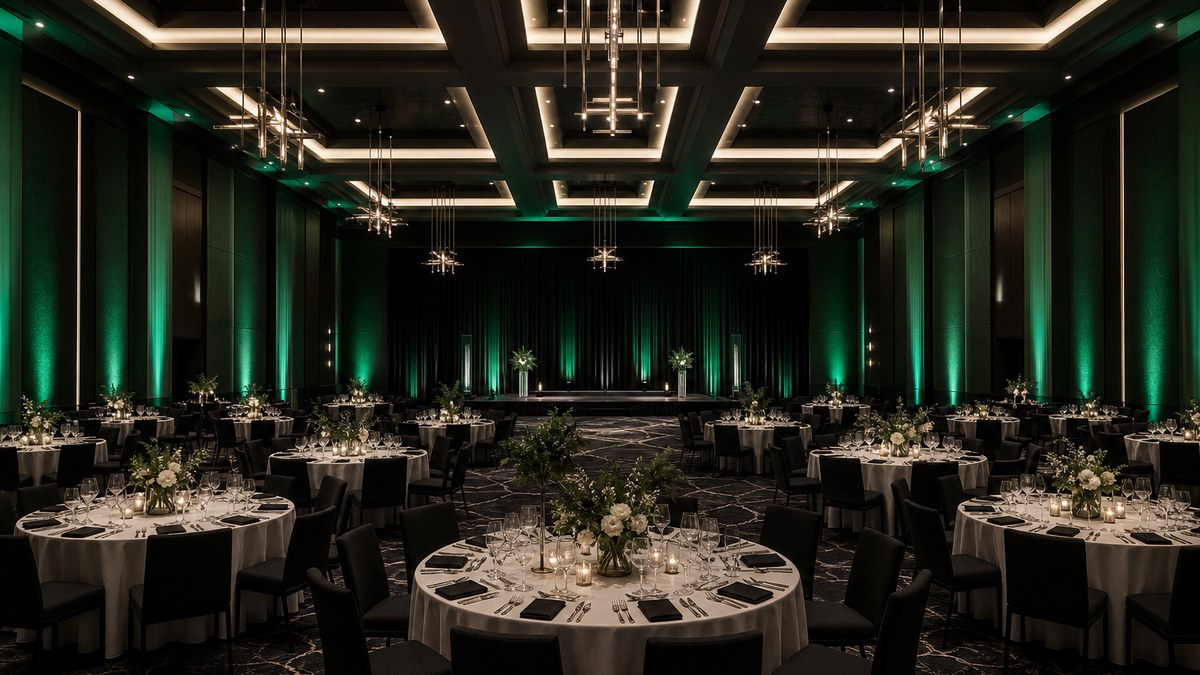
Event lighting in Dallas has changed. For convention centers, hotel ballrooms, conference centers, and large event venues, lighting is no longer a truckload of rented fixtures that arrives the morning of a show and leaves at midnight. The best venues in the metroplex now build event-ready LED lighting into the room itself — permanent, tunable, camera-friendly systems that can switch from a 7 a.m. general session to an evening gala at the touch of a panel.
That shift matters because DFW is one of the busiest meetings and events markets in the country, and competition for bookings is intense. Planners compare rooms on what they can do: how fast a ballroom turns over, how good it looks on a livestream, whether a sponsor can brand the space without renting an outside lighting package. Permanent event lighting answers those questions before the site visit is over.
This guide covers every lighting layer in a modern event space, the role of LED video walls, the control systems that tie it all together, how to upgrade a busy venue without losing bookings, and what to ask an event lighting company in Dallas before you sign. It is written for venue owners, hotel asset managers, convention and conference center operators, and developers planning large event spaces.
A permanent event lighting system for a Dallas convention center, ballroom, or large event venue should include:
- Tunable-white house lighting: dimmable, high-CRI LED that shifts from crisp daylight for meetings to warm tones for dinners
- Architectural color and accent: RGBW uplighting, coves, and wall washers that brand the room without rentals
- Camera-ready performance: flicker-free drivers and even light for livestreams, broadcasts, and phone video
- LED video walls: permanent stage backdrops and sponsor displays sized to the room and viewing distance
- Scene-based controls: DMX/sACN and DALI-2 systems with one-touch presets on a simple touch panel
- Phased installation: work scheduled around the event calendar so the venue keeps booking
Why permanent event lighting is a revenue tool
Event spaces are some of the highest-earning square footage in a hotel or venue. A ballroom or exhibit hall that books more events, turns over faster, and photographs better earns more. Lighting influences all three.
Faster turnovers. When every look is saved as a scene, staff can reset a room in minutes instead of waiting on a rental crew to refocus fixtures. Back-to-back bookings — a breakfast keynote, an afternoon breakout, an evening reception — become routine instead of a scramble.
Lower dependence on rentals. Many venues still rely on outside production companies for basic uplighting, color washes, and stage looks. A built-in system covers the most common requests in-house. Large productions will always bring extra gear, but the house system becomes the foundation they plug into rather than something they work around.
Better on camera. Almost every event is now filmed, streamed, or posted. Older dimmed fluorescent and halogen systems often flicker on video, render skin tones poorly, and leave hot spots and dark corners. Modern LED designed for camera work makes every speaker, award winner, and wedding couple look better — and that footage markets your venue for free.
A stronger sales story. Planners touring a room want to see what it can become. A sales manager who can show conference, dinner, and gala scenes from a tablet during a site visit is selling an experience, not square footage.
Think of event lighting as two systems that share one room: house lighting (general light, egress, energy code, every-day use) and show lighting (color, accent, stage, video). Designing both together — with one control platform — is what separates a modern event venue from a ballroom with a few rented uplights.
Event venue lighting layer by layer
Every great event space is built from the same set of layers. The mix changes between a 100,000-square-foot exhibit hall and a boutique hotel ballroom, but the thinking is the same.
1. Tunable-white house lighting
This is the backbone. Downlights or linear fixtures that dim smoothly to very low levels and tune color temperature — often across a range of roughly 2700K to 5000K or wider — let one room serve every kind of event. Cool, bright light keeps a morning general session alert. Warm, low light makes a dinner feel intimate. High color rendering (CRI 90 or better is a common target) keeps food, fabrics, and faces looking natural. Dimming quality matters as much as the fixture: cheap drivers drop out or stutter at the bottom of the dimming curve, which is exactly where dinners and galas live.
2. Architectural color and accent
RGBW or RGBA uplights along walls and columns, color-changing cove lighting in ceiling coffers, and wall washers on feature walls turn a neutral room into a branded environment. A corporate client gets its brand colors. A wedding gets soft blush or champagne. A sports-themed fundraiser gets team colors. When these fixtures are permanent and wired to the control system, there is no rental fee and no setup labor every time a client asks for color.
3. Decorative fixtures and chandeliers
Many Dallas ballrooms have signature chandeliers or decorative pendants. Retrofitting them with quality LED sources — with the right color temperature and smooth dimming — preserves the character of the room while cutting maintenance. Replacing lamps in a ballroom chandelier means lifts, labor, and lost booking time, so long-life LED pays off quickly in these hard-to-reach spots.
4. Stage, presenter, and production-ready positions
Event rooms need light on the stage and the presenter. Permanent front-light positions, rigging-ready points, and pre-wired power and data locations for touring production gear make it faster and safer for production companies to work in your room. Planning these positions during the design phase avoids the extension cords and ad-hoc truss that make venues look unfinished.
5. LED video walls
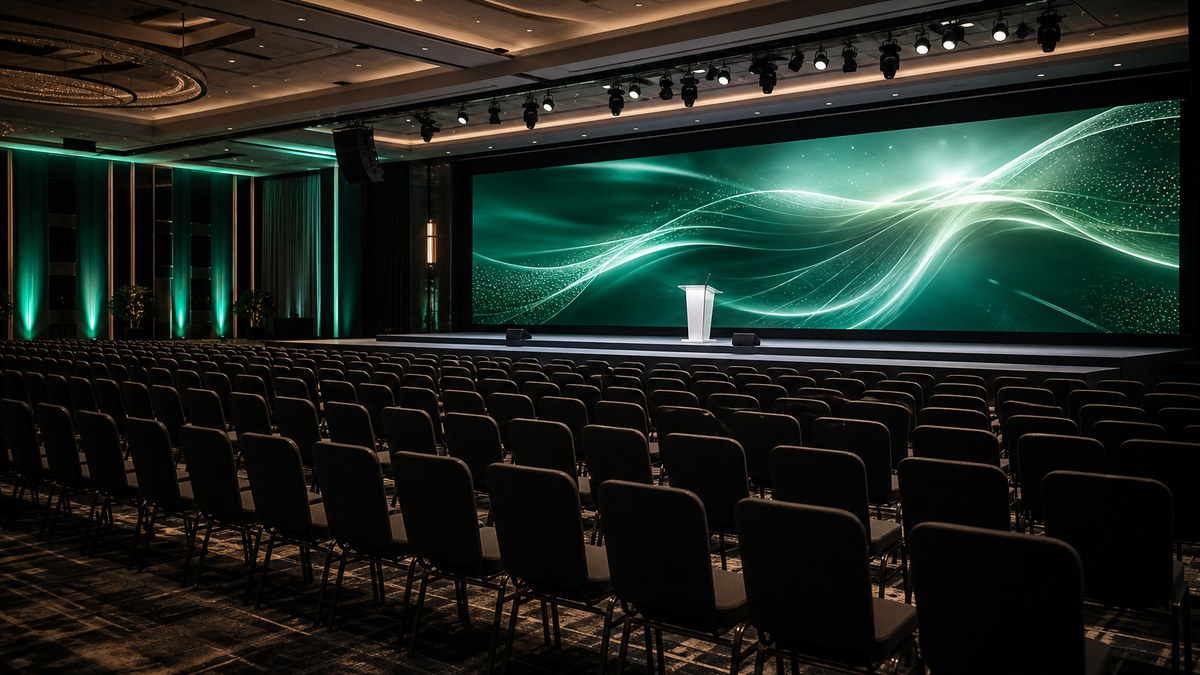
A permanent LED video wall behind the stage replaces rented screens and projectors for keynotes, award shows, worship-style events, and sponsor content. Video walls are bright enough to work with house lights up, have no projector shadows, and can be split into multiple content zones. We cover sizing and placement in detail below and in our LED video wall guide.
6. Prefunction, concourses, and lobbies
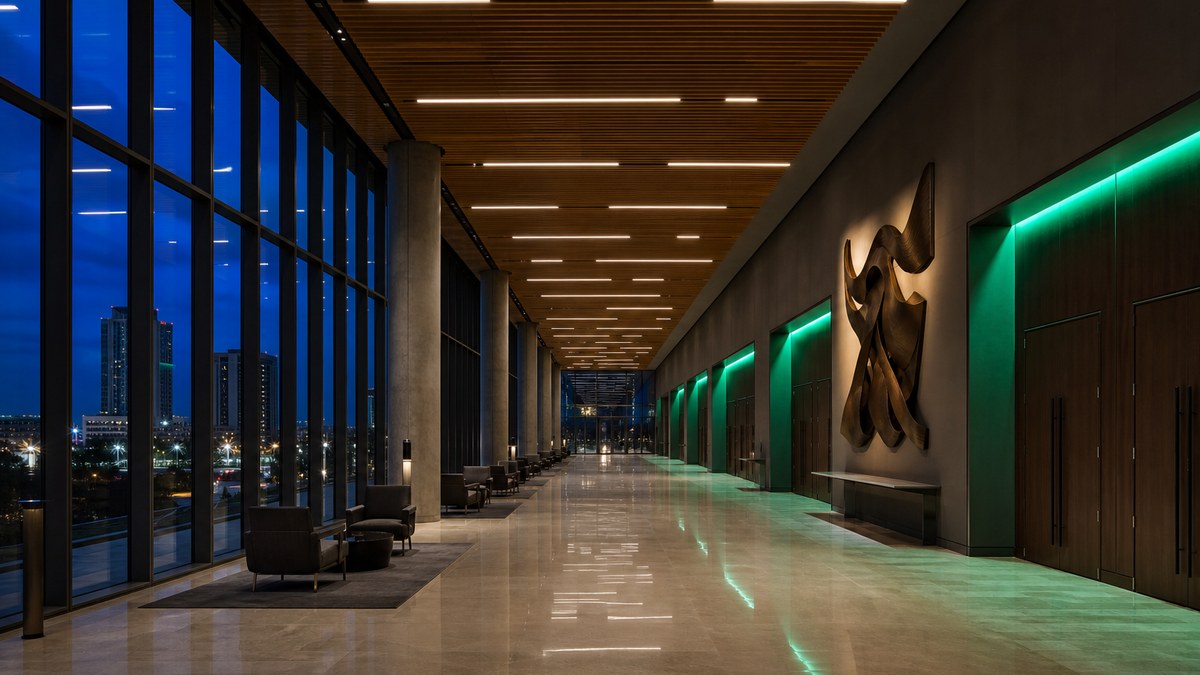
Guests experience the prefunction space before the ballroom doors open. Linear LED along concourses, accent lighting on art and architecture, and daylight-responsive controls along glass curtain walls create a premium first impression — and keep energy in check during the many hours these spaces sit empty between events.
7. Exterior, arrival, and facade
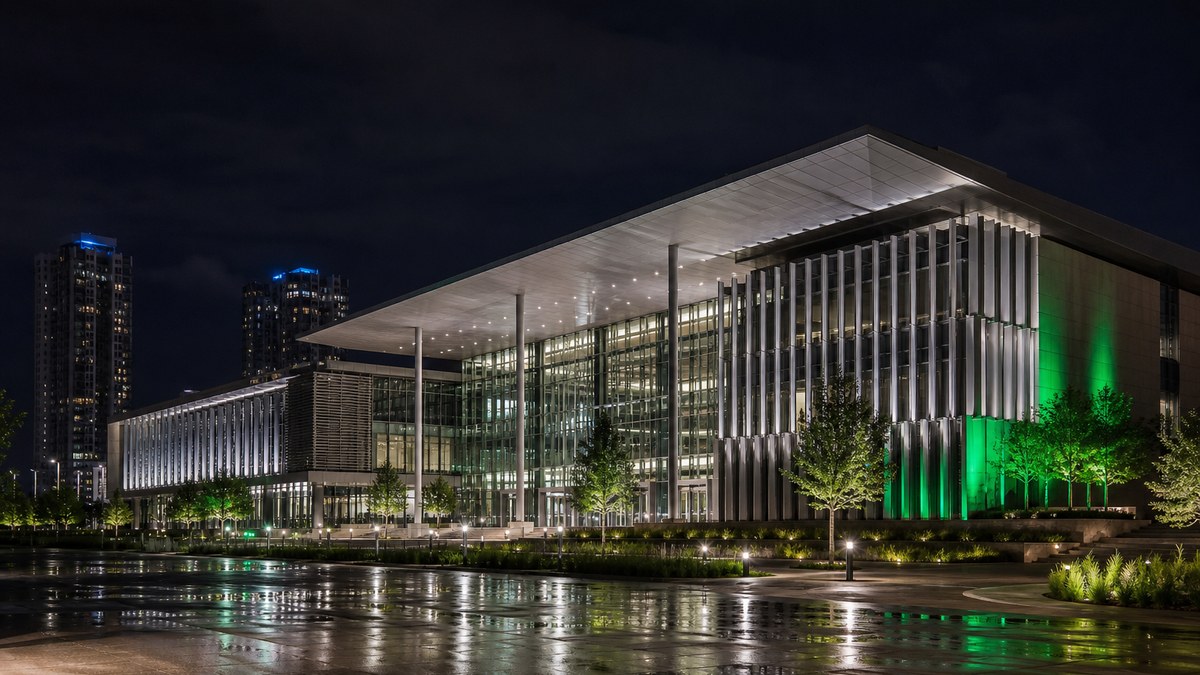
Convention centers and event venues are civic landmarks. Facade lighting, illuminated canopies, plaza lighting, and digital displays signal that something is happening inside. Color-capable exterior systems let a venue light up for a major convention, a championship, or a holiday. For larger buildings, see our guide to high-rise and facade lighting in Dallas; for marquees and venue signage, see our marquee and entertainment venue lighting guide and our partners at American LED Signage.
8. Back-of-house, loading docks, and service corridors
Kitchens, loading docks, freight corridors, storage, and exhibit-hall service areas are where efficient LED plus occupancy sensors deliver much of the energy savings. They are not glamorous, but on a large convention or conference property they can represent a big share of the connected lighting load.
Event spaces at a glance
| Space | Main Goal | Typical LED Approach | Controls |
|---|---|---|---|
| Exhibit halls | Even, efficient light; fast changeovers | High-bay LED, dimmable, zoned by hall section | Networked zones, occupancy, show/move-in/clean presets |
| Grand ballrooms | Flexibility, atmosphere, revenue | Tunable white, RGBW accent, chandelier retrofit | DMX/sACN + DALI-2, touch-panel scenes, airwall-aware zones |
| Meeting & breakout rooms | Comfort, presentations, code compliance | Tunable or warm-dim downlights, display-friendly zones | Room scene stations, occupancy, AV integration |
| Stages & general sessions | Presenter visibility, camera quality | Front-light positions, LED video wall, flicker-free drivers | DMX/sACN, production console input |
| Prefunction & concourses | First impression, wayfinding | Linear LED, accent, decorative | Daylight harvesting, time-of-day scenes |
| Exterior & plazas | Landmark presence, safety | Facade washers, canopy and plaza lighting, displays | Astronomical clock, event color scenes |
| Back-of-house & docks | Energy, safety | High-efficiency LED fixtures | Occupancy and daylight sensors |
Event lighting controls: one system, every scene
On a large event property, controls are what turn hundreds or thousands of fixtures into something a banquet captain can run from a wall panel. A well-designed control system for event space usually combines several layers, which we explain in depth in our guide to networked lighting controls in Dallas.
- DMX / sACN for show lighting: color fixtures, accent lighting, and video-wall-adjacent effects run on the same protocols touring production consoles use, so a visiting lighting designer can take control of house fixtures when needed.
- DALI-2 for house lighting: addressable dimming and tunable white with fixture-level monitoring, so engineering can see failures before a client does.
- Airwall-aware zoning: when a ballroom divides into salons, each section’s panel controls only its own lights — and recombines automatically when the walls open.
- Preset scenes: “Breakfast,” “General Session,” “Dinner,” “Dance,” “Clean,” and “Load-in” saved and locked so staff cannot accidentally break them.
- AV and building integration: lights can respond to the AV system (dim when a video plays) and report to the building automation system for scheduling and energy tracking.
- Code compliance: current commercial energy codes based on IECC and ASHRAE 90.1 require automatic shutoff and other controls in many spaces. Event rooms can meet these rules while still giving staff full manual control during events.
One partner for your entire event venue
Audit, lighting design, fixture specification and sourcing, installation, controls, video walls, and ongoing service — coordinated end to end for convention centers, hotel ballrooms, and large event venues across Dallas–Fort Worth.
LED video walls for ballrooms and convention space
Video walls have become the centerpiece of modern event rooms. Done well, they replace rented projection, add sponsor revenue opportunities, and make every general session feel like a broadcast. Done poorly, they look pixelated up close, wash out the stage, or block sight lines. Here is what matters for big rooms.
Pixel pitch and viewing distance
Pixel pitch is the distance between LED pixels, measured in millimeters. Smaller pitch means a sharper image at close range — and a higher-cost panel. A common rule of thumb is that the closest comfortable viewing distance in feet is roughly two to three times the pitch in millimeters, so the right choice depends on how close the front row sits. Ballrooms with tight front rows often need a finer pitch than large exhibit halls where the audience sits farther back.
Brightness and contrast
Indoor walls do not need outdoor brightness. In fact, a wall that is too bright overpowers the presenter on camera. Good indoor walls run at controlled brightness with high contrast and calibrated color so they match the house lighting and look natural on video.
Placement, structure, and service
A permanent wall needs a structural mounting plan, power and data routes, cooling, and front or rear service access. Many venues choose a wall that can be flown, recessed into a stage surround, or split into center and side screens. Planning these details during design avoids costly rework later.
Content and control
A video wall is only as good as what plays on it. Integration with the room’s AV system, simple input switching, and preset layouts for keynotes, sponsor loops, and wedding backdrops let in-house staff run it confidently. Larger productions can still feed it from their own media servers.
We size, specify, source, and install indoor and outdoor LED video walls for ballrooms, convention spaces, churches, lobbies, and venues. Start with our LED video wall quote page. Worship venues with event-style programming can also see our church LED lighting and video wall guide.
How to upgrade a venue without losing bookings
The event calendar is the constraint. A ballroom that goes dark for a month loses revenue that a lighting upgrade can take years to recover. The solution is a project built around the booking schedule from the first meeting.
- Lighting audit and asset survey: a room-by-room inventory of fixtures, controls, circuits, and problem areas. Our commercial lighting audit creates the baseline for design, savings, and any incentive applications.
- Event-use interviews: sales, banquet, AV, and engineering teams explain how rooms are actually sold and set. The best designs come from the people who flip the rooms every day.
- Design, mockups, and scene planning: fixture selections, color temperatures, and draft scenes — with on-site mockups in one salon or one bay before full rollout.
- Phasing around the calendar: work blocks are mapped to low-occupancy dates, divisible salons are done one at a time, and much of the installation happens overnight.
- Installation and integration: fixtures, controls, video walls, and AV integration installed by crews who understand working in occupied hospitality and venue environments.
- Commissioning and scene tuning: every zone, scene, sensor, and airwall combination tested and tuned, ideally with a real event setup in the room.
- Training and service: banquet staff learn the panels; engineering learns the system; ongoing service keeps it performing.
This audit-to-service approach is the core of our design-build lighting process, and it is how large hotel projects are phased, too — see our hotel LED lighting guide for how ballrooms fit into a full-property program.
What makes Dallas event venues different
A fast-growing convention market
Dallas is investing heavily in its convention and event infrastructure. As a public example (not a project of ours), the City of Dallas is rebuilding and expanding the Kay Bailey Hutchison Convention Center into a roughly 2.1-million-square-foot facility with about 750,000 square feet of exhibit space and a 105,000-square-foot ballroom, set to debut in 2030, according to the official convention center expansion page. Projects of that scale raise the bar for every hotel ballroom, conference center, and private event venue competing for the same meetings and events business.
Hotel-ballroom competition
DFW has large clusters of meeting hotels downtown, in the convention district, around Las Colinas, near both major airports, and along the Frisco and Grapevine corridors. When a planner is weighing several ballrooms of similar size, the one that looks better, flips faster, and needs fewer rentals wins. Lighting is one of the few upgrades that improves all three at once.
Big-event spikes
Major concerts, championships, and international events bring sudden waves of corporate hospitality, watch parties, and galas. Properties preparing for those moments — see our article on whether your Dallas property is World Cup ready — benefit from rooms that can be re-themed instantly with color, video, and saved scenes.
Heat and weather on exterior systems
Event venue facades, canopies, and plaza lighting face North Texas summer heat, dust, driving rain, and spring hail. Exterior fixtures, drivers, and displays should be rated for high ambient temperatures and harsh weather, with mounting and lens details chosen to survive storms. Getting those ratings right up front avoids early failures that are expensive to fix at height.
Energy savings, incentives, and pricing
Convention centers and hotel event spaces carry large lighting loads across exhibit halls, ballrooms, concourses, and back-of-house areas. Replacing older metal halide, fluorescent, and halogen fixtures with LED commonly reduces lighting energy by 50–75%, and adding networked controls with occupancy sensing and daylight harvesting can reduce it further. Longer LED life also means fewer lift rentals and less maintenance in tall ballroom and exhibit-hall ceilings.
Commercial properties in the Dallas area may also qualify for utility energy-efficiency incentive programs, such as those offered through Oncor, depending on the project and program availability. A proper audit documents the baseline needed to apply.
Every event venue is different — room sizes, ceiling heights, existing infrastructure, video requirements, and phasing all change the scope — so we do not publish one-size-fits-all pricing. We prepare a project-specific proposal after reviewing your property. Use our project quote form or explore our full range of commercial lighting services and premium lighting solutions.
Choosing an event lighting company in Dallas
There is a big difference between a company that rents and runs lights for one night and a partner that designs and installs a permanent system for a venue. For permanent event-space lighting, look for:
- Large-project experience: convention, hotel, arena, and multi-room venue work — not just single-room installs
- Design capability: layered lighting, scene planning, and camera-ready performance, not fixture swaps
- Controls and video expertise: DMX/sACN, DALI-2, airwall logic, AV integration, and LED video walls under one plan
- Specification and sourcing depth: fixtures with proper photometric and lifetime data, selected for the room
- Calendar-aware phasing: installation plans built around bookings, not around the contractor’s schedule
- Commissioning and training: scenes tuned in the room and staff confident on day one
- Ongoing service: a team that stays with the venue after the ribbon cutting
Dallas LED Lights brings 15+ years as an authorized architectural lighting dealer and project coordinator. Our licensed installation partner has completed over 200 major sports and commercial projects across the US and Canada — NFL, NBA, NHL, MLS, NCAA and NASCAR. We are not a manufacturer: we specify and source the right fixtures for each space, then coordinate installation, controls, and commissioning. For sports and large-assembly venues, see our stadium and arena LED lighting guide.
Event spaces are one part of a bigger picture. Owners upgrading ballrooms often tackle garages, offices, and back-of-house at the same time — our commercial LED retrofit guide covers that side. For broader context, read our architectural LED lighting guide, our overview of commercial lighting in Dallas, the complete guide to LED lighting in Dallas, and the warning signs your building needs a lighting audit. Rooftop terraces and amenity decks can add signature features such as fiber optic starlight ceilings or pool and amenity deck lighting. Learn more about our team or contact us.
Frequently Asked Questions
What is permanent event lighting for a ballroom or convention center?
Does permanent event lighting replace rental production companies?
What is tunable white lighting and why do event venues use it?
How do I make a ballroom look good on camera and livestreams?
What pixel pitch should a ballroom LED video wall have?
Can lighting work with ballroom airwalls and divisible salons?
Can a convention center or hotel upgrade event lighting while staying open?
How much energy can an event venue save with LED lighting?
How much does event venue lighting cost in Dallas?
Does Dallas LED Lights only do event spaces?
Planning a ballroom or event venue lighting upgrade?
Tell us about your venue, your event calendar, and what planners ask for. We will review it and send a clear, project-specific proposal covering design, video, controls, installation, and phasing.
Related guides & services
Our partner network covers large projects across Texas and beyond: Fort Worth LED lighting, commercial LED lighting in Arlington, LED lighting in Plano, Irving LED lighting services, Texas-wide LED lighting, and wholesale LED solutions, plus fiber optic lighting solutions, modular building solutions, and modular structures in Dallas.