Commercial LED Retrofits in Dallas: Office Towers, Parking Garages & Distribution Centers
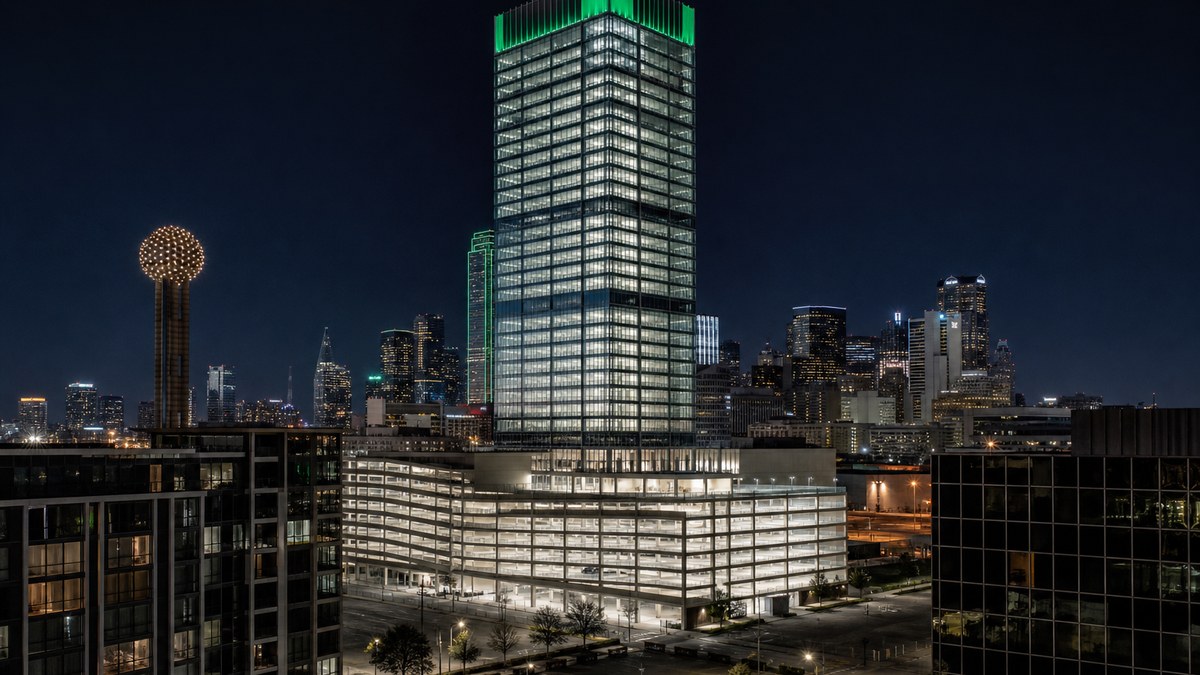
A commercial LED retrofit in Dallas is one of the few building upgrades that pays you back every hour the lights are on. For owners and asset managers of office towers, parking garages, distribution centers, and warehouses across DFW, replacing aging fluorescent, metal halide, and high-pressure sodium fixtures with LED — and adding modern controls — cuts operating costs, improves safety, and makes a property more attractive to tenants and buyers.
But large retrofits are not a box-swap. A 30-story tower, a 2,000-space garage, or a million-square-foot cross-dock facility has thousands of fixtures, dozens of circuits, tenants who cannot be disturbed, and code requirements that change the moment you touch the lighting. That is why the choice of commercial LED lighting installation in Dallas matters as much as the fixtures themselves.
This guide explains how big commercial retrofits work, what each building type needs, how controls multiply savings, how to phase work without disrupting operations, and what to ask before you hire commercial LED lighting installers for a large property.
A large commercial LED retrofit in Dallas typically follows five steps — audit, design, phasing, installation, and commissioning — and works best when one partner manages all of them:
- Office towers: LED troffers or retrofit kits, tunable or neutral white, networked controls with daylight harvesting
- Parking garages: high-uniformity LED with bi-level occupancy dimming — often the fastest payback in the portfolio
- Warehouses & distribution centers: LED high-bays with aisle and occupancy sensors for 24/7 operations
- Energy impact: LED commonly uses 50–75% less energy than the lighting it replaces; controls add more
- Disruption: phased by floor, level, or zone, often after hours, so the building keeps operating
- Incentives: projects may qualify for utility programs such as Oncor’s, depending on program availability
Why big Dallas buildings are retrofitting now
Many large commercial buildings in Dallas–Fort Worth were built or last relit in an era of T8 and T12 fluorescent tubes, metal halide high-bays, and high-pressure sodium garage fixtures. Those systems still work, but they work expensively. Lamps and ballasts fail constantly, replacement parts are harder to find, and the light quality looks dated next to newer buildings competing for the same tenants.
Three forces are pushing owners to act:
- Operating costs. Lighting is one of the largest electrical loads in offices, garages, and warehouses. Cutting it reduces net operating expenses, which directly supports property value.
- Tenant expectations. Office tenants expect bright, comfortable, glare-free spaces. Logistics tenants expect high light levels for safety and scanning accuracy. Dim, flickering buildings lose renewals.
- Maintenance burden. Every failed lamp in a 40-foot warehouse ceiling or a garage ramp means a lift, labor, and a safety risk. LED fixtures with long rated lives dramatically reduce that cycle.
If you are seeing frequent outages, uneven light, or rising utility bills, review the 7 warning signs your building needs a commercial lighting audit. Most large retrofits start there.
The best retrofit projects are planned as a portfolio, not a punch list. Start with the spaces that run the most hours — garages, stairwells, corridors, and warehouse floors — then invest in design and controls where tenants and visitors see the difference.
Retrofit vs. full replacement
“Retrofit” covers a range of approaches. Choosing the right one for each space is where an experienced design team earns its keep.
Lamp replacement (TLEDs)
Tubular LED lamps replace fluorescent tubes in existing fixtures. They are the quickest option, but they leave old housings, lenses, and sometimes ballasts in place. They suit short-term holds or spaces with limited budgets, and they usually offer the least control flexibility.
Retrofit kits
Retrofit kits replace the guts of an existing fixture — the light engine, driver, and lens — while keeping the housing in the ceiling. In office towers this avoids ceiling-tile damage and asbestos-sensitive work in older buildings, while delivering performance close to a new fixture. Many kits are controls-ready.
Full fixture replacement
New luminaires deliver the best optics, efficiency, and integrated sensors. In warehouses, garages, and exteriors, full replacement is often the right call because the old fixtures are heavy, corroded, or poorly matched to current layouts. Full replacement also lets the design team fix the light layout itself, not just the light source.
Relighting design
For lobbies, amenity floors, and building exteriors, a retrofit is the moment to rethink the look. This is where premium lighting solutions and architectural LED lighting for Dallas commercial buildings turn an efficiency project into a repositioning project.
Office towers: floors, lobbies & facades
Office towers combine almost every lighting type in one building: open office floors, private offices, conference rooms, corridors, restrooms, stairwells, mechanical rooms, the lobby, the garage, and the exterior. A tower retrofit has to respect each.
Tenant floors
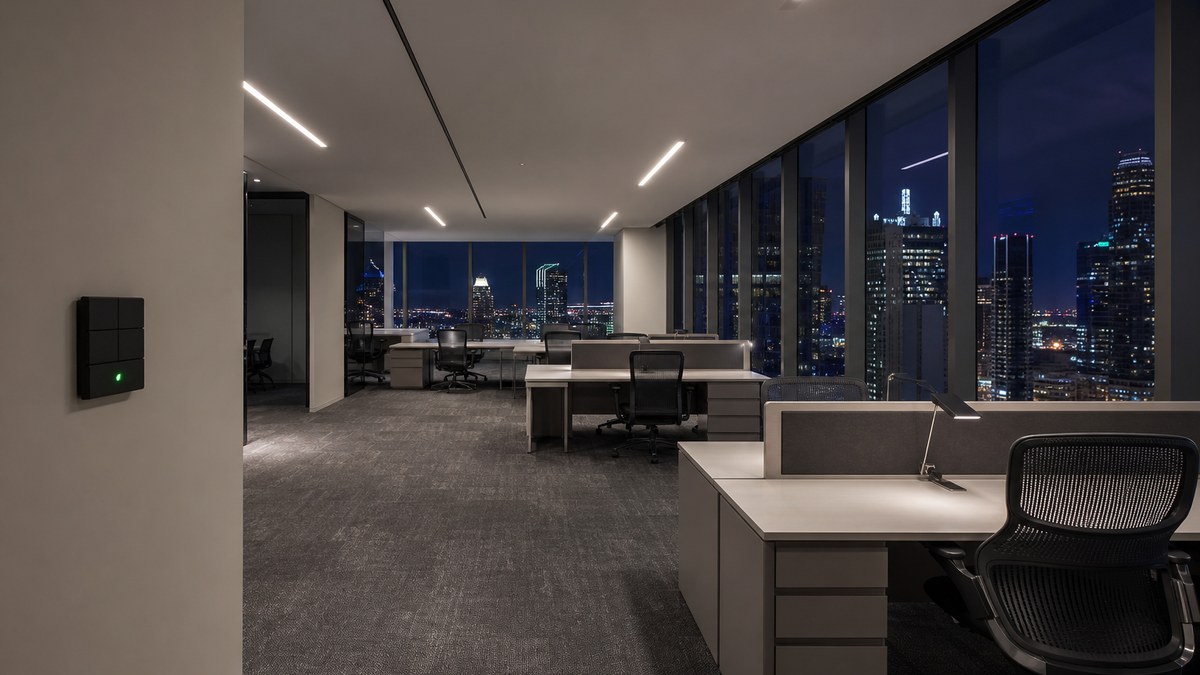
Open offices benefit from LED troffers or kits with good glare control, neutral color temperatures, and dimming. Networked controls with occupancy sensing and daylight harvesting near windows reduce energy on every floor while keeping light comfortable. Vacant floors can be lit minimally and brought up quickly for tours.
Lobbies and amenity spaces
The lobby is the building’s first impression and a leasing tool. Layered LED — cove lighting, wall washing, accent lighting on art and finishes, and decorative fixtures — makes an older lobby feel current. Some owners add an LED video wall for tenant communications, art, and branding.
Core and life-safety areas
Stairwells, corridors, and restrooms often run around the clock. LED with code-compliant occupancy controls and properly integrated emergency lighting delivers large savings while preserving required egress light levels.
Crown and facade lighting
Dallas has one of the most recognizable skylines in the country, and an office tower’s crown and facade lighting is part of its identity. Color-capable architectural LED can mark holidays, sports moments, and civic events while using far less energy than the floodlights it replaces.
Parking garage LED lighting
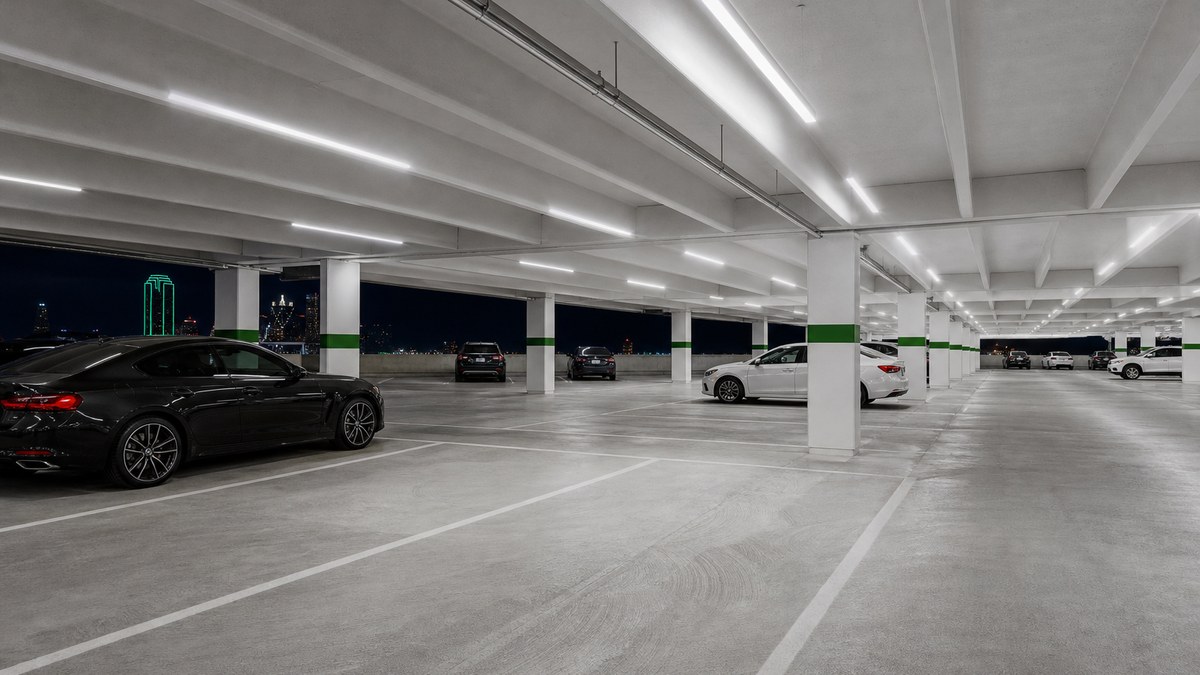
Parking structures are often the single best retrofit opportunity in a commercial portfolio. Lights frequently run 24 hours a day, older high-pressure sodium and metal halide fixtures produce orange, uneven light, and dark corners create real safety and liability concerns.
- Uniformity over raw brightness: well-designed LED garage lighting eliminates dark spots between columns and makes faces and plates easier to see on security cameras.
- Bi-level occupancy dimming: fixtures dim when no vehicles or people are present and brighten instantly when motion is detected, where code and owner policy allow.
- Daylight zones: perimeter fixtures near open sides can dim during the day.
- Durability: garage fixtures must handle Dallas heat, humidity, vehicle exhaust, and wash-downs, so housing ratings and corrosion resistance matter.
- Ramps, entrances, and stairs: transition zones at entrances need higher light levels so drivers’ eyes can adjust from bright Texas sunlight.
Because garages serve hotels, towers, hospitals, venues, and mixed-use developments alike, a garage retrofit is often bundled with other work. Our guides to hotel LED lighting in Dallas and stadium and arena LED lighting cover how garages fit into those larger properties.
Warehouses & distribution centers
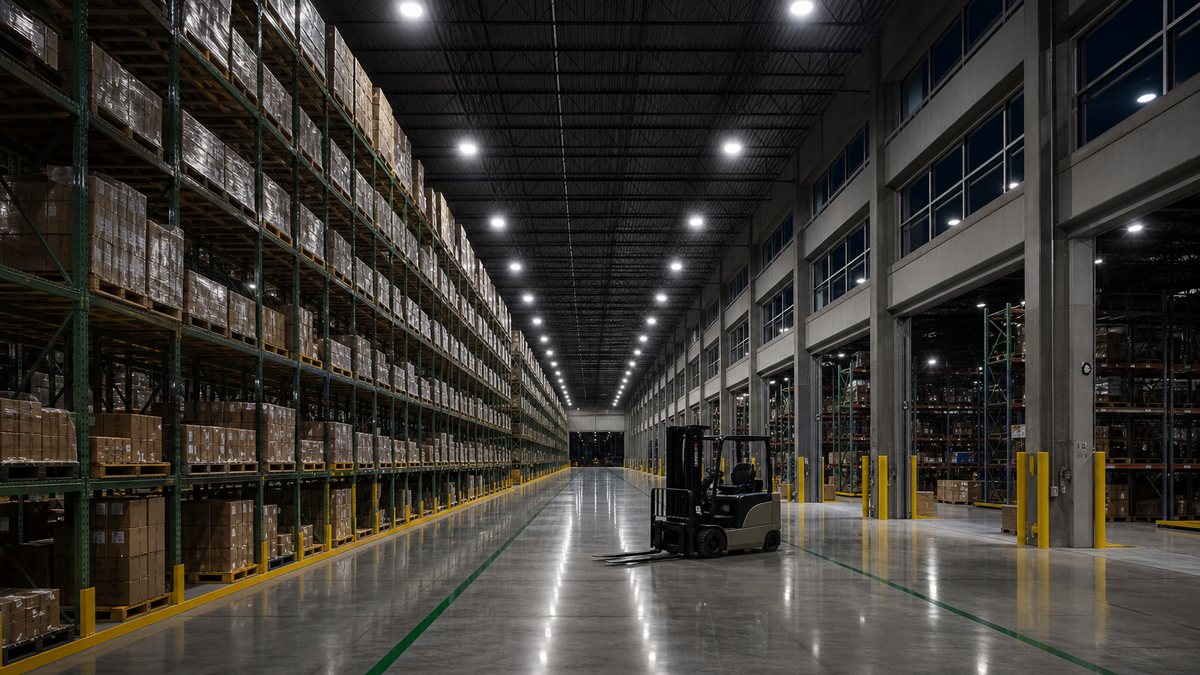
The DFW logistics market is one of the largest in the nation, with massive distribution centers along the I-35, I-20, and I-45 corridors and around the airports. These buildings have tall clear heights, long aisles, and operations that often run three shifts a day — a perfect profile for LED.
High-bay LED fixtures
LED high-bays replace metal halide and fluorescent high-bays with instant-on light, better color, and much lower energy use. Optics are chosen for the racking layout — narrow distributions for tall aisles, wider distributions for open floor and staging areas.
Aisle and occupancy controls
In aisles that are only visited occasionally, sensors can dim fixtures to a low level and bring them to full output when a forklift or picker enters. In 24/7 facilities, this alone can deliver significant savings beyond the LED conversion.
Docks, yards, and perimeter
Dock doors, truck courts, and perimeter lighting affect safety, security, and loading speed. Exterior LED area lights and wall packs with photocells and scheduling keep yards bright when needed without wasting energy at dawn and dusk.
Cold storage and harsh areas
LED performs well in cold environments where older lamps struggle to start. Fixtures for freezers, wash-down areas, and dusty spaces need the right enclosure ratings.
Building types at a glance
| Building / Zone | Typical Old Lighting | LED Approach | Controls That Add Savings |
|---|---|---|---|
| Office floors | T8/T12 fluorescent troffers | Retrofit kits or new LED troffers | Networked occupancy, daylight harvesting, scheduling |
| Lobby & amenities | Halogen, CFL downlights | Layered LED, cove and accent lighting | Time-of-day dimming scenes |
| Stairs & corridors | Fluorescent, 24/7 operation | LED with integrated emergency | Code-compliant occupancy step-dimming |
| Parking garages | High-pressure sodium, metal halide | High-uniformity LED garage fixtures | Bi-level occupancy, perimeter daylight zones |
| Warehouse floor | Metal halide, fluorescent high-bays | LED high-bays with matched optics | Aisle occupancy sensors, scheduling |
| Docks & yards | Metal halide area lights | LED area lights and wall packs | Photocells, astronomical time clocks |
| Facade & crown | Metal halide floodlights | Architectural and color-capable LED | DMX scenes and schedules |
Controls: where the second wave of savings comes from
Converting to LED is the first wave of savings. Controls are the second. On a large property, networked lighting controls connect fixtures, sensors, and schedules into one system that facility teams can see and adjust from a dashboard.
Industry research supports the investment: a widely cited study by the DesignLights Consortium and the Northwest Energy Efficiency Alliance found that networked lighting controls reduced lighting energy by an average of roughly 47% in the buildings studied, on top of efficiency gains from the fixtures themselves. Results vary by building, but the direction is clear.
- Occupancy and vacancy sensing: lights dim or switch off when spaces are empty.
- Daylight harvesting: fixtures near windows and skylights dim automatically in bright conditions.
- High-end trim: fixtures are set to the light level the space actually needs, not the maximum the fixture can produce.
- Scheduling: after-hours sweeps and astronomical time clocks for exterior lighting.
- Monitoring: fault alerts and energy data help engineering teams fix issues before tenants notice.
Controls are also a code issue. Commercial energy codes based on the IECC and ASHRAE 90.1 require automatic shutoff and other controls in many spaces when lighting is substantially altered. A qualified design team will confirm which requirements apply to your project with the local authority having jurisdiction, so the retrofit passes inspection the first time.
One partner for your entire portfolio
Audit, design, supply, installation, controls, and ongoing service — managed end to end for office towers, garages, distribution centers, hotels, and venues across Dallas–Fort Worth.
The large-project retrofit process
Big retrofits succeed or fail on planning. This is the sequence we follow through our Luminance design-build program:
- Lighting audit and asset catalog. A fixture-by-fixture survey of every space: fixture types, lamp counts, wattages, run hours, mounting heights, circuits, and problem areas. Our commercial lighting audit creates the baseline for design, savings estimates, and incentive applications.
- Design and specification. Fixture and kit selections, light levels, color temperatures, control strategy, and photometric checks for critical spaces like garages and warehouses.
- Mockups and sign-off. Sample fixtures installed on a typical floor, garage bay, or aisle so owners and tenants see the result before full rollout.
- Phasing plan. Floor-by-floor, level-by-level, or zone-by-zone scheduling built around tenants, shift changes, events, and lease deadlines.
- Installation. Licensed crews working after hours or in sectioned areas, with clear safety plans for lifts, traffic, and occupied spaces.
- Commissioning. Every sensor, schedule, and scene is tested and tuned. Uncommissioned controls are one of the most common reasons retrofits underperform.
- Close-out and service. As-built documentation, incentive paperwork support, staff training, and ongoing service.
Phasing without disrupting tenants
The biggest concern for property managers is disruption. Large buildings cannot go dark, and tenants cannot work around lifts in their aisles. Good phasing solves this:
- Office towers: work floor by floor, often at night or on weekends, with vacant floors and common areas scheduled first.
- Garages: close one level or section at a time, keeping ramps and entrances open with temporary lighting where needed.
- Distribution centers: coordinate aisle by aisle with operations, avoiding peak shipping windows and using lifts rated for the floor and rack layout.
- Mixed portfolios: sequence buildings so that early wins and lessons learned carry into the larger sites.
Energy savings & incentives
Replacing older fluorescent, metal halide, and high-pressure sodium lighting with LED commonly reduces lighting energy use by 50–75%. Because garages, stairwells, and warehouses run so many hours, savings add up quickly. Lower maintenance — fewer lamp changes, fewer lift rentals, fewer service calls — adds to the return.
Commercial properties in the Oncor service area may qualify for energy-efficiency incentive programs, such as Oncor’s commercial programs, depending on the project and program availability. Incentive programs typically require pre-approval and a documented baseline, so the audit should happen before fixtures are ordered.
Every property is different, so we do not publish one-size-fits-all pricing. Large retrofits are scoped by fixture counts, building type, controls, and phasing requirements, and we provide a project-specific proposal after reviewing your site. You can request a quote or contact our team to start the conversation.
How to choose commercial LED lighting installers
Plenty of contractors can swap a fixture. Far fewer can manage a multi-building retrofit with thousands of fixtures, networked controls, incentive paperwork, and tenants who need to keep working. Before you hire, ask:
- Large-project experience: Can they show towers, garages, distribution centers, venues, or campuses of similar scale?
- Audit capability: Will they build a fixture-level baseline, or just count fixtures from drawings?
- Design depth: Do they check photometrics and controls strategy, or simply match wattages?
- Controls commissioning: Who programs and tests sensors and schedules, and how is that documented?
- Phasing and safety: How will they keep tenants, traffic, and operations moving?
- Incentive support: Will they help document the baseline and post-retrofit conditions?
- Service after handover: Who do you call when a sensor or driver needs attention?
Dallas LED Lights brings experience on both sides of a big project. Our licensed installation partner has completed over 200 major sports and commercial projects across the US and Canada — NFL, NBA, NHL, MLS, NCAA and NASCAR. Our team brings 15+ years as an authorized architectural lighting dealer and project coordinator. Learn more about our team or browse our full list of LED lighting services.
What makes Dallas retrofits different
Heat and storms
North Texas summers push garage, rooftop, and exterior equipment hard. Drivers and fixtures should be rated for high ambient temperatures, and exterior housings and mounts should stand up to hail, wind, and driving rain.
Scale and growth
DFW keeps adding office, industrial, and mixed-use space. Older buildings compete directly with new construction for tenants, and a modern lighting system is one of the most visible ways to close that gap. Our commercial lighting guide for Dallas, TX and complete guide to LED lighting in Dallas cover the broader market.
Big-event visibility
With major concerts, conventions, and international sporting events coming to the region, owners near downtown, Arlington, and Frisco are refreshing exteriors and garages alike. See is your Dallas property World Cup ready and our guide to marquee and entertainment venue lighting in Dallas for venue-focused planning. For signage that matches a new lighting scheme, our partners at American LED Signage handle building signs, pylons, and marquees.
Frequently Asked Questions
What is a commercial LED retrofit?
How much energy does a commercial LED retrofit save?
Should I use retrofit kits or replace the fixtures?
Can a large building stay open during an LED retrofit?
Why are parking garages good candidates for LED?
What lighting is best for warehouses and distribution centers?
Do lighting retrofits have to meet energy code?
Are there incentives for commercial LED retrofits in Dallas?
How much does a large commercial LED retrofit cost?
Does Dallas LED Lights handle projects outside Dallas?
Planning a large commercial LED retrofit?
Tell us about your tower, garage, distribution center, or portfolio. We will review it and send a clear, project-specific proposal covering audit, design, installation, controls, and phasing.
Related services
Our partner network covers large projects across Texas and beyond: Fort Worth LED lighting, commercial LED lighting in Arlington, LED lighting in Plano, Irving LED lighting services, Texas-wide LED lighting, and wholesale LED solutions, plus fiber optic lighting solutions, modular building solutions, and modular structures in Dallas.