Parking Garage & Parking Lot LED Lighting in Dallas: The Big-Project Guide for Structures, Surface Lots & Event Parking
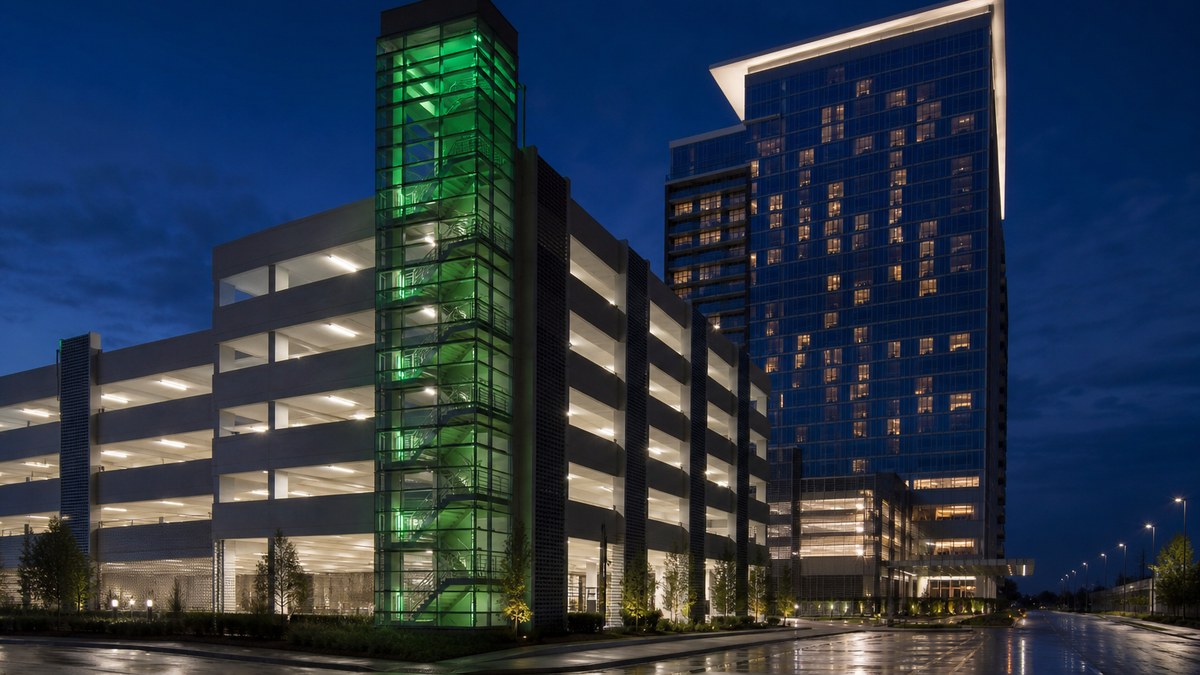
Parking garage and parking lot LED lighting in Dallas is one of the least glamorous parts of a big property — and one of the most important. For a hotel, an arena, a hospital, a corporate campus, or a mixed-use district, the parking structure is the first building most people walk through and the last place they see at night. It is where people decide whether a property feels safe. It is also where lights burn the most hours, which makes it one of the biggest energy line items on the whole site.
Across Dallas–Fort Worth, big properties are carrying thousands of parking spaces lit by aging metal halide, high-pressure sodium, and fluorescent fixtures. Those systems are dim, orange, uneven, and expensive to keep running. A well-designed LED program fixes all of that at once: brighter and more even light, better camera footage, smarter controls, and far lower energy use. The catch is that a large garage or lot is not a simple fixture swap. It is a lighting design, a controls project, a code question, and a phasing puzzle — all while cars keep moving.
This guide is for owners, asset managers, developers, and facility directors responsible for large parking structures and surface lots in DFW. It covers how much light a garage and a lot actually need, how the energy code shapes controls, what makes Dallas parking different, and how a big parking lighting project runs from audit to handover without closing a single level.
A big-property parking garage or parking lot LED lighting project in Dallas should cover:
- Light levels to IES guidance: even, glare-free light designed with photometrics — not just “brighter”
- Uniformity and vertical light: so faces, plates, and pedestrians are visible to people and cameras
- Entrances and transitions: extra daytime light at garage entries so drivers’ eyes can adjust
- Controls: occupancy dimming, daylight sensing near openings, and dusk-to-dawn schedules for lots
- Energy impact: LED commonly uses 50–75% less energy than the older lighting it replaces, and controls add more
- Installation: phased level by level and zone by zone, often overnight, so parking stays open
Why parking is a big-project lighting problem
Most lighting in a building switches off at some point. Parking garage lighting usually does not. Interior decks of a structured garage have little or no daylight, so fixtures often run all day and all night, every day of the year. Surface lots run from dusk to dawn, which in North Texas winters can mean thirteen or more hours a night. Multiply those hours by hundreds or thousands of fixtures on a big property and parking quickly becomes one of the largest lighting loads on the site.
The U.S. Department of Energy built an entire national campaign around that fact. Through the Lighting Energy Efficiency in Parking (LEEP) campaign, run with partners including BOMA, IFMA, the International Parking Institute, and the Better Buildings Alliance, participants upgraded more than 540 million square feet of parking facilities, saving about 137 million kilowatt-hours a year, according to a Building Design + Construction report on the DOE results. The same report notes that high-efficiency parking lighting can deliver energy savings of up to 70%.
Energy is only half the story. Parking is also where most security incidents, slips, and fender-benders happen on a commercial property, and where guests form a quick judgment about whether the place is well run. Dim corners, flickering tubes, and orange sodium light all send the same message: nobody is watching. Crisp, even white light sends the opposite one.
On many big properties, the parking structure is the single fastest-payback lighting project on the site — because it runs the most hours. Start your property-wide lighting plan in the garage, then use those savings to fund the lobby, facade, and venue lighting guests notice most.
Which big properties need parking lighting done right
Every big project in DFW comes with parking, and each type uses it differently. A good lighting plan starts with how the property actually operates.
Hotels and resorts
Hotel garages serve guests arriving late, valet staff moving quickly, and service vehicles at all hours. Lighting has to feel safe and welcoming, match the brand’s arrival experience, and keep cameras useful. We cover the guest side in our hotel LED lighting guide.
Arenas, stadiums, and entertainment venues
Event parking goes from empty to full to empty again in a few hours. Lighting needs to handle huge pedestrian surges after a game or concert, then drop back to a security level for the rest of the night. See our stadium and arena lighting guide and our guide to marquee and entertainment venue lighting for the venue side.
Hospitals and medical campuses
Healthcare garages run around the clock for staff shift changes, patients, and visitors who may be stressed or unfamiliar with the campus. Clear wayfinding and even light matter as much as energy. Our hospital and campus lighting guide covers the wider site.
Office towers, mixed-use districts, and retail centers
Office garages see heavy weekday use and almost none on weekends, which makes occupancy controls especially valuable. Mixed-use and retail parking runs late into the evening and needs to support restaurants, shoppers, and residents at once. See our guide to shopping center and mixed-use lighting and our breakdown of commercial LED retrofits for office towers and garages.
Airports, logistics, and large campuses
Remote lots, employee parking, truck courts, and trailer yards cover enormous areas with tall poles. Here the goals are uniformity, low glare, smart dusk-to-dawn controls, and fixtures that hold up to Texas weather for years. Industrial sites are covered in our industrial and manufacturing lighting guide and data campuses in our data center lighting guide.
How much light a garage and a lot actually need
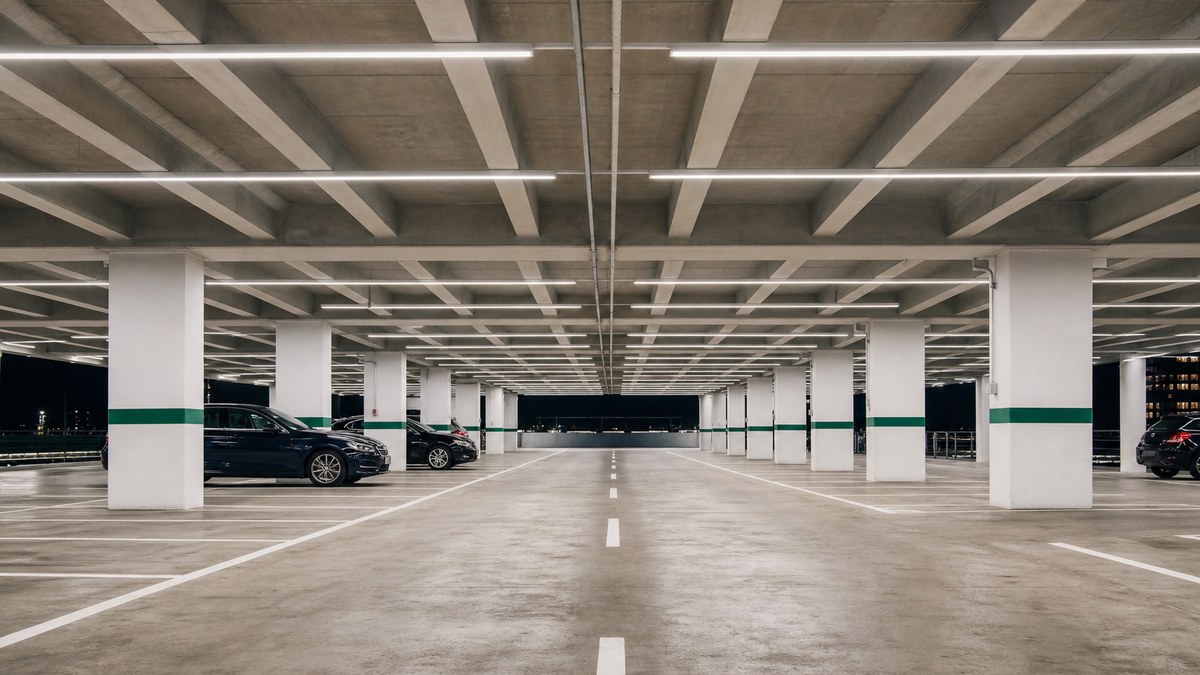
The goal of good parking lighting is not maximum brightness. It is the right amount of light, spread evenly, with vertical light on faces and vehicles and as little glare as possible. Too much light wastes energy, causes glare, and spills onto neighbors. Too little, or light that is uneven, leaves dark pockets where people feel unsafe and cameras see nothing.
The Illuminating Engineering Society (IES) publishes the main North American guidance for parking facilities. As summarized by ASIS International’s Security Management, IES recommends a minimum of about 0.2 footcandles of horizontal light for regular surface parking with a maximum-to-minimum uniformity ratio of 20:1, and a higher minimum of about 0.5 footcandles with a tighter 15:1 ratio for enhanced-security parking. The same article cites the ASIS security manual: around 5 footcandles of horizontal light with a 4:1 uniformity ratio provides an adequate level of security in parking structures, and cash-collection and vehicle access control points should be lit to at least 5 footcandles.
What those numbers mean in practice:
- Uniformity matters more than peak brightness. A lot with very bright spots under each pole and dark gaps between them can meet an average target and still feel unsafe. Good LED optics spread light evenly between poles.
- Vertical light is what people and cameras see. Faces, license plates, and pedestrians stepping out between cars are vertical surfaces. Fixture placement and optics should put light on them, not just on the pavement.
- Glare destroys visibility. Unshielded fixtures pointed at drivers’ eyes or straight into camera lenses make it harder to see. Full-cutoff optics and careful aiming solve this.
- Every zone is different. Pay stations, elevator lobbies, stair towers, and pedestrian crossings need more light than general parking rows.
The only way to get these right on a big property is a photometric design — a computer model of light levels across every deck and every part of the lot, built from the actual fixture data. It is also how you prove to a city, a lender, or an insurer that the design meets the target before anything is installed.
Parking structure lighting zone by zone
A multi-level garage is not one space. It is a set of zones that each need something different.
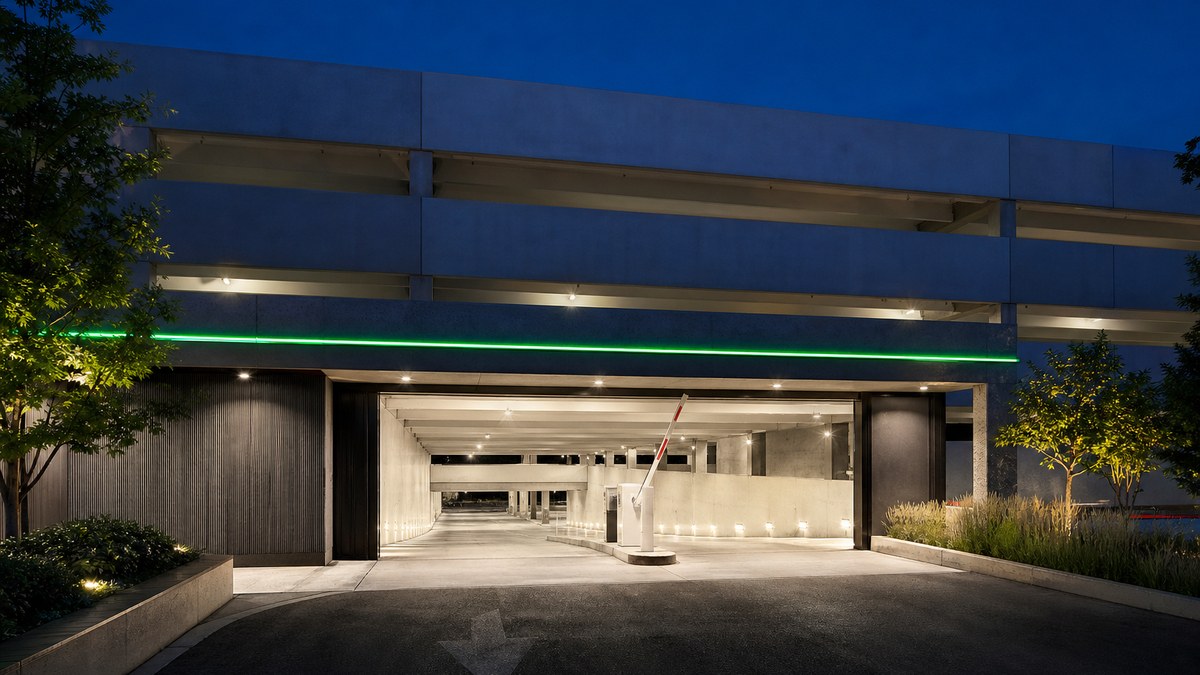
Entrances, exits, and the daytime transition
On a sunny Dallas afternoon, a driver pulling into a dark garage is momentarily blind. That is why garage entries get extra daytime “transition” lighting, which steps the light level down gradually so eyes can adjust. At night, that extra light is not needed, so a well-designed system dims it automatically after sunset. The 2021 IECC requires exactly that, according to the Lighting Controls Association’s summary of the 2021 IECC: entrance and exit lighting must be reduced by at least 50 percent between sunset and sunrise.
Drive aisles and parking rows
The bulk of the fixtures. Linear or low-profile LED fixtures with wide optics, placed over drive aisles and between parking rows, give even light across the deck. Fixture height is often limited by low ceilings, beams, sprinkler pipes, and ductwork, so the layout has to be coordinated with everything else in the structure.
Perimeter decks near openings
Open garage decks get real daylight near the perimeter. Daylight sensors dim or switch off fixtures along the open edges during the day, which saves energy on every sunny afternoon — and Dallas has a lot of sunny afternoons.
Ramps, helixes, and the roof deck
Ramps need even light with no bright-dark cycling as drivers turn. The top deck is an exterior space: it needs pole-mounted or wall-mounted fixtures rated for full sun, heat, wind, and hail, with optics that keep light out of neighboring windows and off the street.
Elevator lobbies, stairs, and pay stations
These are where people stop, wait, and make decisions. They need higher light levels, warmer and more welcoming color, clear signage and wayfinding, and emergency lighting that works when the power doesn’t. Illuminated level identifiers and wayfinding signs can be designed alongside the lighting by our partners at American LED Signage.
Emergency and egress lighting
Garages need emergency lighting along exit paths. As the ASIS article summarizes, NFPA guidance calls for emergency lighting that comes on within 10 seconds of a power loss and lasts 90 minutes, with an average of at least 1 footcandle along exit paths at the start. On a big project, emergency fixtures, battery units, or generator-fed circuits are designed together with the normal lighting, not added afterward.
Parking lighting plan at a glance
| Zone | Main Goal | Typical LED Approach | Controls |
|---|---|---|---|
| Garage entrances & exits | Eye adaptation, safe entry | Higher-output transition fixtures near the opening | Daytime boost, automatic night reduction |
| Drive aisles & parking rows | Even light, visibility | Low-profile linear LED with wide optics | Occupancy dimming by zone |
| Perimeter decks | Use free daylight | Same fixtures as aisles | Daylight sensors near openings |
| Ramps & helixes | No bright-dark cycling | Continuous, evenly spaced fixtures | Occupancy dimming with safe minimums |
| Roof deck | Exterior safety, no spill | Full-cutoff pole or wall fixtures, Texas-rated | Dusk-to-dawn schedule, after-hours dimming |
| Elevator lobbies, stairs, pay stations | Welcome, wayfinding, security | Higher-level, warmer accent and task light | Always-on minimums, scheduled scenes |
| Surface lots | Uniformity, low glare | Full-cutoff LED area lights on poles | Photocell, schedules, occupancy dimming |
| Emergency & egress | Safe exit in a power loss | Battery or generator-backed fixtures | Monitored self-testing where specified |
Surface parking lot LED lighting for big sites
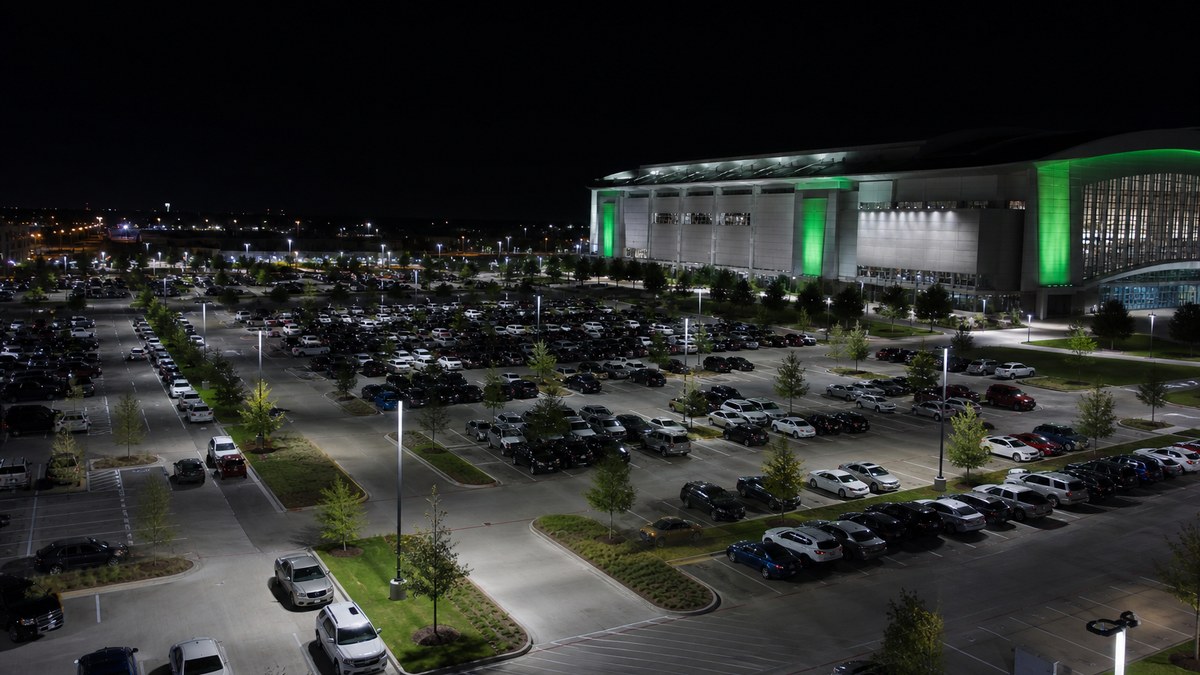
Large surface lots — at arenas, hospitals, shopping centers, corporate campuses, and logistics sites — are a different lighting problem from garages. The fixtures sit on tall poles, the areas are huge, and the light has to stop at the property line.
- Pole layout and height: fewer, taller poles with the right optics can light a lot more evenly than many short ones — but height, spacing, and optics have to be modeled together. Existing poles and bases can often be reused if they are structurally sound.
- Full-cutoff optics: LED area lights with full-cutoff or shielded optics put light on the pavement instead of the sky, neighbors’ windows, or drivers’ eyes. Many DFW cities have outdoor lighting rules that limit light trespass and glare.
- Color and camera performance: neutral white LED gives cameras far better color and detail than old orange sodium lights, which makes footage useful when it matters.
- Dusk-to-dawn controls: photocells and schedules turn lots on and off automatically, and after-hours dimming cuts energy when lots are empty.
- Wind and hail ratings: pole-top fixtures in North Texas face storms, high winds, and hail. Housings, lenses, and pole calculations should be checked for the site.
Lots also include the edges people walk through: landscape paths, plazas, and building approaches. Treating those as part of the same plan keeps the whole site consistent. On resort and amenity properties, deck and pool areas next to parking can be coordinated with our partners at premium pool lighting.
One partner for every garage, lot & building
Audit, photometric design, fixture sourcing, installation, controls, and ongoing service — handled end to end for hotels, venues, campuses, and large commercial properties across Dallas–Fort Worth.
Controls: where parking lighting really saves
LED fixtures cut energy on their own. Controls are what make parking lighting smart — and on big properties they are often required by code. According to the Lighting Controls Association’s summary of the 2021 International Energy Conservation Code (IECC), the model code behind many current commercial energy codes:
- Garage lighting must be controlled by an occupancy sensor or a time-switch control, with occupancy-based light reduction after 20 minutes without activity and control zones no larger than 3,600 square feet.
- Garage entrances and exits must reduce their lighting by at least 50 percent between sunset and sunrise.
- Daylight-responsive controls must be able to dim down to 15 percent of full output or lower.
- Exterior lighting must turn off when there is enough daylight, and dusk-to-dawn lighting must be reduced by at least 50 percent after hours.
- Parking lot luminaires over 78 watts mounted 42 feet or lower need occupancy sensing that reduces power by at least 50 percent after 15 minutes without activity, in zones of no more than 1,500 watts.
Which edition applies depends on the city and the project, so always confirm the locally adopted code. But the direction is clear: modern parking lighting is expected to dim when nobody is there.
In practice, the best parking control systems do more than meet code:
- High-low dimming instead of off: fixtures drop to a safe minimum level when an area is empty and brighten instantly when a car or person enters. Nobody walks into a dark deck.
- Event modes: venue garages can run full output for post-event surges, then step down automatically once traffic clears.
- Networked monitoring: facility teams see failed fixtures, energy use, and schedules from one dashboard instead of walking every deck.
- Security tie-ins: lighting can respond to access control or camera events where the property’s security plan calls for it.
We go deeper on control systems in our guide to networked lighting controls for large properties.
What makes Dallas parking different
Heat on the roof deck
Top-deck and surface-lot fixtures sit in full Texas sun through long summers. Drivers and housings should be rated for high ambient temperatures, and fixtures should be specified with real thermal data, not just a lumen number.
Storms, wind, and hail
Spring storms bring hail and high winds across DFW. Lens materials, housing ratings, and pole and mounting details all matter for exposed fixtures. Specifying for the weather up front prevents early failures that are expensive to fix on a 30-foot pole.
Big events and sudden crowds
Dallas–Fort Worth hosts major sporting events, concerts, conventions, and international crowds. Properties near venues see sudden parking surges and media attention. If your property is preparing for global events, see is your Dallas property World Cup ready.
Many cities, many rules
A portfolio that spans Dallas, Fort Worth, Arlington, Irving, Plano, and Frisco may face different adopted energy codes and outdoor lighting rules in each city. A partner who designs to the local requirement on every site saves time at permitting and inspection.
Incentives
Commercial properties in the Dallas area may qualify for utility energy-efficiency incentive programs, such as those offered through Oncor, depending on the project and program availability. Many programs need pre-approval before old fixtures are removed, so check before demolition — a big-property lighting audit documents the baseline you need.
How a big parking lighting project runs without closing
Owners’ number one concern is keeping parking open. A large garage or lot upgrade can be done level by level and zone by zone while cars keep moving. Here is how a typical big project runs.
- Audit and baseline: a deck-by-deck and lot-by-lot survey of fixtures, run hours, light levels, controls, problem areas, and emergency lighting. Our commercial lighting audit creates the energy baseline and incentive documentation.
- Photometric design: modeled light levels, uniformity, and glare for every zone, with fixture options and a controls narrative that meets the local code.
- Mockup: a test bay or a few poles installed first so owners, security, and operations can see the result before full rollout.
- Phasing plan: one level, one section, or one lot zone at a time, scheduled around shift changes, events, and peak hours, with temporary light where needed.
- Installation: crews work with traffic control and lifts in coned-off sections, often overnight on busy properties.
- Commissioning: every sensor, time delay, daylight zone, schedule, and emergency fixture is tested and tuned — and light levels are spot-checked against the design.
- Training and service: facility teams learn the system, and ongoing service keeps it performing year after year.
This is the same design-build approach we explain in design-build lighting in Dallas: one partner from concept through commissioning, so nothing falls between the designer, the supplier, and the installer.
Choosing a parking lighting partner in Dallas
Big parking projects are not catalog orders. Look for a partner who can show you:
- Big-property experience — garages and lots attached to hotels, venues, campuses, and towers, not just small retail lots
- Photometric design — modeled light levels and uniformity, not a one-for-one fixture count
- Controls and code knowledge — occupancy, daylight, and schedule controls commissioned to the locally adopted code
- Security awareness — layouts designed with the property’s camera and security plan
- Phasing discipline — work plans that keep parking open and safe
- Service after install — a team that stays with the property
Dallas LED Lights is an authorized architectural lighting dealer and project coordinator. We do not manufacture fixtures; we specify and source the right fixtures for each project and coordinate design, installation, and controls. Our team brings 15+ years as an authorized architectural lighting dealer and project coordinator, and our licensed installation partner has completed over 200 major sports and commercial projects across the US and Canada — NFL, NBA, NHL, MLS, NCAA and NASCAR.
Parking is often the first phase of a larger plan. Owners frequently follow a garage upgrade with high-rise facade lighting, lobby and venue upgrades, or a full property program under our premium lighting solutions. Learn more about our team, explore our full services and commercial lighting services, or read our complete guide to LED lighting in Dallas. If your garage shows the warning signs it needs a lighting audit, start there.
Frequently Asked Questions
How much energy can a parking garage save with LED lighting?
How much light does a parking lot need?
How bright should a parking garage be?
Are lighting controls required in parking garages?
Can a parking garage stay open during an LED upgrade?
Is LED parking lot lighting better for security cameras?
Can existing parking lot poles be reused?
Do parking lighting upgrades qualify for incentives in Dallas?
How much does a parking garage lighting project cost?
Does Dallas LED Lights handle other big projects besides parking?
Planning a parking garage or large lot upgrade?
Tell us about your property. We will review it and send a clear, project-specific proposal covering photometric design, fixtures, controls, installation, and phasing.
Related services
Need help with a project elsewhere? Contact us through our contact page. Our partner network covers large projects across Texas and beyond: Fort Worth LED lighting, commercial LED lighting in Arlington, LED lighting in Plano, Irving LED lighting services, Texas-wide LED lighting, and wholesale LED solutions, plus fiber optic lighting solutions, modular building solutions, and modular structures in Dallas.