Warehouse Lighting in Dallas: The Big-Project Guide for Distribution Centers, Cross-Docks & Logistics Campuses
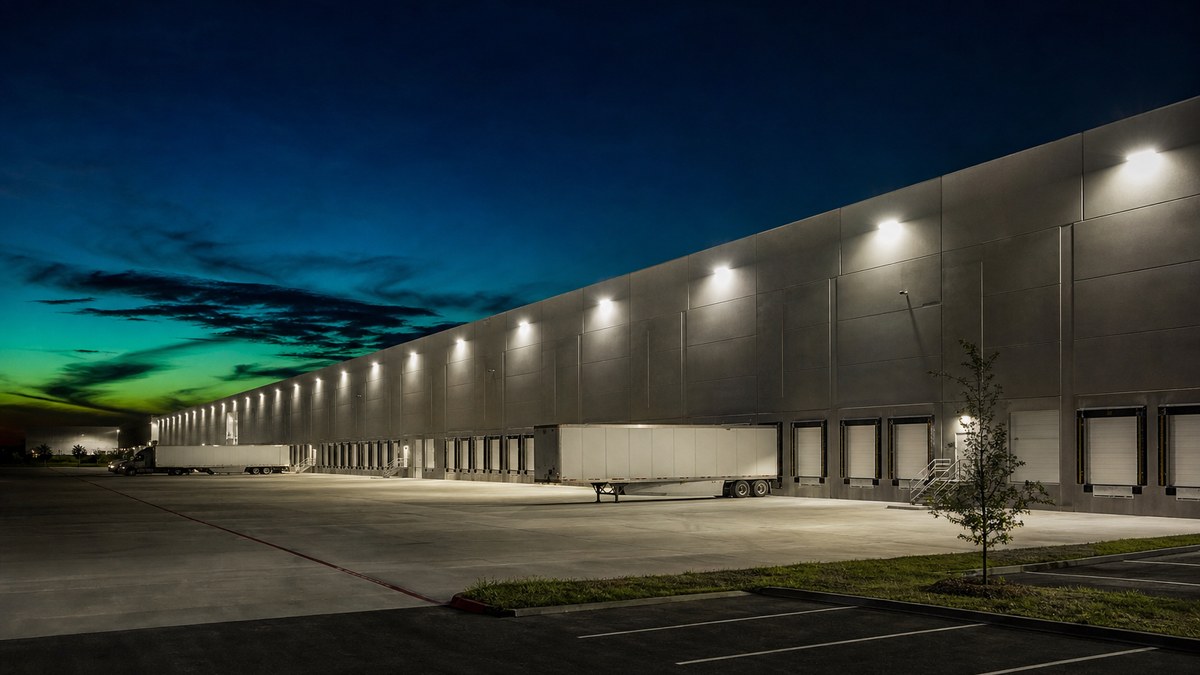
Warehouse lighting in Dallas has become a big-project discipline. The buildings going up across Dallas–Fort Worth are no longer small storage boxes — they are million-square-foot distribution centers, cross-docks with a hundred or more dock doors, e-commerce fulfillment buildings with automated systems, and logistics campuses with several buildings, truck courts, and trailer yards on one site. In buildings like these, lighting runs long hours over enormous floor areas, and every decision about fixtures, controls, and layout shows up in the energy bill, in picking accuracy, and in safety for years.
DFW is one of the busiest industrial markets in the country. According to CBRE’s Q3 2026 Dallas/Fort Worth industrial figures, the region had 33.91 million square feet of industrial space under construction — leading the nation — while overall vacancy tightened to 7.8% and quarterly leasing volume reached 23.5 million square feet. Every one of those new buildings needs a lighting design, and every existing building competing for tenants needs lighting that looks and performs like new.
This guide is for developers, owners, asset managers, 3PL operators, and facility directors responsible for large warehouses and distribution centers in North Texas. It covers how big-box warehouse lighting differs from ordinary commercial lighting, the zones every distribution center has to plan for, how the energy code shapes controls, what Texas heat and weather mean for fixtures, and how a large warehouse lighting project runs without shutting down a single shift.
A big-project warehouse or distribution center lighting plan in Dallas should cover:
- Aisle-by-aisle design: fixtures and optics laid out over rack aisles so light lands on rack faces and labels, not on top of the racks
- Zone planning: storage aisles, open staging, cross-dock lanes, docks, mezzanines, offices, and the truck court each get their own approach
- Controls: aisle-level occupancy sensing, time schedules, and daylight dimming under skylights — much of it required by the energy code
- Energy impact: LED commonly uses 50–75% less energy than the metal halide or fluorescent lighting it replaces, and controls add more on top
- Texas-ready hardware: fixtures rated for hot roof-deck temperatures inside and for heat, hail, and wind outside
- Phasing: installed bay by bay and shift by shift so receiving, picking, and shipping never stop
Why warehouse lighting in Dallas is a big-project problem
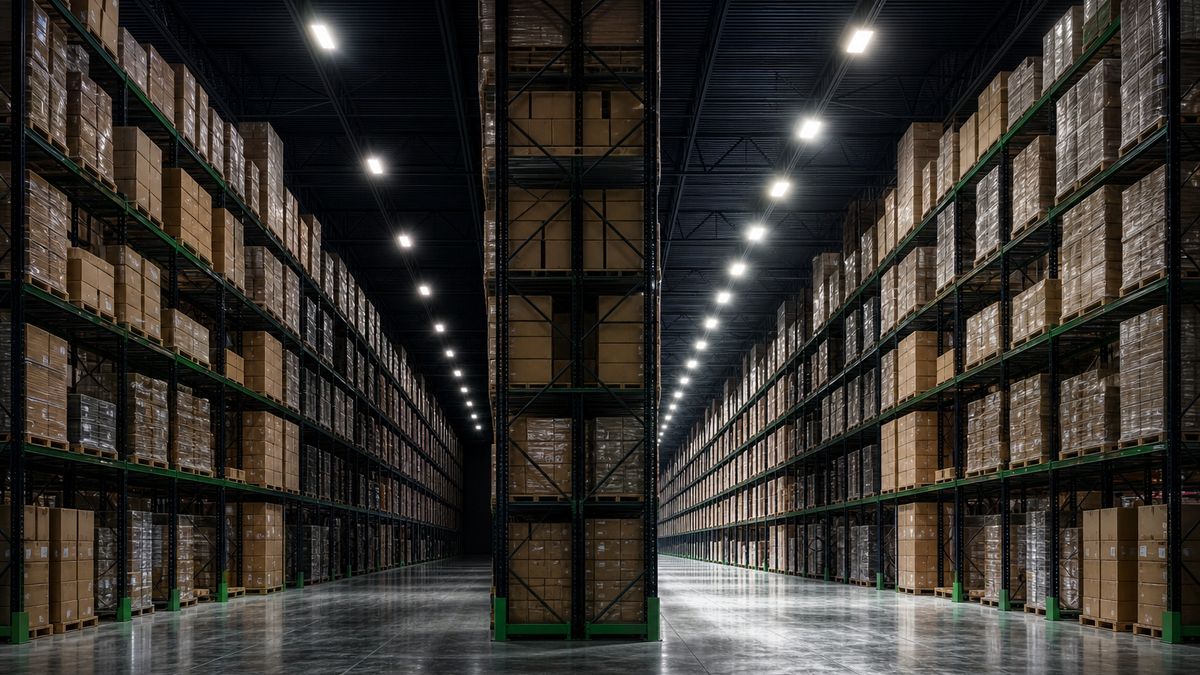
A modern bulk distribution building in North Texas often has a clear height of 32 to 40 feet, a floor that covers several football fields, and racking that turns the open space into dozens of long, narrow canyons. That geometry changes everything about lighting. A fixture that looks fine in an open room will throw most of its light onto the tops of the racks, leaving the lower pick faces and labels in shadow. A layout that ignores the rack plan has to be redone the moment a tenant installs racking.
Hours change the math too. Many DFW distribution centers run two or three shifts, six or seven days a week, especially through peak season. Two or three shifts can mean lighting that burns 5,000 hours a year or more across hundreds of high bays, which makes it one of the largest controllable loads in the building.
Then there is scale. A single big-box building can need several hundred fixtures inside, plus wall packs, dock lights, pole lights, and parking lighting outside. A logistics campus multiplies that by every building on the site. At that scale, small decisions add up: one wrong optic, a sensor timeout set too long, or a fixture that cannot handle the heat under a Texas roof deck can cost far more over the building’s life than the fixtures themselves. That is why large warehouse lighting should be designed, not just ordered.
For spec buildings, lighting is part of the leasing pitch. Tenants and their brokers walk the floor and judge the building in seconds. Bright, even, modern LED with controls already in place tells them the building is ready to operate — and keeps a costly tenant-improvement lighting line off the negotiation table.
The types of big warehouse projects we light in DFW
“Warehouse” covers very different buildings. The right lighting plan starts with how the building will actually be used.
Bulk distribution and big-box warehouses
Large, deep buildings with full-height selective or very narrow aisle racking. The priorities are vertical light on rack faces, good uniformity down long aisles, and controls that keep empty aisles from burning full power all night. These buildings are the core of the DFW market along the I-20, I-35E, I-45, and Alliance corridors.
Cross-dock facilities
Long, narrow buildings with dock doors on both sides and freight moving straight through. Most activity happens in the staging lanes and at the doors, so lighting has to support fast, accurate sorting, forklift traffic, and trailer loading, often around the clock.
E-commerce fulfillment and automated buildings
Pick modules, multi-level mezzanines, conveyor and sortation systems, and in some buildings automated storage and retrieval or robotic systems. Lighting has to work around dense equipment, light multiple levels evenly, and coordinate closely with the automation layout. Some fully automated zones need much less light; the human work areas around them need more.
Cold storage and temperature-controlled distribution
Freezers and coolers need fixtures rated for low temperatures and condensation, and controls that work in the cold. We cover special environments in more depth in our industrial and manufacturing lighting guide.
Multi-building logistics campuses
Several buildings, shared truck courts, trailer yards, guard gates, and employee parking on one site. The goal is one consistent lighting standard and one control approach across the whole campus. We cover the North DFW growth corridor specifically in our guide to big-project lighting in Lake Dallas and North DFW.
Warehouse lighting zones: one building, many jobs
A distribution center is not one space. It is a set of zones with very different lighting needs. Designing each zone on purpose is what separates a big-project lighting plan from a fixture count.
1. Rack storage aisles
This is where most of the fixtures go. The goal is vertical light on the rack faces, from the floor beam to the top pick level, so operators can read labels and scanners work reliably. That usually means aisle-oriented linear high bays or narrow-distribution optics centered over each aisle, mounted to clear the racks and the sprinkler system. Each aisle should be its own control zone, so it can dim or switch off when no one is in it.
2. Open staging and bulk floor areas
Staging lanes, bulk floor storage, and open work areas need even horizontal light across a wide area with good uniformity — no dark spots between fixtures where pallets or people can disappear. Wide-distribution high bays and careful spacing do this best.
3. Dock doors and cross-dock lanes
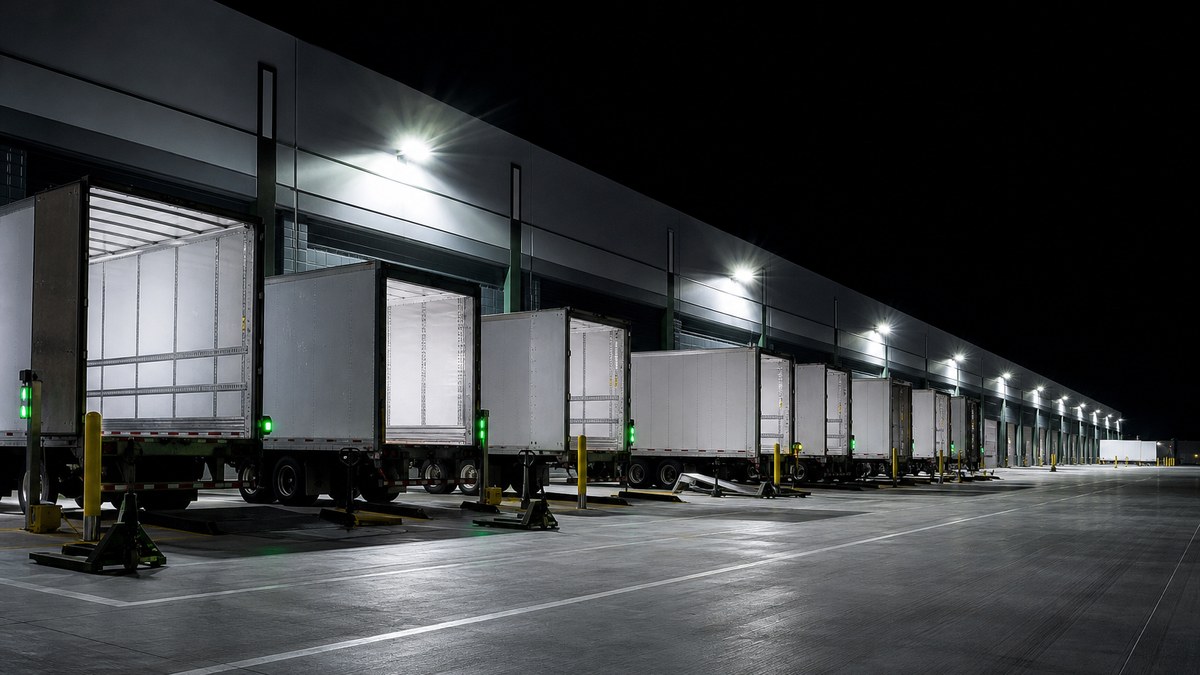
Dock areas need higher light levels at the doors, glare control for drivers backing in and forklifts turning, and dedicated dock lights that reach inside trailers. Lighting at the door threshold also needs to handle the shift from bright exterior daylight to the interior, so operators’ eyes are not blinded when doors open.
4. Pick modules, mezzanines, and conveyor areas
Multi-level pick modules need light on every level, often from lower-mounted fixtures under each deck, plus clear light along conveyor lines and at merge and transfer points. Coordination with the conveyor and automation layout has to happen early so fixtures do not end up blocked by equipment.
5. Value-added services, packing, and returns
Kitting, packing, labeling, and returns processing are task-heavy work areas. They need higher light levels, good color rendering for checking products and labels, and low glare at the work surface.
6. Offices, break rooms, and restrooms
The office front and employee areas follow ordinary commercial lighting practice, but they are part of the same project and should share the same control platform where it makes sense. Spec buildings often deliver a small office shell that the tenant builds out later.
7. Exterior: truck courts, trailer yards, gates, and parking
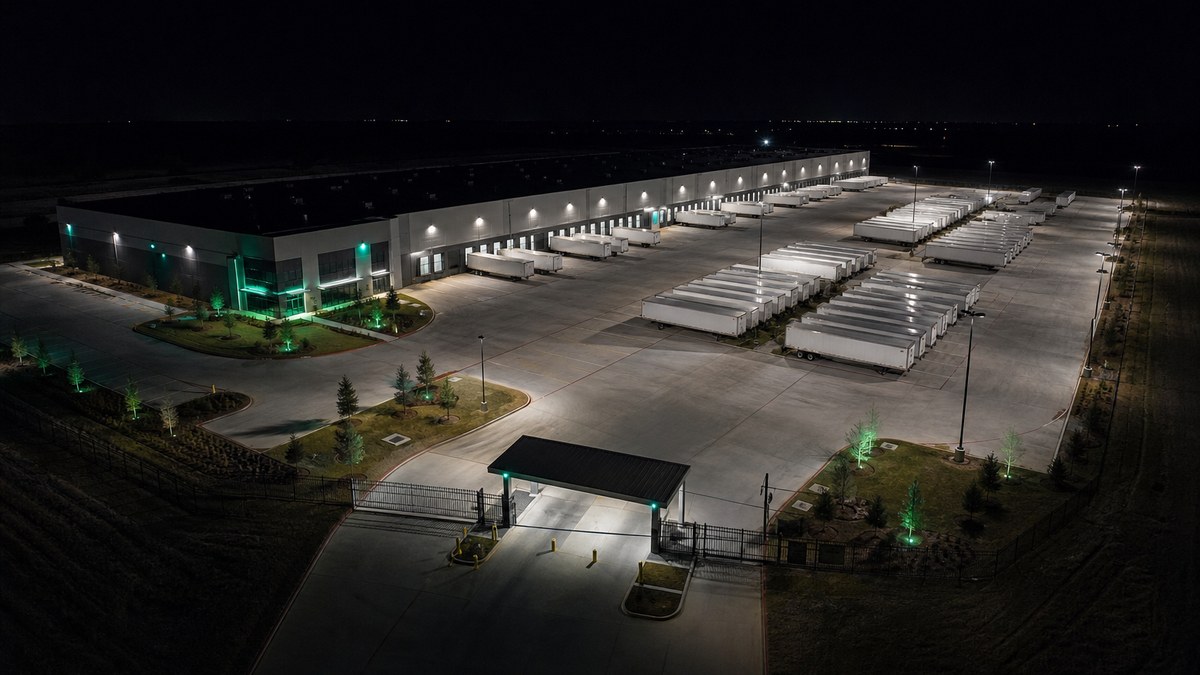
The exterior is where a distribution center is judged at night. Truck courts and trailer yards need even, glare-free light from full-cutoff wall packs and pole fixtures, the guard gate needs clear vertical light for checking drivers and paperwork, and employee parking needs safe, uniform light for shift changes. Our parking garage and parking lot lighting guide covers parking light levels and controls in detail.
Warehouse lighting plan at a glance
| Zone | Main Goal | Typical LED Approach | Controls |
|---|---|---|---|
| Rack storage aisles | Vertical light on rack faces and labels | Aisle-oriented linear high bays or narrow optics over each aisle | Occupancy sensing zoned to a single aisle |
| Open staging & bulk floor | Even horizontal light, no dark gaps | Wide-distribution high bays on a planned grid | Time schedules, occupancy, daylight under skylights |
| Dock doors & cross-dock lanes | Safe loading, light inside trailers | Higher-level fixtures at the doors plus LED dock lights | Shift schedules, local switching at docks |
| Pick modules & mezzanines | Light on every level | Lower-mounted fixtures under each deck, conveyor-line lighting | Occupancy by level and zone |
| Packing, kitting & returns | Accurate task work, good color | Higher-level, high-CRI task lighting with low glare | Scheduled scenes, occupancy |
| Truck court & trailer yard | Safety, cameras, no glare or spill | Full-cutoff wall packs and pole fixtures, Texas-rated | Dusk-to-dawn schedules, after-hours dimming |
| Guard gate & employee parking | Clear faces and plates, safe walking | Canopy and pole lighting with good vertical light | Photocell and schedule, shift-change boost |
Fixtures and optics: what actually matters in a big warehouse
Big-box lighting is less about the brand on the fixture and more about matching optics, mounting, and performance to the building. A few points make the biggest difference.
Optics matched to the rack plan
In racked areas, a narrow or aisle-shaped distribution puts light down the aisle and onto the rack faces. In open areas, a wide distribution spreads light evenly between fixtures. Using one generic optic everywhere is one of the most common reasons a new warehouse feels dim at the pick level even though the fixtures are new. Photometric calculations based on the actual rack plan and mounting height show what each option will deliver before anything is ordered.
Mounting height and sprinkler coordination
Most large DFW warehouses use high-challenge sprinkler systems such as ESFR heads. Fixtures have to be located to respect the sprinkler design and the clearances the fire protection engineer requires, and coordinated with ductwork, heaters, fans, and structure. This is easiest when the lighting layout is drawn alongside the fire protection and electrical design, not after.
Heat ratings for Texas roof decks
The air under a metal roof deck in an unconditioned North Texas warehouse can get very hot in summer. Fixtures and drivers need ambient temperature ratings that cover those conditions, or their life and light output drop fast. This is easy to specify up front and expensive to fix later.
Documented performance
On big projects, fixtures should come with tested performance data — photometric reports, lumen maintenance data, and realistic life projections — so the design can be checked and incentive programs can be documented. Our design-build lighting guide explains how we specify and source fixtures for large projects. We are an authorized architectural lighting dealer and project coordinator, not a manufacturer, so the specification follows the building, not a product catalog.
Color and visibility
Neutral to cool white light with good color rendering helps operators read labels, check product, and spot hazards. Packing, quality-check, and returns areas benefit most from higher color rendering. Exterior light should be designed with the security camera team so faces and plates are visible without glare.
One partner for the whole distribution campus
Audit, photometric design, fixture sourcing, installation, controls, and ongoing service — handled end to end for distribution centers, logistics campuses, and large commercial properties across Dallas–Fort Worth.
Controls and the energy code: where the real savings live
LED high bays cut energy on their own. In a warehouse, controls are what turn good lighting into a high-performing system — and on new construction and many major renovations, the energy code requires them. According to the Lighting Controls Association’s summary, IECC 2021 Decoded, the 2021 International Energy Conservation Code includes several requirements that matter for warehouses:
- Warehouse storage aisles: occupancy sensors are required, with each sensor zone limited to a single aisle, so lighting in an empty aisle drops automatically.
- Open warehouse areas: time-switch control is required, along with a manual way to turn lighting off.
- Occupancy sensor timing: where occupancy sensors are used, they must turn lights off within 20 minutes after a space is vacated.
- Daylight under skylights: toplit daylight zones need automatic daylight-responsive controls that dim continuously and can turn lights off when there is enough daylight.
The exact code edition and local amendments vary by city across DFW, so every project should be checked against the jurisdiction where the building sits. Either way, the controls that the code asks for are the same ones that pay back fastest in a big warehouse.
Why aisle controls pay off
In a large storage building, most aisles are empty most of the time. Forklifts visit an aisle, pick or put away, and leave. With aisle-level occupancy sensing, each aisle runs at a low background level until someone enters, then comes up to full light. Across hundreds of aisles and thousands of operating hours, that adds up quickly — on top of the 50–75% savings LED commonly delivers over legacy metal halide and fluorescent lighting.
Daylight and skylights
Many DFW warehouses have skylights or clerestory windows. Daylight sensors dim fixtures under them on bright days, which is free light the building is already paying for in its roof. The control system has to balance daylight and occupancy so the space never drops below what operators need.
Networked controls for the whole building
A networked system lets the facility team set schedules by shift, adjust sensor timing, see which zones run the most, and connect lighting to the building management system. On a multi-building campus, it gives one dashboard for everything. We cover platforms and commissioning in our networked lighting controls guide.
Commission the controls, do not just install them. Sensors in high-ceiling aisles need to be placed and adjusted so they see forklifts at the aisle ends, and time delays need to match how the building actually operates. A poorly tuned system either wastes energy or annoys operators enough that someone overrides it.
New construction vs. retrofitting an existing warehouse
New construction and spec buildings
The best time to get lighting right is before the electrical design is final. Lighting should be coordinated with the structure, sprinklers, and the likely racking plan, and controls should be in the base design rather than added later. For spec buildings, the developer has to decide how much lighting to deliver before a tenant is signed. A flexible approach — a solid base layout with controls and the ability to re-aim or re-zone when racking goes in — avoids paying for lighting twice.
Retrofits and tenant changes
Many DFW warehouses still run metal halide or older fluorescent high bays. Those buildings are good retrofit candidates: the hours are long, the old fixtures waste a lot of energy, and the light quality is often poor. A retrofit also happens when a new tenant brings a new racking plan, or when an owner repositions an older building to compete with new supply. Our guide to commercial LED retrofits for office towers, garages, and distribution centers covers the retrofit side across building types.
Every big retrofit should start with a baseline. A lighting audit documents existing fixtures, run hours, light levels, and controls, then shows where the biggest savings are. See our step-by-step guide to a lighting audit for large properties or request a commercial lighting audit.
Incentives
Large warehouse upgrades may qualify for utility incentive programs, such as those offered by Oncor, depending on program availability and the property’s utility. Programs often require pre-approval before old fixtures are removed, so the incentive application should be planned before the project starts.
Texas conditions that shape warehouse lighting
Dallas–Fort Worth adds its own challenges to big-box lighting:
- Heat: high temperatures under roof decks in summer demand fixtures and drivers with proper thermal ratings.
- Hail and wind: exterior wall packs and pole fixtures on truck courts need to be built for severe storms, and existing poles and bases should be checked before reuse.
- Dust: busy docks and unconditioned buildings collect dust, so sealed fixtures and a cleaning plan protect light output.
- Neighbors and night sky: new industrial parks are increasingly built near homes. Full-cutoff exterior lighting and after-hours dimming reduce glare and light spill, which matters to cities and neighbors alike.
- Many jurisdictions: DFW industrial growth spans dozens of cities and counties, each with its own permitting and code adoption, which a single coordinated plan has to respect.
How a big warehouse lighting project runs without stopping a shift
Distribution centers cannot close for a lighting project. Peak season, carrier schedules, and tenant service levels all depend on the building running. A large project needs a plan built around operations.
- Discovery and audit: walk the building, document fixtures, controls, run hours, rack plans, and problem areas, and agree on goals for energy, light quality, and safety.
- Photometric design: model each zone with the actual rack layout, mounting heights, and optics, and confirm light levels and uniformity before anything is ordered.
- Controls design: zone aisles, open areas, docks, and exterior lighting, and plan schedules, sensors, daylight controls, and any building management integration.
- Pilot area: install one aisle or one bay first so operators and managers can see and approve the result.
- Phased installation: work bay by bay, often on off-shifts or weekends, with lifts scheduled around forklift traffic and peak periods.
- Commissioning: aim sensors, set time delays and schedules, verify light levels, and train the facility team.
- Service and tuning: adjust controls as operations change, support re-racking, and keep documentation current for tenants and incentive programs.
This is the same design-build process we use on hotels, venues, and campuses — one partner from audit to service. Learn more on our Luminance program page or our premium lighting solutions overview.
Who coordinates big warehouse projects
Dallas LED Lights is an authorized architectural lighting dealer and project coordinator. We bring 15+ years as an authorized architectural lighting dealer and project coordinator, and our licensed installation partner has completed over 200 major sports and commercial projects across the US and Canada — NFL, NBA, NHL, MLS, NCAA and NASCAR. For distribution centers, that experience means planning large fixture counts, high mounting heights, lifts, phasing, and controls commissioning on busy, operating sites.
Every project is quoted individually. Because the right answer depends on building size, rack plan, hours, controls, and phasing, we provide a project-specific proposal rather than a price list. Explore our full services, our commercial lighting services, or learn more about us. For a broader overview of LED options in North Texas, see our complete guide to LED lighting in Dallas and our guide to commercial lighting in Dallas. If your building is showing the warning signs it needs a lighting audit, that is a good place to start. Large tech and logistics campuses often include server rooms or full data halls — see our data center lighting guide for that side of the site.
Frequently Asked Questions
What is the best lighting for a warehouse in Dallas?
How much energy can a warehouse save with LED lighting?
Does the energy code require lighting controls in warehouses?
Why does my new warehouse look dim at the pick level?
Can you upgrade warehouse lighting without shutting down operations?
How should lighting be coordinated with ESFR sprinklers?
Should a spec warehouse be delivered with full lighting?
What exterior lighting does a distribution center need?
Are there incentives for warehouse LED upgrades in Dallas?
How much does warehouse lighting cost in Dallas?
Planning a warehouse or distribution center lighting project?
Tell us about your building or campus. We will review it and send a clear, project-specific proposal covering photometric design, fixtures, controls, installation, and phasing around your operations.
Related services
Need help with a project elsewhere? Contact us through our contact page. Our partner network covers large projects across Texas and beyond: Fort Worth LED lighting, commercial LED lighting in Arlington, LED lighting in Plano, Irving LED lighting services, Texas-wide LED lighting, and wholesale LED solutions, plus fiber optic lighting solutions, modular building solutions, and modular structures in Dallas. For on-site offices and guard buildings, modular structures can be a fast option on logistics campuses.